
 AUS
AUS
 NZ
NZ
 UK
UK
 CA
CA
 USA
USA
 IND
IND


_07_03_2026_03_50_21_133108.jpg)



Highlights
- The Australian Competition and Consumer Commission (ACCC) has accused Mastercard of substantially trying to lessen competition in debit card acceptance services.
- According to the ACCC, the said activity began in 2017 during Reserve Bank of Australia’s (RBA) least cost routing initiative.
- Following RBA’s decision, Mastercard allegedly attempted to take a shorter route by entering into agreements with big retail businesses, including supermarkets, fast food chains and clothing retailers.
American multinational financial services corporation Mastercard has seized the limelight, and not for a very good reason. The Australian Competition and Consumer Commission (ACCC) has sued Mastercard over retailer deals.
Encouraging competition and examining allegations of anti-competitive conduct in the financial services sector, with emphasis on payment systems, is a top significance for the ACCC.
Anti-competitive conduct in deals with large retailers
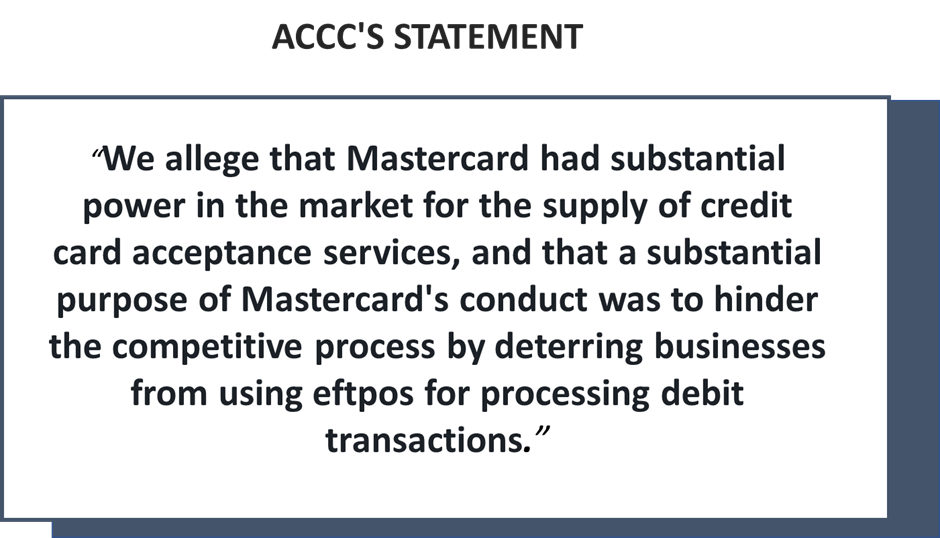
Australia’s consumer watchdog, ACCC, has sued Mastercard for allegedly conducting anti-competitive agreements with large retailers. The main accusation that ACCC has put is that Mastercard substantially tried to lessen the competition in debit card acceptance services.

Source: © Vicdemid | Megapixl.com
Glancing at the context of allegations
According to the ACCC, the said activity began in 2017 during RBA’s least cost routing initiative. The main aim behind the RBA’s initiative was to increase the competition across the financial services sector and reduce payment costs for businesses. So, companies would have the autonomy to choose among Visa, Mastercard or eftpos, whichever is the cheapest.
ALSO READ: QBE, SUN, IAG: How are these ASX financial stocks faring?
However, following RBA’s decision, Mastercard allegedly attempted to take a shorter route by entering into agreements with around 20 big retail businesses, including supermarkets, fast food chains and clothing retailers.
What did the agreement entail?
Under the agreement, the businesses were obliged to process all their Mastercard-eftpos debit card transactions through Mastercard instead of the eftpos network. In return, the companies would get discounted rates for Mastercard credit card transactions.
© 2022 Kalkine Media®
As per ACCC Chair Gina Cass-Gottlieb, Mastercard’s alleged conduct meant that businesses did not receive the full benefit of the increased competition that was intended to flow from the least cost routing initiative. Reducing costs for businesses enables them to offer their customers better prices. Ensuring the major card schemes, Mastercard, Visa and eftpos, compete strongly is significant for both those businesses as well as their customers.
Repercussions of the agreement for peers
Because of the alleged agreement between Mastercard and business retailers, businesses wouldn’t receive the optimum benefit from the increased competition entailed by RBA’s initiative. And, ultimately, it is a loss for the direct customer also. Because blocking the reduced costs for businesses means they wouldn't be able to offer better prices to customers. Thus, ensuring tough competition among the financial services providers was essential to making the initiative work.
Notably, this case demonstrates ACCC’s heightened interest in addressing competitive harm caused by exclusive arrangements engaged in by firms with market power.
