
 AUS
AUS
 NZ
NZ
 UK
UK
 CA
CA
 USA
USA
 IND
IND

.jpg)




Summary
- Australia’s consumer prices were up 0.9 per cent in the December quarter.
- The Consumer Price Index or CPI-based inflation surged in the given period because of the rise in tobacco excise and several government schemes.
- The electricity prices plunged by a steep 7.5 per cent in the given quarter.
The consumer prices soared 0.9 per cent in the December quarter even as the Australian economy suffered the economic fallout from the COVID-19 pandemic in 2020. In the September quarter, inflation stood at 0.7 per cent.

Image Source: Shutterstock
The spike in the Consumer Price Index or CPI-based inflation during the given period was attributed to the rise in tobacco excise and the introduction and continuation of several government schemes such as childcare fee subsidies, the latest data from the Australian Bureau of Statistics (ABS) showed.
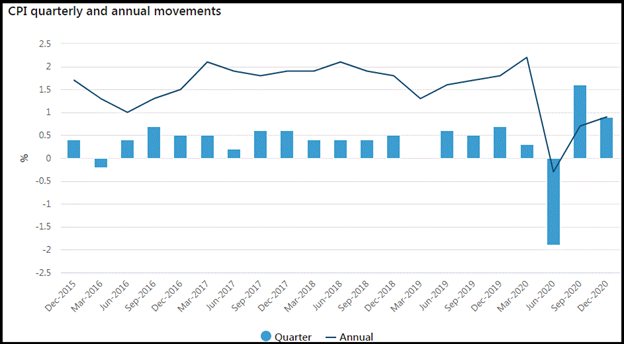
Image Source: ABS data, 27 January 2021
Annual inflation
The annual inflation rose to 0.9 per cent over the twelve months to the December 2020 quarter. The surge in annual inflation was triggered by withdrawal of free childcare and increased petrol prices. The June quarter posted a decline of 0.3 per cent in consumer prices.
The six capital cities witnessed annual rises in prices - 0.8 per cent in Sydney and Hobart, and 1.3 per cent in Melbourne at all groups level. Darwin was flat and Perth reported a drop of 0.1 per cent.
Main contributors to change
Tobacco, child care prices impact
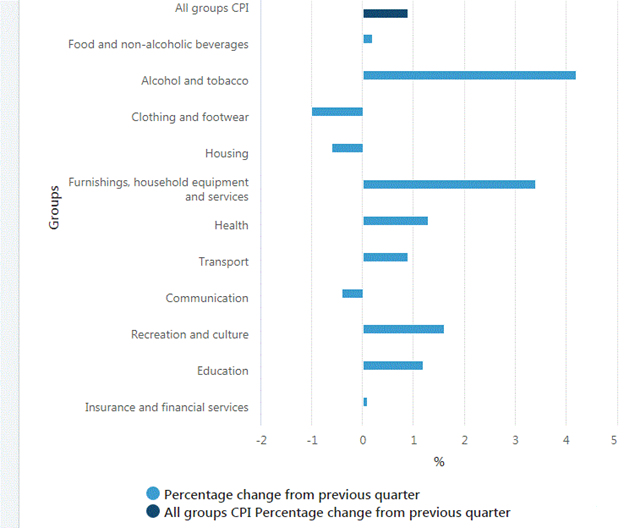
While tobacco prices increased by 10.9 per cent), childcare rose by 37.7 per cent in the given quarter. Similarly, the prices for domestic holiday travel were up 6.3 per cent, as the state and territory borders reopened ahead of the Christmas period. The prices of medical and hospital services rose 2.5 per cent following a rise in private health premiums.
The purchase price of new dwellings surged 0.7 per cent amid an increased demand as the economy slowly rebounded. The increase in demand was on account of higher approvals for houses and housing loan commitments in November, said Michelle Marquardt, Head of Prices Statistics at the ABS.
READ MORE: Will Australian economy look up in 2021? Top 5 things to look forward to
Electricity prices fall
The electricity prices reported a steep fall of 7.5 per cent in the given quarter. The prices declined after the Western Australia Household Electricity Credit gave one-off $600 credit households with a one-off $600 credit, leading to a fall of 66.7 per cent in Perth.
