
 AUS
AUS
 NZ
NZ
 UK
UK
 CA
CA
 USA
USA
 IND
IND







Summary
- UK inflation jumps to 3-month high in October mainly due to rise in prices of clothing, food, and furniture
- The inflation trends in 2020 have been largely driven by the coronavirus pandemic-led business restrictions
UK inflation rose to a three-month high level in October, largely due to the hike in price rises of food, clothing and furniture. The inflation factor for all the three components have turned positive in October from a negative reading in September.
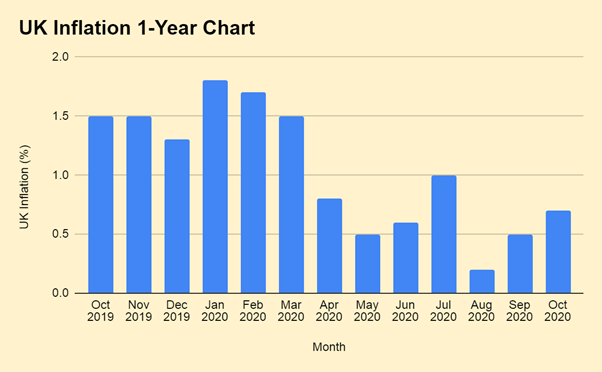
The annual rate of inflation in the UK soared to 0.7 per cent in October as compared to a rate of 0.5 per cent in September, as per the official consumer price inflation data released by the Office for National Statistics (ONS) on Wednesday.
(Source: Office for National Statistics, UK)
Food, clothing, furniture steer rise in inflation
- The prices of food, clothing, and furniture nudged up in the reporting month returning to their normal seasonal pattern after the months of disruption mainly due to the pandemic, said Jonathan Athow, Deputy National Statistician for Economic Statistics, ONS.
- The largest upward movement in the inflation factor was contributed by the rising prices of clothing, food and furniture, furnishings and carpets made. As per the estimates of ONS, furniture, clothing, and food collectively contributed a total of 0.16 percentage points to the inflation rate of October.
- In October 2019, the inflation rate in the UK stood at 1.5 per cent, 80 basis points higher than the inflation rate recorded for October this year.
- However, the contribution made by the food, clothing, and furniture were partially offset by the contributions from the recreation & culture and transport.
UK inflation October 2020: Key highlights
- The prices of clothing, food and furniture saw a major rebound in October to 0 per cent, 0.6 per cent and 0.1 per cent from -1.5 per cent, -0.1 per cent and -0.5 per cent, respectively, in September.
- The prices for transport and miscellaneous goods & services also contributed positively to the October headline retail inflation of the UK.
- The inflation trends in the current calendar year have been largely driven by the global health emergency and the business restrictions in place due to it.
- In July, UK inflation came in at 1 per cent, while it dropped sharply to a nearly five-year low level of 0.2 per cent in August.
- The steep plunge in the UK inflation in the month of August was mainly due to the relaxations in curbs imposed by the government.
- A rise of 30 and 20 basis points has been observed in the UK inflation in the months following August.
- A 12-month consumers prices index including owner occupiers’ housing costs (CPIH) inflation rate of 0.9 per cent has been recorded in October.
- The upward changes in the clothing & footwear, and food & non-alcoholic beverages groups have mainly contributed to the increase in CPIH.
- According to the ONS, the clothing & footwear have had a downward contribution in the headline inflation rate of the United Kingdom from September 2018 onwards.
- The clothing & footwear prices tend to follow a clear seasonal pattern with large falls between June and July each year.
- However, this year, the prices of clothing and footwear have followed an altogether different pattern largely because of the challenges brought by the pandemic.
- Whereas prices of housing & utilities and recreation & culture declined on a monthly basis providing a downward contribution to the inflation reading of October.
- As per the records maintained by the ONS, footwear and clothing registered an increased discounting during March and April responding to the initial phase of nationwide lockdown.
