
 AUS
AUS
 NZ
NZ
 UK
UK
 CA
CA
 USA
USA
 IND
IND




_07_03_2026_03_50_21_133108.jpg)

Summary
- Heavy job losses accompanied by a fall in new orders for the month of October
- PMI could go down below 50 in the coming weeks, as the impact of tighter restrictions is felt
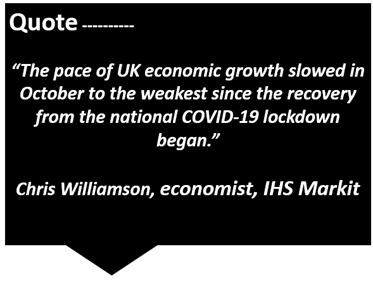
The UK IHS Markit flash PMI survey for October 2020 revealed that the economic recovery seen in the earlier months has faded away as the coronavirus cases spike up in the UK.
The services sector which has a significant share in the nation’s economic output had lost momentum in the month of October, highlighted the IHS survey.
The reputed IHS survey calculates the purchasing manager’s index or PMI on a monthly basis. A figure below 50 denotes contraction while one above it implies an expansion in business activity.
The UK services PMI for October 2020 recorded a value of 52.3 as compared to a much higher value of 56.1 registered in the previous month of 56.1. The latest figure came as a dampener as the market analysts had predicted a better value of 55 for October.
The UK manufacturing PMI also fell from 54.1 in September to 53.3 in October 2020. Here also, the market analysts had expected it to touch a higher value of 54.3 for the month of October.
The UK PMI composite index which represents the state of the overall economy was 52.9 for October 2020 against a value of 55.7 attained during the previous month of September.
The October survey pointed out that new orders fell for the first time since the month of June 2020, which is an area of concern.
Samuel Tombs, Chief U.K. Economist, Pantheon Macroeconomics lamented that the nation’s economic revival process seemed to have stalled. The main culprit for this slowdown was the advent of second wave of coronavirus cases across the UK, he explained.
At the same time, it was known that the PMI growth numbers in July were mainly a result of the pent up demand that was witnessed after the lockdown restrictions were eased, especially for the services sector, Tombs added. So, they could not have been sustained anyhow.
Consumer facing businesses
The ground level situation is worrisome with many consumer facing businesses under the threat of a total closure as they might not be able to recover the losses being made since the beginning of March 2020, when the pandemic struck Britain.
Many hospitality firms have been badly impacted by the pandemic, both during the spring and autumn seasons when the Covid-19 cases surged. Their cost of operations shot up as they were neither able to open fully not could attract enough customers to be able to sustain themselves.
Additional cost of ensuing safety measures also burdened many firms at a time when people were not comfortable stepping out of their homes.
Few other sectors that have been badly impacted by the coronavirus pandemic are transport and travel.
Unemployment rises
Both manufacturing and services sectors saw a sharp rise in job losses with lowering demand for goods and services and a consequent need by businesses to reduce their operational expenses.
The overall unemployment rate in the UK rose to 4.5 per cent during the three months to August 2020 period, as per latest government statistics. It was recorded lower earlier, at a value of 4.1 per cent during the three months to July 2020 period.
The total number of employees on the payrolls of companies has dropped and the redundancies have risen, according to latest government data.
The furlough scheme that began in March and is meant to end on 31 October 2020 has supported more than 9 million jobs throughout Britain. The scheme asked for rising contribution from employers beginning August, which might have been tough for many, hence the impact showed up in a higher unemployment rate across the nation, feel many economists.
Experts’ view
According to market experts, the PMI numbers for October were released days before the full impact of latest tier-2 and tier-3 restrictions could have been felt. At many places, these new set of restrictions have instructed pubs and restaurants to shut down early and have limited social gatherings too.
Therefore, as the complete effect of these latest tighter rules is felt during the coming weeks, the economy might just start to contract again. Going forward, this could get reflected as a ‘less than 50 PMI number’ for both manufacturing and the services sectors.
The only ray of hope in the UK right now is that the country did not have to go in for the second national lockdown, which would have brought the economic activity to an absolute standstill.
At the same time, the rising coronavirus cases need to be closely watched at least till the infection rate does not start to come down to a desirable level. Right now, the confirmed cases are rising fast at the rate of 20 per cent on a weekly basis. At this pace, the hospitals might get full within no time and patients with other ailments would also find it difficult to avail treatment.
Further, the second wave has taken the government finances for a toss. At a time when the UK treasury wanted to wean off state support and focus on its long term plans, the struggling businesses forced Rishi Sunak to provide additional aid by strengthening the furlough replacement scheme, which is slated to begin on 1 November 2020.
