
 AUS
AUS
 NZ
NZ
 UK
UK
 CA
CA
 USA
USA
 IND
IND





Summary
- The coronavirus pandemic has accelerated the online shopping behavior.
- A study by Waitrose showed that the number of buyers at online shopping sites doubled from the 2019 levels.
- Many retailers are strengthening their online shopping platform to increase sales.
Amid the fears of contagion and social distancing norms, there has been a greater preference for online shopping during the coronavirus pandemic. A recent research report by Waitrose & Partners, a British supermarkets brand that sells groceries, showed a tremendous shift in shopping behavior of the Britishers towards online purchasing. We present the details of this report, besides tracking the performance and plans of some prominent retailers such as M&S, Next, and ASDA during the pandemic-led crisis.
Online shopping trend report by Waitrose
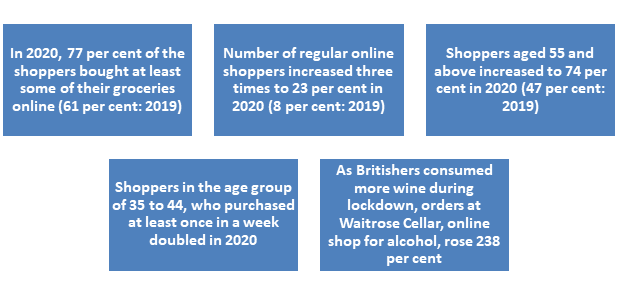
A new report on online shopping trends by Waitrose showed a rising shift in shopping behavior of the Britishers towards online purchasing during the pandemic crisis. One in four Britons shopped online for their grocery needs at least once in a week. The number of buyers flocking to online shopping sites doubled from the 2019 levels. The supermarket company saw a similar trend at its own online website for groceries, waitrose.com. In recent past, it added more than 100,000 customer order slots to its website, and at present has in excess of 160,000 slots available on a weekly basis.
Some interesting findings from the Waitrose report
(Source: Waitrose website)
Since the outbreak of the coronavirus pandemic, 60 per cent of people shopped for groceries online at frequent intervals. Out of this, around 41 per cent of people said that it was easier to buy online. In addition, there was a substantial rise in demand for quick delivery. At present, the Waitrose Rapid service boasted of more than 23,000 customers, recording a three-fold rise from the pre-pandemic levels.
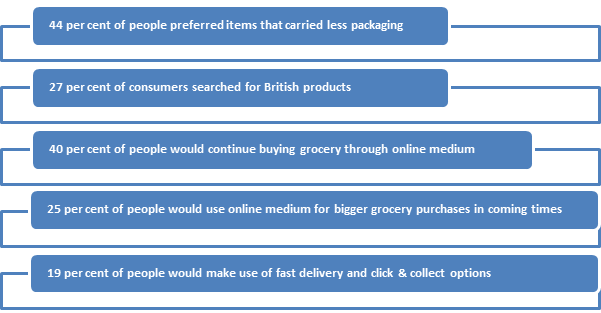
Online shopping: Quick look at buyer preferences and future prospects
(Source: Waitrose website)
Stressing on the need for strengthening the Waitrose brand to suit the changing customer behavior, the supermarket invested £100 million in its online division. By end-2020, the online shopping segment is expected to triple in size and become a £1 billion business. The company would increase its order capacity to 250,000 slots per week. Waitrose prepared the report based on the findings of a new OnePoll consumer research of people across Britain and not only the shoppers who visited the Waitrose website.
Also read: The United Kingdom to Enact New Consumer Laws as Online Retailing Expands in The Country
Also read: Two Online Retail Stocks Trending on LSE: Goco Group & Studio Retail Group
Retail sales saw a jump in July 2020
With ease in lockdown restrictions, the July 2020 sales climbed higher than the pre-pandemic times. The retail sales volume increased by 3.6 percent from June 2020, 1.4 percent more than July 2019, according to an estimate by the Office for National Statistics (ONS). This rise was a steep recovery from the double-digit falls recorded in the lockdown months of April and May 2020. In comparison to February 2020, before the country was hit by the infectious coronavirus, sales were almost 3 per cent higher. These encouraging data indicated that Britain’s retail sector bounced back quickly from the impacts of the coronavirus crisis as compared to other sectors of the economy.
In recent past, the UK saw a rise in demand for warehousing space, given the rise in online shopping. In the three months to June 2020, there were greater demands for bigger warehouses that reached up to a record 1.2 million square metres. While online retailers took up almost 50 per cent of this space, traditional businesses too asked for warehousing space to accommodate the shift in consumer behavior towards online shopping. Many of these retailers such as John Lewis Partnership Plc, which planned to close their department stores and cut jobs, mentioned that the projected online sales would account for 60 per cent of total business, an increase from 40 per cent in the pre-pandemic times.
Also read: Retail industry faces ‘COVID-19 hangover’ as consumers spend with caution
Also read: Is The UK Retail Spending Approaching Pre-Pandemic Levels?
Recent sales numbers and plans at M&S, Next, and Asda
Below we present some recent announcements by the UK’s prominent retailers.
Marks & Spencer Group plc (LON:MKS): Due to the coronavirus crisis, the retailer announced around mid-August to off role 7000 jobs after 950 job cuts declared in July 2020. The company that employs 78,000 people in the UK, said that given the recent shift in business, it is too early to put an exact estimate to the new post-pandemic sales mix. Despite a rise in its online and home delivery segment, the clothing and home trading category recorded sales below 2019 levels. The 136-year old retailer is trying to revamp itself once again after several earlier failed attempts. In May 2020, M&S indicated about speeding up its turnaround plans. Stressing on the need for its workforce to carry out multi-tasking, it announced to incorporate more technology for various operations, become a leaner and faster business entity to service the changing consumer needs.
Group sales at M&S fell 19.2 per cent year-on-year (YOY) in the 19 weeks to 8 August 2020. While the sales for clothing and home segment declined 49.1 per cent, food sales dropped 1.1 per cent. It saw a surge in its online sales at 39.2 per cent. The sales at the physical stores reduced 47.9 per cent. M&S traded its food stores during the lockdown periods and recorded an increase of 2.5 per cent in the latest eight weeks. M&S would soon launch an online food service in partnership with Ocado, a British online supermarket company for grocery.
On 22 August 2020, at 10.05 AM, the company’s stock was trading at £ 109.80 up 0.73 per cent from its previous day’s close of 109.80. The 52 week low high range was recorded as 85.04 and 228.90. With a market capitalisation (Mcap) of £2,129.19 million, the stock provided a negative return on price, which was minus 49.14 per cent on a year to date (YTD) basis. The total volume of shares traded at the time of reporting was recorded at 9,681,405.
Also read: Covid-19 Impact: Job Redundancies Continue to Rise in High Street Retail
Also read: Boots and John Lewis Further Aid the Tsunami of Job Losses in Retail Sector
Next plc (LON:NXT): The British multinational clothing, footwear, and home products retailer, saw difficult trading after reopening its stores post lockdown. In the second quarter (Q2) of 2020, the company recorded a 28 per cent fall in full price sales. Over the last six weeks of Q2, total full price sales dropped 8 per cent. Next registered a 9 per cent rise in online sales YOY in Q2 2020. The online sales were estimated to grow further with the warehouses returning to normal capacity. In Q2, the in-store sales fell steeply by 72 per cent. After reopening the stores post lockdown, this fall eased to 32 per cent YOY. Looking specifically at the entire first half of 2020, the company’s overall full price sales plunged 33 per cent YOY. Out of this, the online sales decreased 11 per cent and in-store sales plummeted 62 per cent. The retailer said due to fear of overcrowding at the stores because of social distancing norms it did not focus on advertising. This lack of effort impacted the sales.
Though the sales declined sharply, it said that the company is in a better position than what it expected few months back. The demand from its customers outnumbered its anticipations and its warehouses for online segment were at a higher capacity level than what it thought to be possible. The retailer successfully controlled the costs and undertook steps to guarantee that its balance sheet remains secure.
Though the company spent considerable time and efforts in managing the business through the pandemic, it did not fail to notice that the retail sector was undergoing significant structural changes due to the consumer shopping behavior inclining towards online buying. The retailer observed that this pattern would gather further momentum during the coronavirus pandemic. Next is expected to come out with its full results for the first half of 2020 during mid-September 2020.
On 22 August 2020 at 10.09 AM, the company’s stock closed at £5,960 down 0.70 per cent from its previous day’s close. The 52 week low high range was recorded as 3,390.00 and 7,340.00. With a market capitalisation (Mcap) of £7,979.62 million, the stock provided a negative return on price, which was minus 14.34 per cent on a year to date (YTD) basis. The total volume of shares traded at the time of reporting was recorded at 260,210.
Also read: Retail Sales in The UK Makes Strong Recovery Amidst Sharp Rise in Public Debt Levels
Also read; Is Retail Landscape changing for good?
Asda Stores Ltd: Asda is the UK supermarket arm of the world’s biggest retailer Walmart. In mid-August 2020, the company announced its plans to expand its weekly delivery capacity to around one million slots in 2021 to meet the demand for online grocery shopping. While Asda’s online grocery sales doubled in Q2 (January to June 2020), there was a four-times increase in the click-and-collect sales. Since March 2020, it raised its online capacity by 65 per cent to 700,000 weekly slots, which would be further increased to 740,000 per week by end-2020. Over the next few weeks, the retailer has plans for expanding its delivery partnership trial with Uber Eats to 25 additional stores from 10 stores at present.
Viewing that the coronavirus pandemic has led to a structural shift in customer behavior towards grocery shopping, Asda has speeded up its online capacity expansion plans. The growth in its online segment coupled with high demand for grocery items resulted in a 3.8 per cent rise in Q2 for like-for-like sales. In Q2, the supermarket’s operating income declined due to rise in pandemic-related costs. Though Asda recorded substantial sales growth, it was behind competing retailers like Tesco, Sainsbury’s, and Morrisons, as per some recent industry data.
In July 2020, Walmart restarted talks with potential buyers to sell a majority stake in Asda. In 2019, Britain’s competition regulator upset the effort to sell the supermarket to J Sainsbury plc for £7.3 billion.
Conclusion
Amid the fears of catching the deadly coronavirus infection at retail outlets, online shopping came as a rescue. Several experts believe that the shift towards online shopping would continue in future as well. The pandemic has compelled the retailers to react swiftly to the changing needs of its customers. And, many have realised the need to strengthen their online divisions to increase demand and grow sales. Some retailers with no online presence have planned to start the segment in order to retain their loyal customers as well as add new ones. It remains to be seen if a strong online segment is just a survival strategy or would act as a major growth driver in the near future.
