
 AUS
AUS
 NZ
NZ
 UK
UK
 CA
CA
 USA
USA
 IND
IND







Summary
- Gold soared past US$ 2,000 for the first time in world history
- Bullion prices rose on the back of COVID-19 uncertainty and inflation fears, geopolitical tensions (Beirut explosion)
- The bull rally is likely to continue, with some analysts projecting a spot prices to hit US$ 3000
There seems to be no end to gold’s bull run. Spot gold smashed US$ $2,000 an ounce mark on Tuesday (August 4) as investors lapped up the “safe haven” asset amid COVID-19 uncertainty and inflation fears.
US gold futures hit a record of US$ 2034.40, before closing at US$ 2,021.00 an ounce, up 1.7 percent.
Gold’s 34 percent rally this year, back by gains from heavy inflows into bullion-backed exchange-traded fund (ETFs), has made it among the best-performing assets across the world. Its price soared as economies try to navigate a global crisis of unseen proportions that wiped out billions of investor wealth in mere weeks.
Why is gold price soaring?
Because of market, financial and social insecurities triggered by an unprecedented pandemic.
The coronavirus has forced worldwide economies to plunge into recession of unseen depths. The Canadian economy contracted by almost 12 percent in April, making it the deepest recession on record.
On one hand, worldwide governments are pumping in stimulus money to keep markets afloat at the cost of depleting capital and forex reserves. On the other hand, central banks are keeping interest rates near zero percent-levels and taking the quantitative easing route of buying government securities till economic recovery is underway.
Amid this pandemic-generated economic morass stands gold – a metal considered a safe, strategic and mainstream asset, one that protects investors wealth.
Gold typically holds a low or negative correlation to other assets and during times of market distress (such as COVID -19 crisis), investors reduce their stock holdings and switch to gold.
A record US$ 7.4 billion flowed in gold-backed ETFs last month, pilling on to the record US$40 billion investment in the first six months of 2020, shows data from World Gold Council. These inflows also helped lift gold price, which gained 17 percent in US dollars in H1 2020.
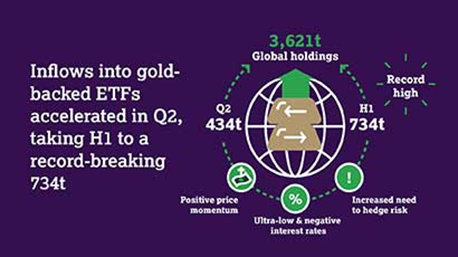
(Source: Gold Demand Trends Q2 2020, World Gold Council)
The yellow metal’s current bull run mirrors the price spike of the 2008-09 financial market crisis that was triggered by US subprime mortgage crisis and the dramatic fall of Lehman Brothers.
So, who all are buying gold?
Mostly senior and experienced investors, says JPMorgan Chase & Co in recent note analyzing investment flows. The “older cohort” are investing their liquidity into gold while the millennials are embracing bitcoins and technology stocks. Gold is poised to outperform stocks and bonds, and investors are jumping on its bull run-train.
Also, gold is a global currency. Its impressive track record goes back thousands of years, even before paper currency, stocks and bonds or electronic payment system were invented. Heck, Egyptians even mummified their corpses with gold coins for a smooth after-life transition!
Gold has been in its longest winning streak since 2012 and current global dovish monetary policy will keep the momentum going.
Gold relative price performance since 2009
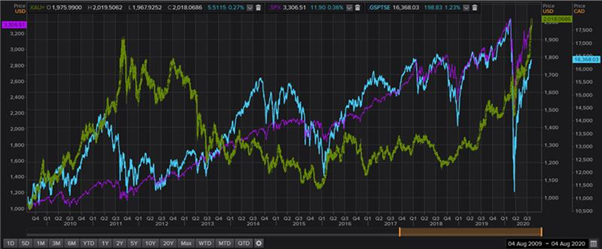
(Source: EODHD/Others, Thomson Reuters)
Will the gold rally continue?
Yes, say most analyst.
The bullion run has been supported by surging coronavirus cases, rising government debt, fiscal stimulus, US-China friction and simmering geopolitical tensions in Middle East following Lebanon blasts on Tuesday. Gold’s performance also coincides with weaker US dollar and low bond yields.
Gold as a currency will hold up against inflation threat to the US dollar and increased stimulus, says Goldman Sachs Group. Reiterating similar views, Citigroup said the current gold cycle is unique and will stay in high range for a long period.
As the US inches closer to the November presidential elections, markets will see more volatility and the rally will continue.
How high will gold go?
At least US$ 3,000 per ounce, says Bank of America Corp while sticking to its April forecast for the next 18 months.
RBC Capital Markets, Royal Bank of Canada’s investment arm, made similar projections. Spot gold will touch US$ 3,060 per ounce by the first quarter of 2021 in a high-case scenario, it forecast.
Goldman Sachs also revised its annual gold price forecast to US$ 2,300 per troy ounce.
However, JPMorgan Chase & Co. sees the rally losing steam by 2020-end. Gold prices could drop to US $1,725 by year-end over US FED’s slashing interest rates to zero “should limit the appeal of long US dollar carry positions,” it said.
Canada’s Gold Stocks
Gold is a key driver of the Canadian economy. It is world’s fifth largest yellow metal producer and has the most active mining companies.
The global sold index on the Toronto Stock Exchange (TSX) has advanced 55.76 percent this year, significantly higher than the broader S&P/TSX Composite Index’s 4.08 percent decline in the same period.
Top two gold stocks in the market are Newmont Corporation and Barrick Gold:
Newmont Corporation (TSX:NGT)
Shares of this gold mining firm has yielded over 55 percent returns this year. It has announced a quarterly dividend of C$ 0.25 per share and currently yields 1.423 percent. In it’s second quarter results, the company’s EBITDA improved 45 percent YoY to C$ 984 million while revenue increased five percent to $2,365 million in the same period. Operations cash flow increased 122 percent from prior year quarter to C$ 668 million due to higher realized gold prices.
Barrick Gold Corporation (TSX:ABX)
Barrick Gold Corporation stocks jumped 60 percent this year, with prices touching 52-week-high of C$ 40.41 on July 26. It paid quarterly dividend USD 0.07 per share and currently yields 0.99 percent.
Barrick will release its Q2 financial reports on August 10.
