
 AUS
AUS
 NZ
NZ
 UK
UK
 CA
CA
 USA
USA
 IND
IND







In January 2018, one of the most influential investors of all time, Warren Buffett, was quoted as saying the digital currency craze will one day have a ‘bad ending’. When and how, Buffett did not add. Back then, the total market cap of most popular cryptocurrency, bitcoin, was almost US$170 billion.
Cut to 2021, and bitcoin reached the $1-trillion milestone in February 2021, and dwarfed market value of giants like Tesla, ironically the CEO of which fueled this rally in bitcoin. Months later, however, and after one bitcoin traded for nearly US$65,000, the market cap has plunged to nearly US$650 billion.
Market defied Buffett’s stance
Buffett’s ominous stance was followed by contrasting actions from intermediaries, many of which learned their investment lessons from the billionaire. Investment banks like JPMorgan Chase and Morgan Stanley prepped to offer trading in bitcoin to their wealthier clients given rich clients could manage with the ‘high risk’ involved in such transactions. In Canada, the regulator approved bitcoin and ether ETFs that created enough buzz and money for investors when they started trading. S&P Dow Jones faced a FOMO situation and came up with indices to track movements in prices of underlying digital currencies.
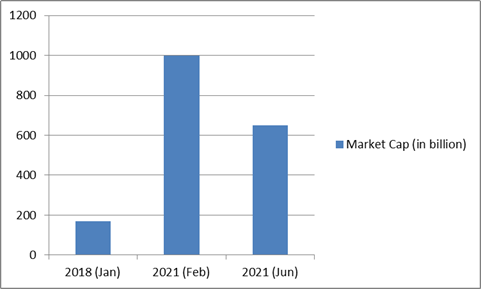
Bitcoin’s Market Cap
But what if the Buffett’s prediction does come true? A sooner-than-expected correction in prices, in the wake of couple of negative tweets from Elon Musk and China’s crackdown on digital assets, can translate into a much wider bearish trend. The ‘bad ending’ warning, if it does follow these recent upheavals in the crypto space, can have wider repercussions.
First, what may become of global stock markets?
Investors that cumulatively have billions of dollars parked in bitcoin and similar assets can suffer a major psychological setback, which can trigger withdrawals from even conventional instruments like shares and bonds. Or, in an exact opposite, money that in future would have gone as investments in digital currencies will go into traditional investment instruments, thereby having a bullish impact on global stock markets.
Second, what may become of blockchain?
The craze for distributed ledger technology and associated things like non-fungible tokens (NFTs) and smart contracts can decisively subside. Blockchain, a promising tech that aims at decentralizing the world of technology, will face the heat. Ethereum and such other blockchain networks may see no further takers, and their linked currencies like Ether that have fueled interest in them, will be blamed for the collapse.
Lastly, what may become of CBDCs and stablecoins?
Countries like El Salvador, which have either adopted or are planning to adopt Bitcoin as a legal tender, will be dealt a huge blow. Central banks that are planning to soon launch their own CBDCs (central bank digital currency) underpinned by the blockchain tech may shelve their plans in the wake of the shock. Ambitious projects, like Facebook-backed Diem’s stablecoins pegged to fiat currencies, may be dropped. Or, in an exact opposite, these projects and CBDCs may gain pace given the confusions over viability of cryptocurrencies coming to an end.
The above are only assumptions, and similar to how despite Buffett’s negative stance in 2018, the world embraced digital currencies, these may never come true.
