
 AUS
AUS
 NZ
NZ
 UK
UK
 CA
CA
 USA
USA
 IND
IND



.jpg)



Summary
- Data mining firm Palantir Technology (NYSE:PLTR) is expected to go public on Tuesday, September 29.
- Productivity tracking app Asana will go live on Wednesday, September 30.
- Canadian investors are closing watching the launch of these two tech unicorns.
- Both the companies are opting for directly listing shares instead of the conventional IPOs.
Tech unicorn Palantir Technology’s (NYSE:PLTR) big day is here. This controversial big data firm is set to go debut on the New York Stock Exchange (NYSE) on Tuesday, September 29. A day later, workplace collaboration app Asana – another tech unicorn – will follow.
Interestingly, both these companies have links with Facebook (NASDAQ:FB). And both are opting for direct listed shares instead of the conventional initial public offering (IPO) or glamorous blank check merger.
The last week of September is proving to be a productive one for the IPO watchers and investors are closing watching the highly anticipated launch of these two tech unicorns.
Palantir Technology (NYSE:PLTR)
Palantir, founded in 2003, has a ‘Lord of the Rings’ (LOTR) connection. In the fantasy books by JRR Tolkien, Palantir refers to ‘seeing-stones’ – a crystal ball-like shaped object, used for communication and to view distant events across timelines.
Tech startup Palantir’s work is not that far from its fantasy counterpart.
For the first few years of its existence, the Silicon Valley firm operated under the radar of public domain, assisting governments and anti-terrorist organizations with top secret projects through big data tools.
It rose to fame after unconfirmed reports credited it for first locating the hideout of (now slain) terrorist Osama bin Laden – the 9/11 attack mastermind and founder of designated militant outfit al-Qaeda.
The markets call it a terrorist-tracking firm. Privacy advocate groups allege ‘Palantir knows it all’.
More recently, Palantir’s services were roped in to track the coronavirus pandemic by governments worldwide.
So, what does Palantir do?
It is a largescale data fusion platform, integrated with machine-assisted but human-driven analysis, helping entities identity future and present patterns for organizational development.
Simply put, Palantir’s platform helps businesses wade through massive amounts of data, gathered from internal and external sources (such as internet traffic, mobile data), and create sense out of it.
On its official website, the big data firm talks about two products: Palantir Gotham (see the Batman reference here?) and Palantir Foundry.
Gotham was reportedly used for counter-terrorism efforts by the United States government agencies and cyber analysts at Canada’s Information Warfare Monitor.
The Central Intelligence Agency was Palantir's first backer, when the company was a venture capital arm of In-Q-Tel.
For most of its 17-years of operations, Palantir has been shrouded in controversy and mystery.
It was founded by Alex Karp, Joe Lonsdale, Stephen Cohen and venture capitalist Peter Thiel – the first investor in Facebook and Paypal co-founder. It employs over 2000 people in 10+ countries.
In 2015, Palantir was valued at US$ 20 billion during a fundraising round. Since 2003, the tech startup has raised over US$ 3 billion in funding, but has not been able to churn profits. Its founder-CEO Alex Karp says breakeven is near. Its current estimated market valuation is US$ 22 billion.
Ahead of its public listing, Palantir released its 2019 financial statement, which shows annual revenue crossed US$ 742.5 million, up 25 per cent year-over-year. In the first half of 2020, it clocked US$ 481 million revenue, 49 per cent increase from the same period last year. But it also lost over US$ 579 million in 2019.
Media reports claim Palantir will price its shares for around US$ 10 apiece.
Asana Inc (NYSE:ASAN)
Tech firm Asana, with an estimated valuation of over US$ 5 billion, is expected to start trading on Wednesday, September 30, via direct listing on the NYSE.
The productivity tracking app also has a Facebook connection. It was created by the social networking giant’s co-founder Dustin Moskovitz and former Facebook engineer Justin Rosenstein.
The name Asana was derived from Sanskrit word ‘Asan’, which literally translates into yoga pose.
It is a software-as-a-service (SaaS) platform, designed to improve workplace collaboration among teams, and track productivity and performance.
As per a Fortune Business report, the global task management software market is expected to hit US$ 4.53 billion by 2026. And Asana is trying to grab a major share of this segment.
As per details on Crunchbase, the tech startup has raised over US$ 453 million over 11 rounds of funding. It has 38 investors including Manhattan Venture Partners, Silicon Valley Bank, G Squared, 8VC and The Founders Fund. Its “post-money valuation” is between US$ 1 billion to US$ 10 billion as of November, 2018.
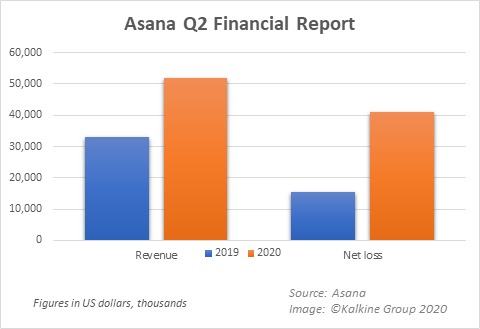
Asana expects revenue between US$ 53.5 million to US$ 54.5 million in the next fiscal quarter.
Slack Technologies is one of Asana’s major competitors.
Asana is headquartered in San Francisco, California, and is said to have held 93,000 paying customers as of March 30, 2021, with 397 of them shelling out over US$ 50,000, as per the data on Wallstreetzen.
