
 AUS
AUS
 NZ
NZ
 UK
UK
 CA
CA
 USA
USA
 IND
IND







Summary
- The Tesco Group has declared an interim dividend of 3.20p per share to its shareholders
- Doubling of online food sales and surge witnessed in the pre-tax profits during the crisis came as a defense for the company to payout dividend
- Since the pandemic outbreak there has been a dramatic change in consumer behaviour, which helped in boosting Tesco’s sales
- Like Tesco, Morrison (WM) Supermarket plc has also declared an interim ordinary dividend of 2.04p, handing £49 million to shareholders, for the half-year ending 2 August 2020
In the H1 20-21 results declared by Tesco PLC (LON: TSCO) on 7 October, the Group has declared an interim dividend of 3.20p per share amounting to £315 million for the period ending on 31 August. There was an increase of 20.8 per cent in the dividend payment in comparison to that in the previous year, which was 2.65p.
Since the beginning of the pandemic, the company has been enjoying business rate break funded by taxpayers worth £249 million. And now it has decided to payout an interim dividend to its shareholders. Factors like doubling of online food sales and surge in the pre-tax profits despite the pandemic In the six months to August 2020 prompted the company to give away dividends. Tesco, the largest supermarket of UK, posted a 28.7 per cent rise in pre-tax profits to £551 million (H1 19-20: £428 million).
The stock of TSCO was trading at GBX 217.40 on 8 October at 3:40 PM, up by 2.26 per cent from its previous close of 212.60. The stock’s 52-week low/high price range was recorded as GBX 210.00/258.90. The supermarket’s total outstanding market capitalisation stood at £20,820.97 million. TSCO’s shares delivered a price return of -16.89 percent since 1 January 2020 till date.
Since the outbreak of the pandemic, the dramatic change in consumer behaviour was the most important factor that has been the game-changer in boosting Tesco’s sales, resulting in an increase in the weekly shopping trips and in demand for online deliveries.
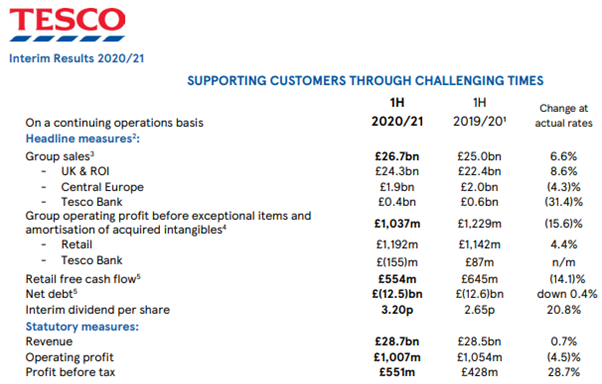
(Source: Company website)
Happy investors
The company’s management including the finance director of Tesco, Alan Stewart believed that paying dividends to shareholders was the right step. Even though the supermarket relied on public funds for functioning of its business, it could pay 20 per cent more interim dividend than that distributed in 2019.
However, the management is of the opinion that Tesco's coronavirus-related costs would add up to £725 million. The Covid-19 related-costs incurred included the implementation of safety measures across stores and the recruitment of thousands of new staff. Stewart said that the extra cost incurred by the business was very significant.
Rough times
A campaign group named Positive Money, criticised Tesco’s move saying that there should be conditions to check that money received by any company in the form of public support should not be wasted on paying out dividends to wealthy shareholders.
The New Economics Foundation also slammed Tesco saying that public funds should not be used for private advantage. The relief fund was accepted by the company and the benefits are being passed on to its shareholders.
What about the rivals
Like Tesco, Morrison (WM) Supermarket plc (LON:MRW) declared an interim ordinary dividend of 2.04p, handing £49 million to shareholders, for the half-year ending 2 August. In H1 2020 results, Morrisons recorded its best sales figures for 16 years, with retail sales 11.1 per cent higher in comparison with the same period in 2019. However, the group witnessed a decline in the profits by 25.3 per cent to £148 million because of the extra Covid-related costs incurred.
In the first half of the fiscal, the company recruited 46,000 employees, retaining at least 13,000 of them on a permanent basis. The online weekly orders doubled to 325,000 as a result of the new staff.
The stock of MRW was trading at GBX 170.65 on 8 October at 3:44 PM, up by 0.68 per cent from its previous close of 169.50. The stock’s 52-week low/high price range recorded as GBX 164.20/204.70. The supermarket’s total outstanding market capitalisation stood at £4,084.41 million. MRW’s shares delivered a price return of -16.25 percent, from January till date.
On the other hand, J Sainsbury plc (LON:SBRY) has no plans of declaring dividends. In fact, the company has announced closure of more than 100 local and Argos stores around the UK, recording a decline in sales and dipping profits.
The stock of SBRY was trading at GBX 196.85 on 8 October at 4:07 PM, up by 0.18 per cent from its previous close of 196.50. The stock’s 52-week low/high price range recorded as GBX 174.95/235.80. The supermarket’s total outstanding market capitalisation stood at £4,370.00 million. SBRY’s shares delivered a price return of -16.25 percent, from the beginning of 2020 till date.
