
 AUS
AUS
 NZ
NZ
 UK
UK
 CA
CA
 USA
USA
 IND
IND





Summary
- The United Kingdom is witnessing a surge in Covid-19 cases since August 2020
- The recent spike has pushed UK to report highest single-day cases since 7 May 2020
- News of the second wave of infections has provoked Britons to stockpile necessary items in case a further lockdown is announced in the coming future
- However, the supermarkets have assured their customers that they have enough essentials in stock for them
After successfully putting a check on the first surge of coronavirus infections early in the year 2020, countries across Europe, including Britain, are seeing a surge in the number of Covid-19 cases, and are now facing a second wave of rising cases. In fact, some of the nations including Belgium, Italy, and the UK are among the Europe's worst-hit countries, seeing a rapid resurgence of the disease. UK's figures look most worrying out of the three, recording 4,926 cases on 23 September 2020, according to the government tally, the highest since 7 May 2020.
The numbers predict that Britain could be dealing with the much-feared second wave. However, to everyone’s respite, the UK government has proactively started taking actions to curb it. On 22 September 2020, British Prime Minister Boris Johnson announced tighter restrictions for England, including compulsory mask covering and closing pubs and restaurants at 10 PM local time, which could last for up to six months.
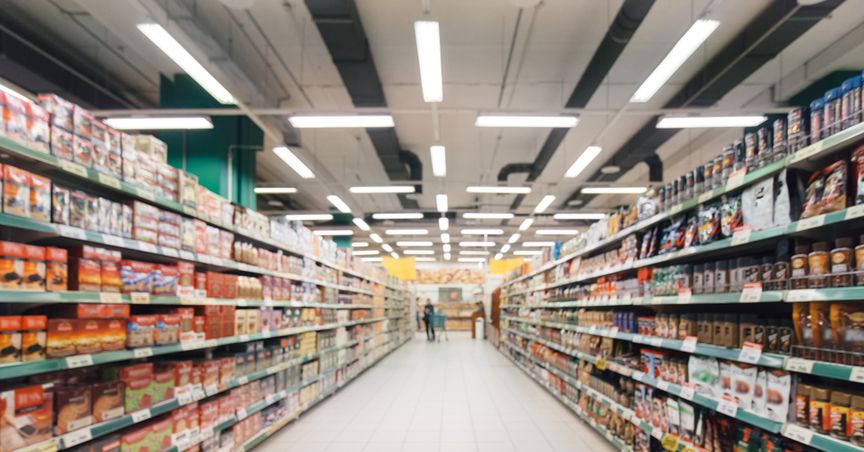
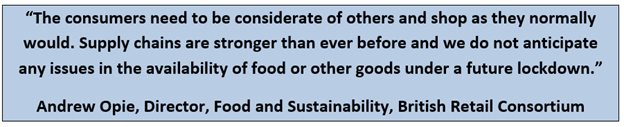
The news of the second wave has provoked Britons to stockpile necessary items in case a further lockdown is announced in the coming future. There have been rumours that shelves of the supermarkets could going empty and delivery slots might run out, but retailers have urged customers not to stockpile food and to shop normally amid concerns of another national lockdown. Major supermarkets have reassured their customers that they are well stocked and more prepared now than they were at the beginning of the pandemic.
Also Read: UK Retail Sales Rose Marginally In August 2020
Let’s look at what the leading supermarkets have to say in particular.
Tesco plc
The owner of Tesco, Dave Lewis said that it was unnecessary to stockpile essential goods as there is no disruption in the supply chains of the products. Lewis also added that the food industry of the UK was a well-managed one. Hence, there is a very good supply of food. After a surge in the sale of tinned goods, toilet rolls, and dried pasta in March 2020, the supermarkets had restocked all these items quickly. Unnecessary panic buying creates tension in the supply chain which may not be desirable, emphasised Lewis.
The supermarket chain also revealed that its online capacity had almost doubled by September 2020 as compared to its March 2020 levels.
Tesco plc (LON:TSCO) stock was trading at GBX 222.60 on 24 September 2020, at 11:30 AM, down by 0.58 per cent from its previous close of GBX 223.80. The 52-week low/high price was GBX 211.20/258.90. It was having a market capitalisation (Mcap) of £21,917.85 million. The volume traded at the time of reporting was 11,284,557. The company recorded a negative return on price, which was 12.51 per cent on a YTD (Year to Date) basis.
Morrison (WM) Supermarkets plc
According to industry sources, an extreme shopping behaviour has been triggered by the localised lockdowns introduced in recent weeks. However, the supermarkets are urging shoppers to shop considerately, and it is hoped to avoid a repeat of long queues and empty shelves. Morrisons has re-introduced marshals on the doors of its 494 supermarkets in order to keep a check at the number of shoppers, and to remind them to wear a face mask.
The operations director of Morrisons, Jayne Wall said that the company has adopted additional hygiene measures to make customers feel as safe as possible, including vending machine-style cleaning stations outside stores and hiring thousands of new cleaners.
Morrison (WM) Supermarkets plc (LON:MSW) stock was trading at GBX 176.75 on 24 September 2020, at 12:01 PM, down by 1.61 per cent from its previous close of GBX 179.65. The 52-week low/high price was GBX 164.20/204.70. It was having a market capitalisation (Mcap) of £4,328.56 million. The volume traded at the time of reporting was 1,396,638. The company recorded a negative return on price, which was 11.24 per cent on a YTD (Year to Date) basis.
Ocado and Sainsbury
Online retailers Ocado and Sainsbury’s have informed that they are facing an increased demand due to which they have uploaded notices on their websites informing the customers that they might have to face difficulty in getting a delivery slot.
Ocado said that its delivery slots were selling out faster than usual.
Also Read: Ocado’s Mark & Spencer JV Strategy Yields Good Return
Ocado Group plc (LON:OCDO) stock was trading at GBX 2,782.00 on 24 September 2020, at 12:35 PM, up by 2.86 per cent from its previous close of GBX 2,865.00. The 52-week low/high price was GBX 1,064.00/2,865.00. It was having a market capitalisation (Mcap) of £21,430.63 million. The volume traded at the time of reporting was 545,492. The company recorded a positive return on price, which was 127.47 per cent on a YTD (Year to Date) basis.
Sainbury’s said that since the slots are in a higher than usual demand, vulnerable customers are being given priority.
J Sainsbury plc (LON:SBRY) stock was trading at GBX 202.70 on 24 September 2020, at 12:38 PM, up by 0.35 per cent from its previous close of GBX 202.00. The 52-week low/high price was GBX 174.95/235.80. It was having a market capitalisation (Mcap) of £4,491.76 million. The volume traded at the time of reporting was 2,037,802. The company recorded a negative return on price, which was 12.97 per cent on a YTD (Year to Date) basis.
Asda
A spokesperson of Asda said that the company was not witnessing any evidence of panic-buying, be it in store or online. Since it had nearly doubled the amount of stocks available since the start of March, it had plenty of delivery slots available.
With respect to the increase in infection rate, Asda notified that it would be placing safety marshals on the entrance of its stores, providing ready-sanitised baskets and trolleys to shoppers, and also reminding them to wear a face covering and maintain social distancing. Shoppers visiting the stores without a mask would be offered a pack of disposables that could be paid with their shop bill.
The chief operating officer of Asda, Anthony Hemmerdinger said that safety of its customers remained a key priority and measures are being carried out to keep its staff and customers safe in-store.
Conclusion
The fear of tighter coronavirus restrictions has led to a change in the buying pattern of the Britons, but the supermarkets are hoping not to see a repeat of the panic buying witnessed before 23 March 2020, when a lockdown was announced across the UK. The stocks of staples and toilet papers were stripped out of the shelves because people were buying these essentials in bulk. The chiefs of supermarkets have reassured their customers that there’s enough quantity for everyone and they should maintain calm and avoid hoarding the daily necessities.
