
 AUS
AUS
 NZ
NZ
 UK
UK
 CA
CA
 USA
USA
 IND
IND






Summary
- FTSE 100 listed retailer expects its pre-tax profit for the year to be £65 million higher than it forecast last month to £365 million
- The company’s full-price sales went up by 4.1 per cent during the third quarter ended 24 October
- Next anticipates a plunge of nearly 20 per cent during its Christmas trading in anticipation of a second national lockdown
The shares of the fashion retailer, Next Plc (LON: NXT) remained steady despite the renewed risks of another lockdown due to the emergence of a stronger wave of the coronavirus pandemic infections. The high street retail has been severely impacted due to the onslaught of the novel coronavirus, which led to supply chain disruption and store closures across the industry. Therefore, the high street retailers have resorted to online channels for achieving sales volumes as the brick and mortar model is yet to pick up steam.
The fashion retailer has underpinned its hopes on the nearing festive season as it aims to make up for the lockdown period. FTSE 100 listed fashion retailer anticipates a plunge of nearly 20 per cent during its Christmas trading in the wake of a second national lockdown induced by the rising number of coronavirus cases. However, enforcement of local lockdowns could send sales of the fashion retailer down by 8 per cent in the fourth quarter of 2020.
Also read: UK Retail Sales Rose Marginally In August 2020
The company’s full-price sales went up by 4.1 per cent during the third quarter ended 24 October. The online sales accounted for more than 20 per cent during the third quarter in contrast to the same period last year.
With declining footfall and customer activity across town and city centres, the sales in the retail stores were down by 18 per cent. However, the overall sales were up by 2.8 per cent. The boom in online orders during the third quarter has allowed Next to upgrade its profit forecast for the year again as the sales volumes surpassed expectations.
Despite challenging trading conditions, the high street retailer has delivered impressive results. The retailer has achieved growth strategically by putting on growth across home products and utilising its sophisticated multichannel operations, while the apparel sales continued to decline. The company’s strong online presence, strategic partnerships helped it in weathering the storm and remain ahead of the curve. However, another lockdown amid the festive season could weigh down heavily on the Christmas trading.
Under its central scenario, the high street retailer expects its pre-tax profit for the year to be £65 million higher than what it forecasted last month to £365 million. However, the company admitted that there remains a very high degree of uncertainty in its profit forecasts, and a lot would depend on the government development to curb the spread of the coronavirus pandemic.
Wales is likely to shut non-essential retail shops as part of stricter short-term lockdown measures. Some areas in the UK such as England, Scotland and Northern Ireland might follow suit. In case of a national lockdown for two weeks, Next could see its full-price sales go down by £57 million. Even with the revised forecasts, the profit will still be 50 per cent down in comparison to 2019 (£728 million).
In terms of product category, the sales performance was at similar levels to that of the second quarter. Due to travel restrictions, the demand for men's and women's formal and occasion clothing remained weak; however, Home and Childrenswear performed comparatively well. In the overseas market as well as in the UK, the company did fairly in terms of generating online revenue. The out of town retail parks continued to outperform the high street stores and shopping centres.
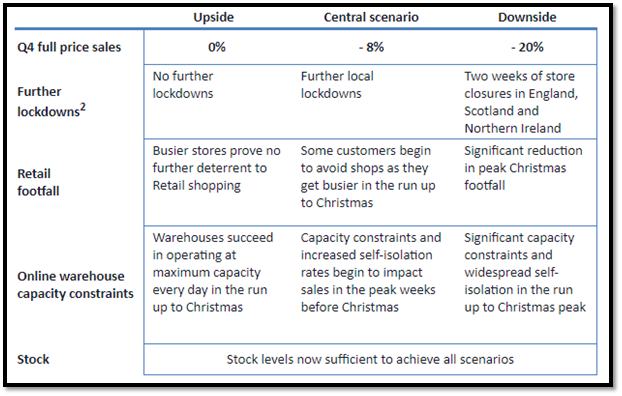
(Source: Company’s filings, LSE)
Alternatively, the plight of high street retailers is not just about declining footfall and store closures. ‘Rents’ are bleeding the life out of the high street businesses. Leading British REITs are struggling to collect rents timely from the retailers. Instead, they are renegotiating terms of payment and tenures to make things work. Theoretically, adjusting rents might help out retail businesses. Lower rents might help in making high street businesses viable despite the economic fallout caused by Covid-19.
Also read: REITS Continue to Remain Under Pressure, Shaftesbury Receives Less Than Half of The Rent
Next shares last traded at GBX 6,042 on 29 October, down by 1.5 per cent (02:25 PM GMT+1) from the previous day’s closing price. Next’s total market capitalisation stood at £ 8,155.11 million. The stocks of the company created a new low of GBX 3,390 during the peak of unprecedented crisis. Since then, Next shares have delivered a price return of 78.35 per cent.
Also read: Fraser Group Gets 48-Hour Deadline to Make A Binding Commitment for Debenhams
Apart from store closures risk, Brexit uncertainties could also pose several headwinds for the company in the near term. In case of a no-deal Brexit, the new tariffs will increase NEXT's annual import duty costs by around £13 million based on pre-pandemic levels of turnover. However, a temporary tariff regime could reduce Next's import duty costs by around £25 million. Although, a no-deal Brexit is not a preferred outcome for the company, however, as long as company’s ports continue to operate, a no-deal Brexit would not pose a material threat to the ongoing operations or profitability of the Group.
