
 AUS
AUS
 NZ
NZ
 UK
UK
 CA
CA
 USA
USA
 IND
IND

.jpg)


_06_19_2026_12_34_15_139937.jpg)

BP releases positive results for Q3, but share price slumps
- The oil major reports small profit but cautions over pandemic related uncertainties
- BP leads an energy alliance to lower carbon dioxide emissions
BP recently released its third quarter results for the year 2020 that beat forecasts, promising its investors that despite challenges, it was on a road to recovery. At the same time, the company informed that the pace of recovery from the pandemic still remained uncertain and it would impact the oil giant’s future prospects too. Global consumption is expected to continue to remain bleak in the fourth quarter of the year 2020 as well.
Defying expectations from market analysts, BP group posted a small profit for the Q3 period ending 20 September 2020, which was down 96 per cent as compared to the corresponding period last year.The group’s net income,defined as its underlying replacement cost profit, was down from $2.25 billion in Q3 2019 to $86 million in Q3 2020.
The results were driven by better than anticipated oil prices and decent natural gas trading results.
The average Brent crude prices for Q3 2020 were $42 a barrel, up from a lower value of $30per barrel for the previous quarter.
The oil trading results for the third quarter of 2020 were not as good as the previous quarter (Q2) ones, which were exceptionally strong, as per experts.
Market analysts had estimated a loss of $120 million instead. During the previous quarter (Q2 2020), BP had reported a record loss worth $6.7 billion, which had compelled the group to halve its dividends.
The energy giant’s net debt dropped to a value of $40.4 billion at the end of Q3 2020, which was another positive development (end of Q3 2019: $46.5 billion).
At the same time, market analysts estimated that the leading oil and gas companies were facing challenges world-over with rock-bottom refining margins. Total SE and Royal Dutch Shell are also expected to release their results within few days.
Concerned about the prevailing weak oil prices, the global oil giant was proactively trying to shift its focus towards renewable energy. In fact, Murray Auchincloss, BP’s Chief Financial Officer (CFO) recently said that the coronavirus pandemic would not be able to slow down the group’s transition plans.
BP leads energy alliance
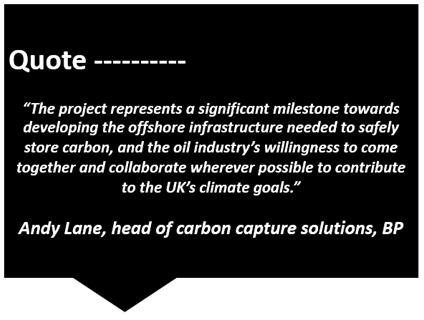
The British Petroleum (BP) group is leading various energy firms to formulate partnerships that would speed up the offshore transportation and storage facilities for carbon emissions in the North Sea of the UK.
The companies involved in the partnership are Shell, Total, Equinor, National Grid, and Eni, in the agreement named the Northern Endurance Partnership (NEP).
Endurance is Britain’s largest saline aquifer for carbon storage. This consortium plan led by BP is slated to have a capacity which will be roughly 50 per cent of total industrial emissions in the UK. These emissions would be stored in the lowest layers of the North Sea beginning with the year 2026, as per the plan.
The NEP would be storing 17 million tonnes per annum of carbon dioxide gas below the North Sea. These targets will greatly help the UK government in meeting its climate change target of becoming carbon neutral by the year 2050.
Carbon capture and storage is the first step in this direction.The plan would be using the carbon capture technology to store the gas emissions. This process follows the following steps:
- Plant emissions injected in a solvent absorber
- Collection of carbon dioxide
- Releasing rest of the emissions
- Separation of solvent from carbon dioxide
- Storage of CO2 beneath the sea
The carbon emissions would be captured from two industrial clusters at Teesside and Humber, located on the east coast of England.
According to the International Energy Agency (IEA), money worth more than £20 billion has been invested in thirty plus carbon capturing projects across the world during the past three years.
The British government has also committed a sum of £800 million towards decarbonising two industry clusters by the year 2030. The NEA has applied to the UK government for the project funding.
Restructuring process
The leading oil and gas major envisaged to raise its renewable energy capacity almost twenty-fold by the year 2030. It would also lower oil production capacity by almost 40 per cent. More funds would be divested to low-carbon investments in this regard.
Over the next few quarters, the group would be laying off close to 10,000 of its staff, which account for 15 per cent of its total global employee strength. The company had laid off around 2800 employees so far in the year 2020.
While investors have welcomed the new strategy, they are concerned about the group’s ability to retain its profit margins in the changing scenario.
According to analysts, it is not easy to predict timelines for correction of the ongoing demand and supply imbalances.
Bernard Looney, BP’s CEO stressed that the group’s shift towards a renewable energy future would be based on projects offering strong returns.
Towards this end, the company had bought a $1.1billion stake in two US based offshore wind energy projects earlier, which were being developed by Equinor.
Stock performance
Despite posting profits, the company stock (LON: BP.) went down by 2.81 per cent on 28 October 2020 at 8.33 AM to reach a value of GBX 190.12, as compared to the previous day’s close.
The company shares had tumbled by more than half of their value since the beginning of the year 2020, continuing to hover near their 25-year low levels. The stock’s 52-week range was quite wide with a low value of GBX 195.74 and a high of GBX 516.40.
