
 AUS
AUS
 NZ
NZ
 UK
UK
 CA
CA
 USA
USA
 IND
IND




_07_03_2026_03_50_21_133108.jpg)

Summary
- The UK’s Medicines and Healthcare Products Regulatory Agency has started the rolling review of AstraZeneca’s potential Covid- 19 vaccine, paving the way for its early roll-out
- The company had given an earlier roll-out schedule of the month of September, but a glitch in the clinical trial phase has set it back by months
- The MHRA has also simultaneously started the review process of another vaccine candidate from Pfizer Inc and Moderna Inc from the United States of America, which are also in their final stages of clinical trials
On the day when the British prime minister Boris Johnson decided to impose second lockdown in the country, AstraZeneca made an announcement that a rolling review of its vaccine has commenced. The Medicines and Healthcare Products Regulatory Agency (MHRA) will conduct a real-time evaluation of the clinical trials data of the potential vaccine so that there is no lead time between the completion of the trail phases and the beginning of the countrywide vaccination process.
It is to be noted here that the United Kingdom is in a race against time to introduce the vaccine as the pandemic has already made a relapse forcing the country into a second lockdown. AstraZeneca which had given an earlier schedule of September this year to complete the trials process could not do it as an unexpected glitch surfaced in the trails process setting it back by months. Had the company been able to meet that deadline, the country would have been in a much comfortable position today as far as controlling the pandemic is concerned and possibly a second lockdown may not have been required.
The MHRA rolling review
The initiation of the rolling review process by the MHRA is the first step in the approval of the potential of potential COVID-19 vaccines in the United Kingdom by AstraZeneca. This process which is so initiated to conclude in accordance with the conclusion of the clinical trials process used in times of public emergencies like the one the country is facing currently. The AstraZeneca vaccine, which was one of the first such vaccine development initiatives launched after the Coronavirus outbreak is being spearheaded by the Jenner institute of the Oxford University.
Given the early advancements that the vaccine candidate made then known as ChAdOx1 nCoV-19, before AstraZeneca took over and changed its name to AZD1222 it was purported that it will capture the lions share of the market of all other competitors that are in the fray.
The vaccine, however, could not come fast enough to prevent the second lockdown in the country, which is set to be imposed from the 5th of November 2020 till 2nd of December 2020. This rolling review process which could run weeks if not months would ensure that the mass vaccination process in the country can start in the last weeks of 2020 at the earliest.
Other major candidates nearing the end of trials
Among the other top potential vaccine candidates that are nearing their clinical trial phases are from American Pharmaceutical majors Pfizer Inc and Moderna inc, both of which have been included in the MHRA rolling review process. Both these vaccines, which are quite promising, had started out their development phase later than AZD1222, but accelerated their pace and are now almost neck and neck with AstraZeneca.
Both the vaccine candidates for Pfizer and Moderna and mRNA-based vaccine candidates are being claimed by their developers to being superior to that of the AstraZeneca candidate are also expected to be comparatively more expensive. For the United Kingdom it is also important that it evaluate more than one candidate, otherwise, if one candidate fails, it will have no other alternative to bank upon.
The AZD1222 vaccine candidate has already faced hiccups in its trials process, and now its developers have come out and stated that the vaccine has mild side effects on elderly patients. It is thus quite likely that the MHRA might give approval to more than one of these potential candidates, paving the way for price competition between these major global pharma players.
Importance of an early roll-out
The relapse of the coronavirus pandemic in the winter months was a well-anticipated event. This pandemic has proven to be more of an economic hazard for the country than it has been a healthcare hazard. Since its outbreak, the country has seen hundreds and thousands of businesses being shut down and millions becoming unemployed. The country has been pulled down to its worst economic crisis encountered in a hundred years. The kind of policy and monetary tools the government and the Bank of England have deployed after this outbreak is unprecedented. The government public borrowings have also reached record levels, and the government’s tax collections have also plummeted sharply given the massive drop in economic activity levels in the country.
The relapse of the pandemic will only result in further pushing the economy into a double-dip recession, and the businesses will lose whatever recovery they have achieved over the past six months since the first lockdown was relaxed.
The early roll-out of vaccines for mass public inoculations is now more critical than ever before. It will not only help reduce the time the country stays in the second lockdown but will also give a big push to the economic jump-start process once this second lockdown ends.
Below we look at the share price performance of AstraZeneca plc on the London Stock Exchange after it announced the initiation of the rolling review process by the MHRA for its vaccine candidate.
AstraZeneca plc (LON:AZN) Share price performance on the London Stock Exchange
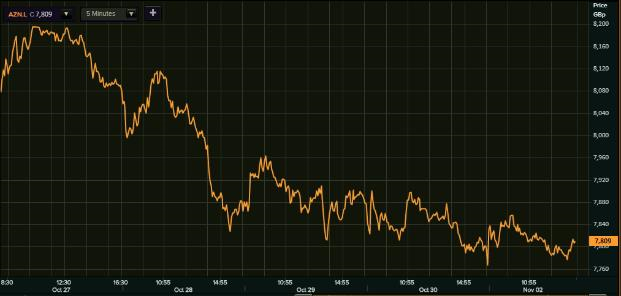
(Source-Thomson Reuters)
As on 02 November 2020, the shares of AstraZeneca plc have been trading at GBX 7,809.00 per share (2.18 PM GMT+1) gaining 0.55 per cent over the previous day’s close.
