
 AUS
AUS
 NZ
NZ
 UK
UK
 CA
CA
 USA
USA
 IND
IND






Summary
- The UK's PMI increased to 53.3 in July 2020 from reported PMI of 50.1 in June 2020.
- The FTSE 250 was trading at 17,010.38 and was up by 0.46 percent (as on 3 August 2020 before the market close at 11:20 AM GMT+1).
- Greencoat UK Wind announced an interim dividend of 3.55 pence per share for H1 FY2020.
- Greencoat UK Wind's wind farms generated 1,494GWh in H1 FY2020.
- Drax Group would start the biomass self-supply capacity from H2 FY2020.
Given the above-market conditions, we would review two stocks - Greencoat UK Wind PLC (LON:UKW) & Drax Group PLC (LON:DRX). UKW is a financial services stock, and DRX is a utility stock. Based on the 1-year performance, UKW was up by ~6.61 percent, and DRX was down by ~9.18 percent (as on 3 August 2020 before the market close at 11:20 AM GMT+1). Let's review the financial and operational updates of the stock.
Greencoat UK Wind PLC (LON:UKW) - Acquired Slieve Divena II wind farm in H1FY2020
Greencoat UK Wind PLC is a UK based renewable infrastructure fund. The Group has exposure to wind farms and has an interest in 36 operating wind farms. The Group is listed on the FTSE 250 index.
H1 FY2020 result (ended 30 June 2020) as reported on 30 July 2020
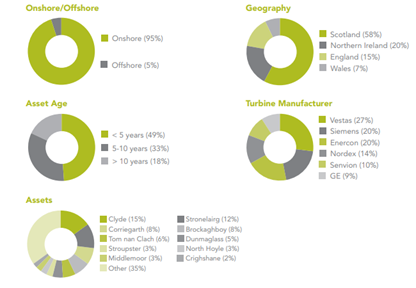
The Group generated 1,494GWh of electricity in H1 FY20 and reported net cash of £71.0 million. The demand was lower in the second half of the reported period following the subdued power demand and low gas prices. As on 30 June, the Group had unaudited net asset value (NAV) of £1,822.7 million that reflect NAV per share of 120.1 pence. Greencoat had gross asset value (GAV) of £2,449.7 million, and it had a total debt of £627 million all at a fixed rate. The Company made total investments in 36 operating wind farms (with a total net generation capacity of 998MW). The Company entered a deal to acquire South Kyle wind farm - 235MW subsidy free wind farm, which is expected to be operational by 2023. Greencoat acquired Slieve Divena II wind farm for £51.0 million, whereas it would invest £320.0 million in the South Kyle wind farm. Greencoat invested an additional £5.5 million in Douglas West subsidy-free wind farm project. In H1 FY20, there was the unavailability of power supply at few projects for some time such as unplanned grid outage at Clyde due to cable failure, maintenance work at Dunmaglass and planned maintenance work at Corriegarth. Optional Downward Flexibility Management (ODFM) service was launched by National Grid to deal with the erratic demand during the lockdown. OFDM was applicable in May 2020 and June 2020 that has a balancing mechanism and is connected to the distribution assets.
Investment Portfolio of Greencoat UK Wind as on 30 June 2020
(Source: Group Website)
Share Price Performance Analysis
1-Year Chart as on August-3-2020, before the market close (Source: EODHD/Others, Thomson Reuters)
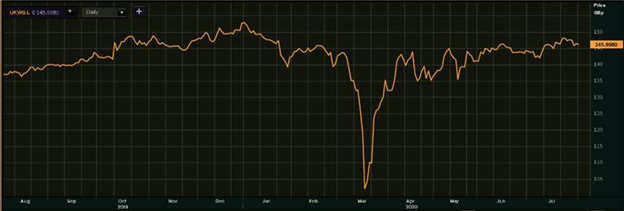
Greencoat UK Wind PLC's shares were trading at GBX 145.99 down by about 0.28 percent from the last closing price (as on 3 August 2020 before the market close at 11:20 AM GMT+1). Stock 52-week High and Low were GBX 155.00 and GBX 99.90, respectively. The Group had a market capitalization of £2.21 billion.
Business Outlook
Greencoat has planned to bring the 45MW Douglas West wind farm operational in July 2021 and 235MW South Kyle subsidy-free wind farm in Q1 2023. The Group would focus on investing in companies that would enhance the shareholder's return. It would invest in subsidy-free farms and farms operating under the renewables obligation certificate (ROC) regime and contract for difference (CFD) regime.
Drax Group PLC (LON:DRX) – Planned to develop a bio-mass supply of five million tonnes by 2027
Drax is a UK based utility group engaged in the energy generation market. Drax has interests in biomass projects, gas projects and hydro projects, and it categorizes the business under Pellet production, Customers and Generations. The Group is listed on the FTSE 250 index.
H1 FY2020 results (ended 30 June 2020) as reported on 29 July 2020
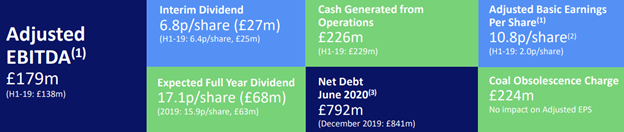
Drax Group reported revenue of £2,205.3 million in H1 FY20, of which Generation business division contributed £1,757.1 million, whereas Customers and Pellet production added £1,031.8 million and £118.0 million, respectively. Drax Group reported an adjusted EBITDA of £179 million, which was up by 30 percent year on year from £138 million in H1 FY19. The adjusted EBITDA includes the impact of capacity payments of £34 million, the impact of COVID-19 of £44 million and robust performance related to biomass. In H1 FY20, the operating loss and loss before tax was £32 million and £61 million, respectively. The cash generated from the operation was £226 million in H1 FY20 that was £229 million in H1 FY19. The Group invested in increasing the capacity of US pellet production and made a total capital expenditure of £78 million during the reported period, and it has provided a full-year capital expenditure guidance of close to £190-210 million. Drax Group has increased the capacity of the biomass self-supply and expects its start from H2FY2020. As on 30 June 2020, the net debt was lowered to £792 million from £924 million a year ago.
Financial Summary H1 FY2020
(Source: Group Website)
Share Price Performance Analysis
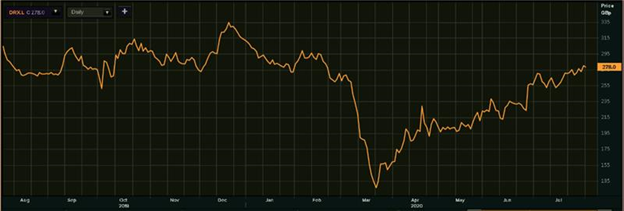
1-Year Chart as on August-3-2020, before the market close (Source: EODHD/Others, Thomson Reuters)
Drax Group PLC's shares were trading at GBX 278.00 down by about 0.71 percent from the last closing price (as on 3 August 2020 before the market close at 11:20 AM GMT+1). Stock 52-week High and Low were GBX 364.60 and GBX 118.90, respectively. The Group had a market capitalization of £1.11 billion.
Business Outlook
The Group expects that it would generate a full-year EBITDA in FY20 that would meet the management's expectation. The operation of projects is anticipated to be strong in the second half of the year. The focus would be lower the cost of pellets production and improve the quality of the output. The Group would develop a bio-mass supply of five million tonnes by 2027 and reduce the cost of biomass to £50 per MWh. The Group would continue to thrive the Generation business and would deliver renewable energy to the businesses. The Customers business was affected due to the pandemic, but the Group would monitor the performance to meet the long-term objectives.
