
 AUS
AUS
 NZ
NZ
 UK
UK
 CA
CA
 USA
USA
 IND
IND






Summary
- Two amendments to the UK Agriculture Bill cleared by the House of Lords – one on standards for imported food items and another relating to the Trade and Agriculture Commission
- The Agricultural Bill will be tabled in the House of Commons during the month of October 2020
- The amendments shall provide a level playing field to the British food industry after Britain exits the EU trade block
- Focus on select food stocks – ABF, TSCO, and MRW
Recently the House of Lords has voted in favour of two amendments in the UK Agriculture Bill. The first amendment will ensure that the imported food products would need to comply with the domestic food standards in Britain once the Brexit transition period is over. The second amendment has empowered the role of UK Trade and Agriculture Commission (TAC), a relatively new body.
We will be taking a closer look at these amendments in this article and its likely impact on the British food stocks.
Amendments and their Impact
Stringent checks around food getting imported into the country are expected to guarantee improved standards for food and beverages coming into the UK beginning 1 January 2021, when the 11-month long Brexit transition period comes to an end. It is to be recalled that the environmental organisations had been requesting the PM Boris Johnson to intervene as they were worried over the country getting flooded with chlorinated chicken and hormone-induced beef in case UK is not able to grab a favourable trade deal with the EU.
In fact, the purpose of the second amendment is also to protect the British food sector and the local farming community. The amendment shall give powers to the TAC to offer an independent view on the effect of future free trade deals on the nation’s food and agriculture sector.
The Agricultural Bill will be tabled once again in the House of Commons during the month of October 2020. It was earlier tables in May 2020, when the House had voted against the first amendment described above.
In effect, these are going to be healthy moves for the British food and drink manufacturing companies and are expected to positively impact their future growth strategies. The domestic sector will get a much-needed level playing field after Britain exits the EU trade block.
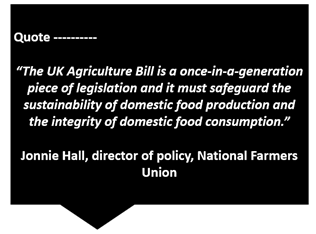
In fact, any reduction in the standards for eatables entering the nation would have provided a competitive advantage to foreign companies who wanted to conveniently avoid the high and expensive standards prevalent in the United Kingdom, explained Dominic Watkins, head of food at DWF, a well-known national law firm.
Let us now take a closer look at few leading food companies and their stock performance in the UK that could benefit from the Agriculture Bill amendments and an overall scenario of a no-deal Brexit.
Associated British Foods plc – the company is a major producer of farm products, specialising in sugar, yeast, and grocery items, among others. To minimise the impact of a no-deal Brexit on its overall operations, the company has already begun the process of reducing its exposure to non-UK suppliers. Domestic raw material suppliers would benefit as ABF is re-evaluating its vendors’- list. According to sources, it may replace its German wheat suppliers with domestic ones.
Stock performance: The company stock (LON: ABF) was trading at GBX 1,871.00 on 28 September 2020 at 11.05 AM, up by 1.49 per cent from its previous close of GBX 1,843.50. The 52-week low/high range was recorded to be GBX 1,607.50 and GBX 2,708.00. The company’s market capitalisation was worth £ 14,594.51 million at the time of reporting. It was providing a negative year to date return (YTD) of 28.55 per cent. The earnings per share was recorded to be 1.11 per cent. The total volume of shares traded at the time of reporting was 344,584.
Tesco plc – it is the largest supermarket in the UK and owns close to 27 per cent of the total market share. With its substantial buying power and global exposure, the company is expected to mitigate the Brexit risks effectively. At the same time, with higher costs imposed over the entire food supply chain post-Brexit, the supermarket might not be left with any other option but to absorb a part of the cost, rather than passing it entirely on to the consumers. Going forward, the company plans to manufacture more of its own products and source domestically as much as possible.
Stock performance: The company stock (LON: TSCO) was trading at GBX 217.60 on 28 September 2020 at 10.54 AM, up by 0.74 per cent from its previous close of GBX 216.00. The 52-week low/high range was recorded to be GBX 211.20 and GBX 258.90. The company’s market capitalisation was worth £21,153.95 million at the time of reporting. It was providing a negative year to date return (YTD) of 15.56 per cent. The earnings per share was recorded to be 0.10 per cent. The total volume of shares traded at the time of reporting was 2,011,127.
Wm Morrison Supermarkets plc – Being a strongly vertically integrated organisation, the company is likely to sail through the no-deal Brexit scenario without much hiccups, according to industry experts. The company manufactures almost one-fourth of its total finished product range. Further, more than 65 per cent of its products are sourced domestically. Therefore, its exposure to competition from imported food products is minimal, at least to that extent.
Stock performance: The company stock (LON:MRW) was trading at GBX 174.00 on 28 September 2020 at 10.52 AM, up by 0.49 per cent from its previous close of GBX 173.15. The 52-week low/high range was recorded to be GBX 164.20 / 204.70. The company’s market capitalisation was worth £4,171.95 million at the time of reporting. It was providing a negative year to date return (YTD) of 14.45 per cent. The earnings per share was recorded to be 0.15 per cent. The total volume of shares traded at the time of reporting was 591,480.
Finally, the recent amendments to the Agriculture Bill are a good move and would protect the domestic industry from any unfair competition that could have emerged if high food standards were not maintained in the UK. Once the Bill is passed by the House of Commons, it will bring cheer to the domestic food producers. Companies like ABF, Tesco, and Morrisons are some of the few who could gain from this move in the long-run.
