
 AUS
AUS
 NZ
NZ
 UK
UK
 CA
CA
 USA
USA
 IND
IND






Summary
- In Q3 2020, Carnival’s revenue dropped to $31 million from $6.53 billion during the same period last year, a fall of more than 99 per cent.
- Carnival restarted its operations in September 2020 with limited guests after halting its global operations in mid-March 2020 due to outbreak of the pandemic.
- The company had planned to dispose of around 18 of its ships, out of which ten have already left the fleet.
The dual-listed cruise company, Carnival Plc and Corporation (LON:CCL) released its third quarter (Q3) earnings report on 8 October 2020. The company’s revenue fell from $6.53 billion reported during Q3 last year to $31 million in Q3 2020, a plunge in excess of 99 per cent. A net loss of $1.69 billion in Q3 was reported by the cruise line as compared to $1.82 billion of adjusted net income during Q3 2019. On 9 October 2020, the stocks of the FTSE 250 company on London Stock Exchange closed at £1,041.50 up 1.26 per cent.
The company restarted its operations in September this year with limited guests after halting its global operations in mid-March 2020 due to the outbreak of the Coronavirus. As the highly infectious respiratory disease impacted the booking patterns, the cruise line company is of the belief that that complete extent of the impact would be determined by the time duration that Covid-19 would influence travel decisions. The company has stated that the ongoing coronavirus crisis on its business operations would continue to negatively impact it’s financial and liquidity position in coming times.
Carnival further mentioned that it was not in a situation to correctly estimate its liquidity needs, given the unprecedented crisis that completely paused its guest operations. However, Carnival anticipated a net loss on both a US GAAP and adjusted basis for the upcoming quarter and year that would end by 30th of next month.
Carnival has already undertaken significant measures in the past to enhance its liquidity. The company would keep implementing other relevant strategies in future as well to considerably reduce its capital expenditure and operating expenses by expediting the removal of ships from its fleet and suspending dividend payouts. In addition, repurchasing the common stock of Carnival Corporation and ordinary shares of Carnival plc, besides undertaking various capital market transactions, would form the strategic interventions. Carnival would be able to generate enough liquidity to satisfy its obligations for at least coming one year from these initiatives.
Also read: Why is the share price of Carnival falling?
Also read: Travel woes during the pandemic: UK to lose £22 billion as international travel dips
Also read: A Lens over Carnival and TUI Stocks Amidst the Jitters in Holiday Companies
The uncertain ongoing developments amid the coronavirus-led crisis would additionally determine the extent to which the company’s valuation of goodwill and trademarks, impairment of ships, collectability of trade and notes, including its receivables as well as provisions for pending litigation would be impacted.
Let us have a look at some developments regarding the resumption of guest operations and Carnival’s plans on fleet management.
Considered to be one of the leading international leisure travel companies, Carnival operates around nine cruise lines. The company has operations across Europe, North America, Australia, and Asia. Some of the well-known portfolio from the company includes Carnival Cruise Line, P&O Cruises (the UK), Holland America Line, Princess Cruises, P&O Cruises (Australia), Seabourn, AIDA Cruises Costa Cruises, and Cunard. Carnival has been severely hit to the coronavirus pandemic.
Resumption of guest operations
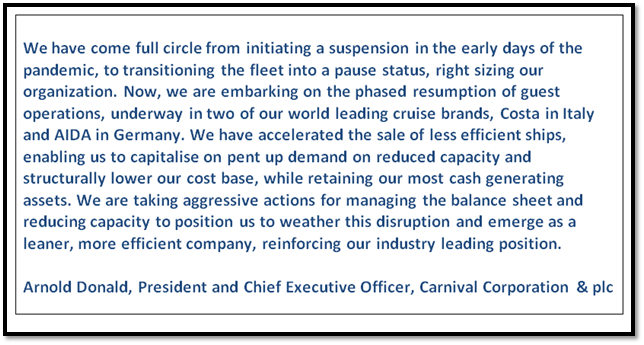
In September 2020, Carnival resumed a limited guest operation with voyages on two of its ships from Costa Cruises and planned to keep sailings on additional Costa ships apart from AIDA Cruises, expected to begin around mid of this month. As part of the phased resumption of operations, the initial cruises would have adjusted passenger capacity amid enhanced health protocols. The health guidelines have been developed with government and health authorities, besides guidance from its own medical and scientific experts.
Carnival also has plans to start operating its other brands and ships in coming time. The cruise operator would be giving required priority to compliance and environmental protection, besides health, safety, and well-being of its crew, shoreside employees, guests, and the people in the communities its ships visit. The Centers for Disease Control's (CDC) “No Sail Order” has been extended till 31 October 2020 and Carnival was hopeful that the industry could collaborate with the CDC and administration to restart cruise operations from the US in 2020 itself.
Fleet optimisation
Carnival has expected its capacity to be moderated by phased re-entry of its ships in future and removal from its existing fleet, besides delay in deliveries of new ships. Since the halt of guest operations, the company expedited the removal of ships this year, especially those, which were earlier planned to be sold over coming years. Carnival has plans to sell around 18 ships, out of which ten have already left the fleet. By selling lesser efficient ships, the company would have substantial operating expense efficiencies in future. In addition, there would be a considerable reduction in fuel consumption. In 2020, Carnival expected only two of the four ships originally scheduled for delivery due to the pause in operations. One ship has been delivered early October.
Carnival cruise bookings
The bookings for the first half of 2021 reflect the company’s expectations of the phased reopening of its guest businesses and planned changes in itinerary changes. As of mid-September 2020, the advanced bookings for later part of 2021, currently available for sale were at the higher end of the historical range. The cruise operator noted that it showed long-term potential demand. Carnival has offered flexibility to its guests with bookings on sailings cancelled by allowing them to take enhanced future cruise credits (FCCs) or alternatively opt for refunds in cash.
Conclusion
The outbreak of the pandemic has severely impacted the leisure travel industry. Amid the rising infection rates in recent times, it remains uncertain when the situation would likely improve, given the absence of an effective vaccine for the illness. However, with ease in lockdown restrictions and resumption of operations, the companies need to come up with strategic initiatives to increase and sustain demand from the consumers. Associating with government and health experts on devising ways to ensure the health safety of staff and travellers would increase the confidence of the consumers. Till the pandemic decimates and economic recovery gathers pace, the companies need to optimise their existing resources and communicate clearly with its customers regarding its various schemes and operations.
