
 AUS
AUS
 NZ
NZ
 UK
UK
 CA
CA
 USA
USA
 IND
IND




_07_03_2026_03_50_21_133108.jpg)

Summary
- British Airways has pinned its survival on commencing coronavirus testing at airports for the travellers
- Testing could be a possible solution for exiting travel bans, though at the same time it could increase the cost
- IATA has proposed a four-point plan which could make air travel hassle-free and instil confidence amongst travellers
From aircraft manufacturers to air carriers, all have been devastated by the onslaught of the coronavirus pandemic. As the novel coronavirus engulfed most of the countries, the number of travellers declined drastically with the strict travel restrictions imposed by the different governments. During the peak of the crisis, major air carriers got their fleet grounded, and all the means of revenue dried up. They were further burdened by parking charges of their fleet. The aircraft manufacturers witnessed a decline in the order of new aircraft. The aviation sector has seen major job redundancies across the globe and can be called one of the toughest times that the industry has ever faced.
Also read: Huge Prospects for Air Carriers to Deliver COVID-19 Vaccines
British Airways calls upon the government to begin health check-ups at the airport
British Airways has pinned its survival on commencing coronavirus testing at airports for the travellers. International Consolidated Airlines Group (LON: IAG) owned air carrier has been seeking support from the British government.
London’s Heathrow airport has been equipped with testing stations and is awaiting approval from the government. Most of the countries around the world have started to rely on this concept of airport testing to find a solution for the coronavirus induced travel restrictions.
British Airways flew just 5 per cent of the capacity during the peak of the unprecedented crisis. Although the skies have reopened, 70 per cent of the flights are still grounded. The company stressed upon resuming the business links such as the transatlantic route between London and New York by introducing coronavirus testing. The country has witnessed several protests amid fears of mass unemployment. More than 100 thousand aviation and allied industry jobs are at risks. According to media reports, British Airways has planned to reduce its workforce by 30 per cent and the remaining staff would have to undergo a 20 per cent of the basic pay cut.
In the pre-pandemic era, the industry thrived upon more revenue per seat. Air travel could once again be out of the reach of common people. The introduction of coronavirus testing could be a costly affair. Setting up of isolation wards at airports and on the aircraft could lead to increased costs and could even reduce the seating capacity of the aircraft. Moreover, the cost of PPE’s and other consumables would increase the operational expenses of the airline.
The government must intervene and chalk out plans with other countries to develop universal testing procedures for departures and arrivals. Defining health & safety standards at a diplomatic level will help in maintaining transparency and safeguarding public health. Moreover, the standardisation of these standards would boost the confidence of travellers.
Do read: British Airways Clashes with Heathrow Ltd Over the Development Cost-Sharing
IATA proposes a rescue plan for air transport
Amid fears of mass unemployment in the sector, International Air Transport Association (IATA) has proposed a rescue plan for UK aviation to the government. IATA has proposed a four-point plan which could make air travel hassle-free and instil confidence amongst travellers.
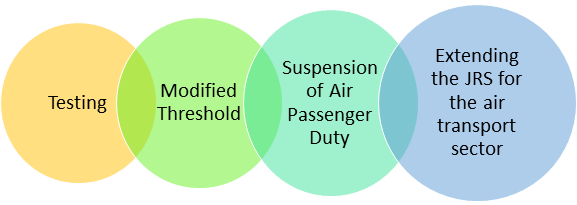
Four-point plan to kick start aviation
- Testing
The existing Travel Corridor policy could be a starting point to initiate testing and unlock travel. Most of the countries have already started to implement coronavirus testing at the airports. People travelling from high-risk countries can also travel as testing has become a standard protocol in most of the countries.
- Modified threshold
France and Spain have been recently added to the list of quarantine nations. The UK arrived at this quarantine list by calculating a frequently quoted metric, which is the threshold of 20 infections per 100,000 of population. Though, this is not in line with other European states. If the government adopts a metric that is in synchronisation with other European countries, travellers can plan their journeys as they will have better transparency.
- Suspension of Air Passenger Duty
Relaxation of this excise duty imposed by the British government, might leave with some additional cash in the pockets of Britons, which could help in propelling the demand for air travel.
- Extension of JRS for the air transport sector
The Job Retention Scheme (JRS) was announced by Rishi Sunak, the Chancellor of the Exchequer, during the peak of the unprecedented crisis to safeguard the jobs of the Britons. JRS, also known as the furlough scheme, is likely to end this October. IATA has proposed an extension of JRS until border restrictions are eased so that the industry gets some more time to recover.
The GDP of the country has slipped by more than 20 per cent in the April to June quarter this year, which implies that the UK is going through a recessionary cycle. Notably, the economic impact of the coronavirus pandemic on the aviation industry has led to a loss of £1.4 billion in GDP along with more than 700 thousand job redundancies up till now. If the current situation persists until the end of the year, UK ‘s GDP will lose another £4.6 billion along with further 87,000 job redundancies.
Coronavirus pandemic has caused carnage in the UK’s aviation sector and has pushed more than 800 thousand people out of work. It is imperative of the British government to find a solution to exit the travel restrictions and bring a less complicated quarantine regime to bolster the demand for air travel.
