
 AUS
AUS
 NZ
NZ
 UK
UK
 CA
CA
 USA
USA
 IND
IND




_07_03_2026_03_50_21_133108.jpg)

Summary
- The current tussle between Heathrow ltd and IAG, the owners of British Airways is over the sharing of costs amounting to £500 million.
- A third runway on the Heathrow airport was under development until the month of February this year before it was halted due to a legal tussle between the airport and the carriers over cost-sharing.
- In the aftermath of the lockdown when most of the airlines are already in red, sharing cost for an asset which is not public is what the airlines are fighting for.
A Civil Aviation Authority (CAA) regulation which allows the private airport operators in the UK like Heathrow ltd to share expansion related costs with airlines has now become a bone of contention between IAG and Heathrow ltd. The airport, which is a privately owned corporation, was earlier in the process of constructing a third runway of the Heathrow airport when it had to be stopped due to legal tussle. IAG (International Consolidated Airlines Grp SA) which is the owner of British Airways, has objected to the airports’ wreck less spending behaviour and has termed it as unfair to share development costs of a private asset. It is to be noted here that both parties are in a severe cash crunch currently because of the sharp drop in the business over the past few months and are on the verge of laying off several of their employees to cope with the situation.
What are the arguments Heathrow ltd have in favour of imposing the costs on airlines?
Heathrow ltd is of the view that the airlines should not have a problem sharing the costs as they are very well aware of the CAA regulations. The way the cost of infrastructure development will be shared by all parties benefiting and no single party will be unduly burdened.
Any infrastructure development expenditures undertaken by an airport involves heavy capital outlays. However, the airports cannot impose normal airport charges on airlines operating beyond a certain point, leaving them with a huge gap to fill, which often is beyond their capacity to afford. In the case of countries where airports are owned by the government, capital expenditures come through government grants and have a very long gestation period before they are fully paid off.
The outbreak of the coronavirus has been an unprecedented situation, which most of us could not have foreseen. Thus, a project like the third runway at Heathrow which would not have created much of a massive tussle before the outbreak is now a major flashpoint between the different parties.
What are the arguments IAG giving against sharing of costs?
British Airways’ owner IAG is of the opinion that it should not be paying for the capital expenditure for a private entity who is going to solely benefit at the cost of the airline companies . The new runway will bring in additional revenues to the tune of a third, which the airport is not going to share with anyone, while not providing any public service at all. The regulation of the CAA that allows the airport operator to charge development costs with the airlines allows it to spend in an unjustified manner without bothering for its answerability. A sum of £500 million for the third runway in an existing airport certainly seems to be exorbitant, and Heathrow Ltd must be called to justify this expenditure.
How has COVID- 19 impacted the two companies?
The airline companies and the airport operators were some of the hardest-hit businesses in the world on account of the coronavirus pandemic.
With severe restriction imposed on air travel domestically as well as internationally since the month of March, airline companies saw their revenues drop to almost zero. They have, however, thousands of employees whom they have to pay salaries and millions of dollars' worth of equipment that needed to be kept, which required a constant outflow of cash. Thus, the longer the ban on air travel continued, the longer these companies had to bleed.
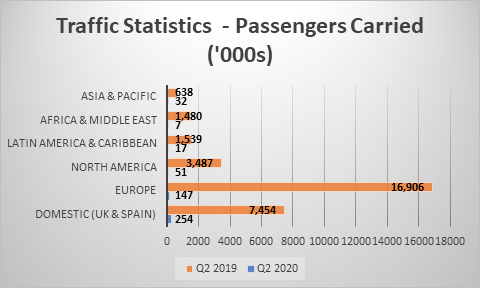
(Data Source -IAG Release)
Airports are highly dependent on the airline industry for their revenues. The more the people pass through an airport, the more revenues it makes. However, the coronavirus pandemic and the subsequent safety measures imposed by the government has meant that the passenger numbers have come down drastically. Plus, the additional sanitization measures that need to be implemented and the additional screening equipment are also costing the airports a fortune to implement.
Both IAG and Heathrow Ltd have announced that they would be laying off a significant number of their staff in order to contain the continuing impact on their finances due to the coronavirus pandemic.
The performance of shares of IAG Plc on the London Stock Exchange.
IAG was one of the worst affected companies in the United Kingdom because of the coronavirus pandemic. Most of the company's aircraft were grounded following the lockdown, with British Airways only operating emergency missions to bring back Britishers stuck back in other countries. Since the opening of the lockdown, the company has steadily scaled back its operations but has not yet reached sustainability levels.
Since the beginning of the year, the shares of IAG (LON:IAG) have been underperforming at the London Stock Exchange. On 2 January 2020, the shares of the company were trading on the exchange at GBX 636.20 per share, and towards the end of March, it took a sharp downward turn to reach a low of GBX 195.00 on 19 March 2020. Since then, however, not much volatility has been seen in the stock, and as of 8 September 2020 the shares of the company were quoted at GBX 209.60, up by 0.38 per cent from the previous close.
Conclusion
The pandemic situation is unique and difficult for both the industries and needs government intervention to protect the interest of the two industries. The case of the infrastructure cost of the additional runway is the perfect example where the government can step in to provide some capital support.
