
 AUS
AUS
 NZ
NZ
 UK
UK
 CA
CA
 USA
USA
 IND
IND







Summary
- Nokia to replace Huawei as BT’s largest equipment supplier for 5G networks across the nation.
- This deal would be the first in the sector after the UK government banned all the mobile providers from buying Huawei 5G equipment in July 2020.
- As per the deal with BT, Nokia would provide base stations and other network equipment so that BT can offer super-fast 5G internet its customers.
Finnish multinational telecommunication giant Nokia Corporation would provide equipment to BT Group plc (LON: BT.A), which is country’s leading telecommunication service provider, after it won a deal to supply 5G networks across Britain. This would mean that Nokia will replace Huawei in BT’s 2G as well 4G networks.
The deal was announced on 29 September 2020. This deal would be the first in the sector after the UK Prime Minister Boris Johnson banned the Chinese telecom company Huawei in July 2020.
As per the deal, Nokia would provide base stations and other network equipment so that BT can offer its customers super-fast 5G internet. For BT, the transition would cost the company around £500 million. For the complete replacement of its 5G equipment from Huawei to Nokia, BT is planning to use other suppliers too. BT officials said that the company would continue to roll out its fixed and mobile networks to deliver best experiences for its customers.
In July 2020, Britain had restricted its mobile providers to use equipment manufactured by Huawei in their new 5G networks. The government said that the ban has been imposed on the national security grounds. Therefore, all mobile providers are compelled to start switching out the high-risk vendors from 2021. In Britain, the deadline for companies to eliminate Huawei’s equipment from their 5G networks is 2027.
Several industry insiders believe that the Huawei ban would be beneficial for its competitors, including Nokia and LM Ericsson. Others cautioned that it would not be easy to meet the rising demands.
In 2019, Nokia had downgraded its 2020 earnings forecast due to stiff competition in the 5G networks domain. The telecom giant had additionally considered the delays in delivering certain orders terming them as ‘less important’. Having recorded an increase in profits lately, Nokia is planning to revamp its operations in an effort to recover some lost ground. On 30 September 2020, at 09.36 AM, Nokia’s stock (LON:OHAF) was trading at €3.36 down 0.19 per cent from its previous close.
Stiff competition
The telecommunication sector in the UK is considered to be one of the largest in Europe. A stiff competition between the key players has brought significant price decline for end-users. Due to consolidation in the mobile market there are fewer key players and a number of mobile virtual network operators (MVNO). Experts believe that in the next few years, mobile broadbands would significantly pressurise the fixed-line broadband subscriber base as a large number of customers would switch to 5G-enabled services. The fixed-line broadband sector has been crumbling in the digital subscriber line (DSL) amid the efforts by several operators to expand their fibre networks. The government also supports this and plans to secure a fully fibred UK by 2033.
Also read: Telecom Industry And The Rising Bandwidth Pressure Amid The Coronavirus Outbreak Also read: BT Increases Tariff Amidst A Boom in Demand, Vodafone And TalkTalk Follow the Trend Also read: Performance Review of Two Telecom Stocks: BT Group PLC & TalkTalk Telecom Group PLC
Why has 5G gained increased importance
The future of the telecommunication sector certainly revolves around a fast and secure internet connection. The various tech-enabled services that have facilitated work from home during the coronavirus pandemic is a proof. Experts believe that the market would be guided by the 5G network.
With expected rise in immersive content, telecom firms would definitely engage to decrease any latency with 5G. Increased customisation is expected to be a key part of this trend and communication service providers (CSP) would rely on it to bring in more customers.
Though there has been an increased interest in 5G over the past couple of years, the future will witness more inclination. Besides efficiency and faster connectivity, customers are also looking to move towards cloud technology and virtualisation. The hype around 5G has significantly raised expectations and would compel telecom players to enhance their network operations. Many experts believed that 5G would considerably influence artificial intelligence (AI) and automation, besides influencing the growing market of ‘Internet of Things’ (IoT).
The coronavirus pandemic has shown the need for connectivity on an international level and digital services across various industries have emerged as a new normal. As more customers are likely to increase their digital experience and usage, the telecom companies would require improving their network traffic management and other related challenges. The pandemic has strengthened some new usages, including robotic health workers, AI-based health management tools, biometric-based virus predictors, work from home systems, machine learning, and teleconferencing apps, etc. It is expected that with 5G, loT would be able to work at ultra-high speeds.
BT in focus
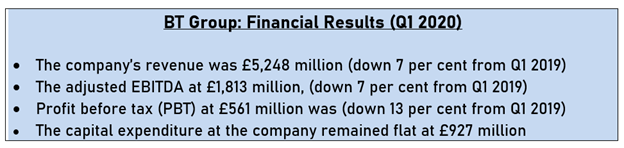
On 24 September 2020, BT confirmed its intention of filing Form 15F with the US Securities and Exchange Commission (SEC) for deregistering its entire registered equity securities. The UK telecom company had made an announcement in this regard during August 2019. On 30 September 2020, at 12.36 PM, BT’s stock (LON: BT.A) was trading at £97.82 down 0.04 per cent from its previous day’s close of £97.86.
US-China War on technology and Huawei
Over the past 10 years, Huawei has been on the radars of the US government as the Chinese telecom giant was considered a danger to privacy and national security. In August 2020, the Trump administration banned Huawei’s access to US-designed chips, which was considered as another major action in the US-China war on technology. This would affect Huawei’s sale of smartphones and telecommunication equipment.
In 2018, the US requested Canada to arrest Huawei’s Chief Financial Officer Meng Wanzhou and Huawei founder’s daughter Ren Zhengfei. The arrests were made for allegedly breaching sanctions against Iran. The US government restricted Huawei from laying down 5G networks in its country.
It is believed that the US campaigned to stop countries like the UK, Japan, Germany, India, Australia, Canada and others to restrict Huawei from building their 5G networks. The US noted that Huawei is a Chinese state-controlled firm and by allowing it in next-generation wireless telecommunication networks could be a potential foolishness. Australia and Japan had also restricted the Chinese firm from entering their 5G networks. Some countries viewed that the possible threats of allowing Huawei could be reduced by allowing its equipment in the periphery network but restricting them in core networks.
Huawei’s products are cheaper as compared to other key suppliers, including Nokia and Ericsson. Huawei was already a part of several countries’ 4G network and a complete ban would incur massive replacement cost. It would also delay the rollout of 5G services. If these countries allowed Huawei for their wireless networks, they risked losing their status as US security partners and by banning Huawei, there could be a risk of losing access to the China market.
To start with Britain limited Huawei’s participation in its 5G networks and then in July 2020, the UK government blocked Chinese tech companies from its 5G networks. The European Union asked its member nations to limit the participation of high-risk vendors like Huawei in their telecom networks, but did not recommend a ban on the Chinese company. India reversed its previous decision to allow Huawei to participate in 5G trials.
As the US and China did not finalise a trade deal as agreed in 2018, in May 2019, the US re-imposed suspended duties, besides banning the US tech giants such as Qualcomm, Google, and Micron from selling chips and software to Huawei. It is known that the Chinese companies were dependent on US-designed chips. As the US chip manufacturers earned their profit by selling to Huawei and others, they found a legal way of supplying their products to the Chinese tech firms.
Finally, the ban on Huawei would definitely be a big gain and opportunity for competitor companies like Nokia and Ericsson as the trend in the telecom sector suggests a growing demand for 5G network in the next few years. The Chinese government is supporting its companies to become self-reliant as the US has restricted its tech players to supply chips to China. The war between the US and China is expected to cost several countries as it would mean more investment to buy equipment from costlier suppliers and also a delay in rolling out of the 5G network around the world.
