
 AUS
AUS
 NZ
NZ
 UK
UK
 CA
CA
 USA
USA
 IND
IND

.jpg)




Highlights
- UK September CPI slowed to 3.1 per cent, from 3.2 per cent in August, despite rising fuel and other prices.
- The slight drop was due to the effect of UK’s Eat out to Help Out (EOHO) scheme falling out of the calculation for the month.
- Analysts expect inflation to rise again in October due to soaring gas and electricity prices
The UK’s consumer price index inflation for the month of September slowed to 3.1 per cent, despite facing rising petrol and transport prices amid a supply chain crisis, according to data from the Office for National Statistics (ONS). August’s inflation reading was 3.2 per cent, as per ONS data.
The number, despite a modest decline, is still much higher than the Bank of England’s target of having a 2 per cent inflation rate.
The head of prices at ONS, Mike Hardie, said September’s reading eased slightly due to the loosening effect from 2020’s Eat out to Help Out (EOHO) scheme, which had raised August’s inflation reading up.
However, the effect from the unwinding of the EOHO programme was partly offset by rising household goods and other prices, and also from food prices easing at a slower pace than September 2020.
Petrol prices surged, touching near eight-year highs in the previous month amid an acute lorry driver shortage. September’s average petrol prices were at 134.9 pence per litre, while it was 113.3 pence per litre in September 2020.
Moreover, furniture and furnishing in the household goods sector rose by 3.8 per cent from September 2020.
Despite the lower September inflation reading, analysts estimate it is a temporary easing as October is expected to face inflation pressure from soaring energy prices and as UK’s energy regulator, Ofgem lifted the price cap on household energy bills.
The BoE had said in September that it expects inflation to rise as much as 4 per cent before lowering again as the economy recovers from the pandemic.
In view of this, let us take a look at 2 FTSE 100 index listed stocks focused on the petrol and household goods sector and their latest developments:
- Unilever PLC (LON: ULVR)
Unilever is a UK based multinational consumer and household goods company.
The group, along with Swedish furniture major IKEA, US-based e-commerce giant Amazon and others jointly became the first signatories on Tuesday, in a net-zero carbon shipping policy. The policy was facilitated by Cargo Owners for Zero-Emission Vessels, a new cargo owner led initiative.
The agreement pledges that signatories will shift their ocean freight vessels to net-zero carbon-emitting fuels by 2040.
(Image source: EODHD/Others)
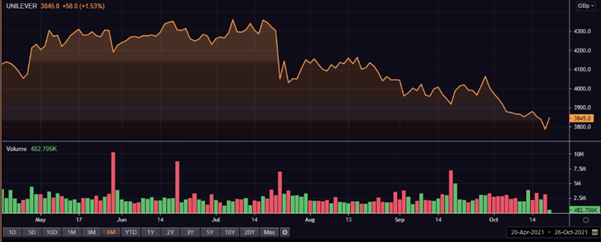
Unilever’s shares were trading at GBX 3,839.00, up by 1.37 per cent on 20 October 21 at 10:45 AM BST. Meanwhile, FTSE 100 index was trading at 7,209.61, down by 0.11 per cent.
The company’s market cap stands at £97,624.74 million as of 20 October.
- BP PLC (LON: BP)
BP is a British multinational oil and gas major and one of the largest forecourt operators in the UK.
BP owned solar energy company Lightsource BP, said today that it had secured 9 solar projects based in Poland.
The projects are part of a 757 MW co-development deal. It will require Lightsource to make a total capital expenditure of EUR 50 million for the entire project.
Roughly 50 per cent of the project is expected to be ready for construction in the next year. BP has a 50 per cent stake in Lightsource BP.
(Image source: EODHD/Others)
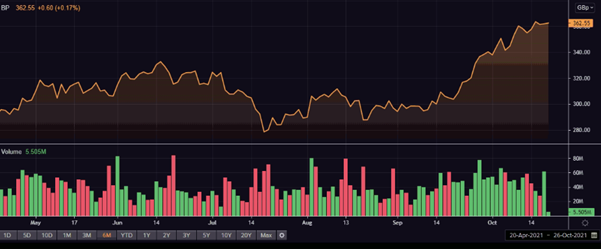
BP’s shares were trading at GBX 362.80, up by 0.24 per cent on 20 October 21 at 10:45 AM BST.
The company’s market cap stands at £72,298.85 million, and its one-year return stands at 74.63 per cent as of 20 October.
