
 AUS
AUS
 NZ
NZ
 UK
UK
 CA
CA
 USA
USA
 IND
IND




_06_16_2026_06_12_08_773360.jpg)


Background of the UK Pharma and Biotech sector
From the investment perspective, Pharmaceuticals and Biotechnology industry have traditionally been a stable industry as compared to some of the other sectors such as Banking, Retail or Oil and Gas. This is primarily due to the fact that the demand for the products stays stable, while the major cost base (which is the research and development conducted), rises only marginally. While another factor is that this industry is not as much affected by the macroeconomic and political factors, as some of the other sectors. 2019 was mostly a flat year for the UKâs Pharmaceutical and Biotechnology industry, as even though the uncertainty in the market saw a fall of a lot of major players from the other sectors, Pharma and Biotech remained stable in terms of demand and sales, as well as the emergence of new players in the market. Though, the dominating subject throughout the year remained mega-mergers and acquisitions activities. On the global terms, the highlight of the list was the US $74 billion purchase of Celgene by Bristol-Myers Squibb which was announced in the month of January 2019 and which after a long period of negotiations, was completed in the month of November 2019. Even the Brexit deal and missed deadlines did not had much of an impact on the industry during the year.
The UK pharma and Biotech players support a Brexit deal that can lead to reductions in supply disturbances if (or when) the United Kingdom were to exit from the European Union without a deal, or even in the case of a hard deal. Out of the 12,300 drugs and medicines that are consumed or find their usage in the UK, the administrationâs estimates suggest that around 7,000 of drugs come from or via the European Union and the vast majority come in to the UK via the short Channel crossings, which happen to be between the English Channel and Continental Europe. Also, around fifty per cent of all supplies used in cases of clinical as well as phase three trials come from or via the EU, and 25 per cent of the total arrive in the UK by the passage of the short Channel crossings.
Another buzz during the year for this space was that it still was an attractive possibility for both private as well as public investors, who deployed a lot of their capital into this industry, especially at the start of the year.
What to expect from the Pharma and Biotech space in 2020?
Pharmaceuticals and Biotechnology space is to set to have a very important time in the year 2020, if the industry experts are to be believed. The growth in the segment is likely to be driven by technology and innovation, both in the presentation of new drugs and treatments to the society, as well as in terms of the biotech technology and overall availability of healthcare. The first change is expected to come from the data revolution, and Big Data will play a huge factor. Big Data Analytics, in partnership with Machine Learning and Artificial Intelligence, will allow the advent of more progressive technologies such as robotics to take over patient care as well and will have a major impact on the research and development side of things. A lot of big drug companies have already come up with robotic products which are helping create a better care environment for patients. Mergers and Acquisitions will still be a relevant theme coming to the fag end of the year, as a lot of individual investors as well Private Equity firms are entering the race and will hold the key to this sector.
Another big factor, worth watching in 2020 in this space is expected to be the regulatory developments. Pharmaceuticals are one of the most regulated products in markets across the world, especially in terms of its trades across the border. With United Kingdom set to exit the European Union, regulation will play a very important role in setting trade practices within as well as outside the country. Technology could play a major role within the regulatory arena as well, as the authorities would be looking to obtain the software, that could standardise and regulate the flow of trade of drugs.
While discussing drugs, we should not forget Cannabis, which would certainly play a bigger role as compared to what it has played in the past, within this sector. As the legalisation of the substance across some of the major countries have put pressure on the UK government to take a more progressive approach towards this. A potential approach that the UK could take in terms of the deregulation of Cannabis could be the same as what Germany did three years ago. There, the process of legalisation and deregulation was gradual and measured, but prescription of CBD based products became a norm by the end of 2018. In April 2019, the first two licences to grow medicinal cannabis in Germany were allowed due to a significant increase in the demand. This approach could also be profitable for the UK cannabis industry, as the demand is growing almost in a similar fashion to Germany. In the current scenario, cannabis plants can be grown in the United Kingdom by obtaining a license from the UK home office, but this is only for the purpose of growing Industrial Hemp, which contains very low levels of THC, which is the Psychotic component in the derivates of Cannabis, but with deregulation appearing to be closer, this could change the production of Cannabis and its derivatives could see expansion in the country.
Considering the above scenario, the following companies AstraZeneca Plc, 4D Pharma Plc, Allergy Therapeutics Plc and Mereo BioPharma Group Plc are likely to play a major role in shaping the industry in 2020. Here is the recent stock price performance from them:
AstraZeneca Plc (LON:AZN) Share Price Performance
On 21st January 2020, at around 01:40 P.M (Greenwich Mean Time), at the time when this report was being written, AstraZeneca Plcâs share price was reportedly at GBX 7698.00 per share on the London Stock Exchange market, a drop in the price of 1.77 per cent or GBX 139.00 per share, as opposed to the last trading dayâs closing price, that was reportedly at GBX 7837.00 per share.
The market capitalisation of AstraZeneca Plc was reported to be at £102.832 billion with regards, to the price at which the companyâs share was trading at the time of writing. The companyâs stock beta was reported at a value of 0.78.
4D Pharma Plc (LON:DDDD) Share Price Performance
On 21st January 2020, at around 01:45 P.M (Greenwich Mean Time), at the time when this report was being written, 4D Pharma Plcâs share price was reportedly at GBX 99.50 per share on the London Stock Exchange market, a fall in the price of 0.50 per cent or GBX 0.50 per share, as opposed to the last trading dayâs closing price, that was reportedly at GBX 100.00 per share.
The market capitalisation of 4D Pharma Plc was reported to be at £65.49 million with regards, to the price at which the companyâs share was trading at the time of writing. The companyâs stock beta was reported at a value of 2.24.
Allergy Therapeutics Plc (LON:AGY) Share Price Performance
On 21st January 2020, at around 01:50 P.M (Greenwich Mean Time), at the time when this report was being written, Allergy Therapeutics Plcâs share price was reportedly at GBX 11.35 per share on the London Stock Exchange market, a jump in the price of 3.18 per cent or GBX 0.35 per share, as opposed to the last trading dayâs closing price, that was reportedly at GBX 11.00 per share.
The market capitalisation of Allergy Therapeutics Plc was reported to be at £69.98 million with regards, to the price at which the companyâs share was trading at the time of writing. The companyâs stock beta was reported at a value of 0.85.
Mereo BioPharma Group Plc (LON:MPH) Share Price Performance
On 21st January 2020, at around 01:55 P.M (Greenwich Mean Time), at the time when this report was being written, Mereo BioPharma Group Plcâs share price was reportedly at GBX 31.50 per share on the London Stock Exchange market, a fall in the price of 3.08 per cent or GBX 1.00 per share, as opposed to the last trading dayâs closing price, that was reportedly at GBX 32.50 per share.
The market capitalisation of Mereo BioPharma Group Plc was reported to be at £31.84 million with regards, to the price at which the companyâs share was trading at the time of writing. The companyâs stock beta was reported at a value of -0.24.
Comparative share price chart of AZN, DDDD, AGY and MPH
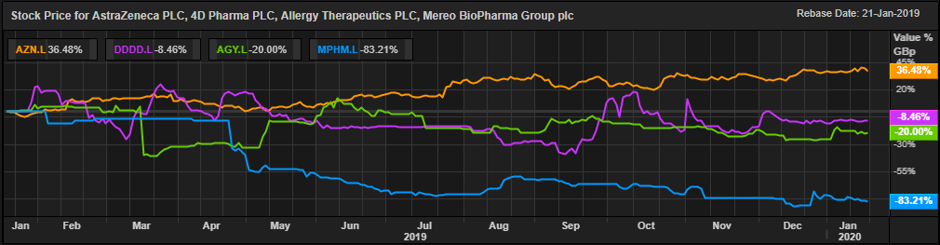
(Source: Thomson Reuters) Daily Chart as on 21-January-20, before the closing of the LSE Market
