
 AUS
AUS
 NZ
NZ
 UK
UK
 CA
CA
 USA
USA
 IND
IND






Summary
- The output of the British car companies was down by nearly 350,000 units to 51,039 cars in August 2020
- The demand for new cars has declined sharply due to the impact of Covid-19 pandemic
- The British car industry needs to brace up for another barrier in the recovery process, the Brexit
The suffering seems to continue unabated for the Automobile sector due to the Covid-19 pandemic, pushing the industry southwards as British car production fell by an annual 44.6 per cent in August, according to the latest release by an industry body SMMT (Society of Motor Manufacturers and Traders)
According to the SMMT, the output of the British factories was down by nearly 350,000 units to 51,039 cars in the month of August compared to the same period last year (August 2019).
With a sudden spike in the number of coronavirus cases, the businesses in this sector are anticipating a second wave of the novel coronavirus and are bracing themselves with tighter social and business restrictions, making a recovery in the sector a bit more challenging.
Most of the companies have witnessed encouraging trading results in June and July and have carried over their momentum in August, but the sustainability of the economic recovery would be the key to resurrect the battered sector.
Declining demand for cars
The end of this deadly virus spread still seems a bit distant and has squeezed a lot of money from the pockets of the people. Therefore, people are refraining themselves from making superfluous expenses and are now prepared to live and work from within their homes. This has led to a fall in demand for new cars.
Moreover, the world has been moving towards cleaner fuel types, and the pandemic has accelerated these plans. Britain has been a leader in manufacturing diesel powered models and exporting them to the world. Diesel vehicles are being discouraged across the globe due to stringent emission norms in place.
Also, the British car industry needs to brace up for another barrier in the recovery process, the Brexit. The Automobile industry has evolved through decades and is closely linked with other European nations for technology sharing and spare parts. A no-deal Brexit could not only disrupt the supply chain but also lead to additional tariffs being imposed on imported parts that can push the cost of the cars higher and can burn a bigger hole in the pocket of consumers. Therefore, the industry is pushing for a free trade agreement that should be implemented post-Brexit to avoid any further shockwaves and boost investor’s sentiment in the battered sector.
Also read: Automobile Manufacturing Sector Facing Challenges Amid Brexit Uncertainties
Let us put our lens through some Automobile stocks to understand how they are withstanding the plunge in demand for cars.
Lookers Plc
UK’s leading motor retail and aftersales service group, Lookers Plc (LON:LOOK) started to see some healthy signs of recovery in vehicle sales since the easing of lockdowns after a very challenging period during the crisis.
The company witnessed improved trading in both of its segments (vehicle sales and aftersales) during June and July. This can be attributed to the release of pent up demand during the lockdown coupled with commuters looking forward to safer commuting options rather than using public transport. It has helped the company to generate good revenue. With a substantial amount of increase in its new vehicle orders, the company has carried the momentum into August.
Although the recent trading performance looks encouraging, however, the sustainability of this recovery appears to be a bit gloomy, given the uncertainties with respect to Brexit and second wave of Covid-19 pandemic, which can severely impact the supply chain, and demand of the cars in the near term.
Due to extended lockdowns in Northern Ireland and Scotland, the Group expects to report revenue of approximately £1.6 billion during the first half of 2020 (2019: £2.6 billion). The Group has also been experiencing margin pressures in both new and used vehicle segments.
The Group is likely to stick with a prudent approach and aims to ensure liquidity through extensive cost reduction/restructuring plans along with the disposal of surplus property and enhanced working capital/ portfolio management.
Aston Martin Lagonda Global Holdings Plc
Due to the uncertain trading environment caused by the Covid-19 crisis, the British luxury carmaker experiences a significant decline in sales in both retail and wholesale divisions and operating losses worsened. The trading environment remained challenging in many markets, and the pace of consumer recovery is still unpredictable.
Despite the adverse trading conditions, Aston Martin (LON: AML) reopened over 90 per cent of the dealer network and has also been expecting additional cost savings. In June 2020, all dealerships in China were reopened. The capital expenditure for FY2020 is pegged at around £260 million by the luxury carmaker. Furthermore, the recent appointments of new Chief Executive Officer, Tobias Moers (joined on 1 August 2020) and Chief Financial Officer, Ken Gregor (joined on 22 June 2020) shall provide new vision to the company with their extensive automotive experience.
The overall revenue of the company declined significantly by 64 per cent during the first half of the financial year 2020 in the wake of Covid-19 pandemic related disruption that translated into lower volumes from retail sales and wholesales.
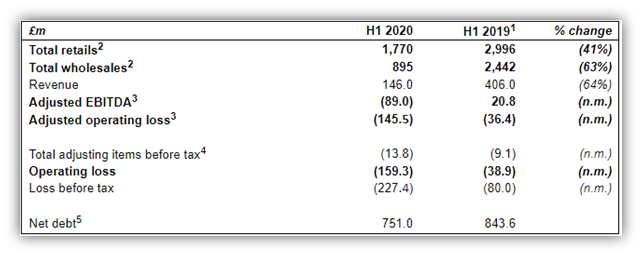
(Source: Company’s filings, LSE)
Due to the fluctuating foreign exchange rates headwinds and declining revenue, operating losses also widened significantly, as compared to the first half of 2019.
The negative free cash flow of £371 million in the first half of 2020 was a result of a working capital outflow of £86 million and weighted capital expenditure of £162 million. As of 30 June 2020, the cash balance stood at £359 million, which included the net proceeds of equity raise with net debt of £751 million.
The Covid-19 pandemic has weighed heavily on the demand and supply of the cars, which widened the operating losses during the first half of 2020.
Industry experts believe that the trading environment is expected to remain a tad challenging during the fiscal year 2020, and the company is unable to predict demand trends until the business starts to operate normally at full capacity. Moreover, a lack of clarity on Brexit related policies from the government might impact the supply chain of the British carmaker.
Also read: There Could Be A €110 Billion ‘No Deal’ Brexit Catastrophe For the EU-UK Carmakers
The Way forward
The industry has braced itself for the second wave of coronavirus and anticipates a challenging trading environment for the remaining part of 2020. The businesses are chalking out plans to reduce costs extensively to boost their finances and therefore improving their chances of survival amid the carnage induced by the pandemic. The global automobile industry is witnessing a similar trend. The UK automobile industry is expecting an ambitious agreement with the EU to withstand the shockwave caused by the novel coronavirus.
