
 AUS
AUS
 NZ
NZ
 UK
UK
 CA
CA
 USA
USA
 IND
IND







Summary
- Most of the key indices of London Stock Exchange have seen a massive wipe-out in October with FTSE 100 closing the month in red
- Stock markets across the world have also witnessed a similar jittery as investors following the uptick of Covid-19 cases are feeling unsettled and uncertain
- On Monday, traders were keen on stock in supermarkets and takeaway businesses, but sold sectors like travel and High Street retail
UK stock markets are back into the focus with the announcement of the second lockdown by the UK government. The FTSE 100 index especially is likely to gain investors’ attention in the coming days of this week. The FTSE 100 has closed October 2020 on a negative footing on the uncertainty around the second nationwide lockdown in the UK.
A bunch of small-to-large scale businesses and industries have been fearing that a further disruption in the business activities can have worse consequences on the regular income of many households and on the national growth.
FTSE 100 in red
Most of the key indices of London Stock Exchange have seen a massive wipe-out in October. FTSE 100 has lost nearly 5 per cent in the last six trading sessions of October steering the index below the level of 5,600.
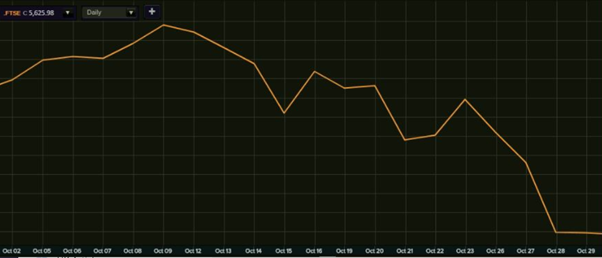
On a wider timeframe, FTSE 100 has lost 5.5 per cent in October 2020 to touch a closing of 5,577.27 from a level of 5.902.12 at the beginning of the month with a 4.83 per cent-drop seen in the last six sessions.
Worldwide uneasiness
Stock markets across the world have also witnessed a similar slump as the investors following the growing Covid-19 cases and feeling unsettled about the upcoming festive season. Most businesses and owners have sought clarity on the government actions for the Christmas and year-ender holiday period in line.
The year-end time is considered to be most prosperous for most retailers, wholesalers, automakers, hospitality and tourism sectors, consumer electricals and other retail consumer-driven businesses.
Of the major stock indices in the world, the New York Stock Exchange-controlled Dow Jones Industrial Average has crashed as much as 6.47 per cent in the last six trading sessions in October breaking the crucial level of 27,000 to 26,501.60 from a level of 28,335.57.
As far as the European stock markets are concerned, France’s CAC 40, Germany’s DAX, Euronext 100 and Euro Stoxx 50 have nosedived between 5-9 per cent in the similar period.
Major concerns for markets
The sudden rise in the coronavirus cases have created major concerns for the stock markets worldwide. Heightened investors’ sentiments due to the US presidential elections, re-imposition of nationwide lockdown in the UK, unemployment, uncertain business activities, shortfall of commerce from the retail section are some of the major hurdles. There is a moderate likelihood of the benchmark FTSE 100 and other sectoral and thematic indices of the UK observing a selling pressure.
A further policy indication from the government’s end with regard to the functioning of businesses and a separate announcement from the Bank of England for quantitative easing are being contemplated.
With the sharp corrections in the major markets, negative investors’ sentiments and uncertain global cues may hit the indices strongly in the near future unless the Boris Johnson government presents a concrete solution for the commercial operations, which can benefit the middle-income group.
