
 AUS
AUS
 NZ
NZ
 UK
UK
 CA
CA
 USA
USA
 IND
IND





Summary
- Hitachi ends business operations in Britain’s horizon project to build a £16 billion nuclear power plant in Wales.
- The scrapping of project would hurt thousands of construction jobs and beat Britain’s aim of becoming a net-zero carbon emission country by 2020.
- The Sizewell C Consortium said the decision by Hitachi would lead to severe implications for companies in Wales and across Britain.
- The decision is likely to impact the involvement of China in Britain’s nuclear power sector.
- The GMB union said that Hitachi’s decision is a result of failure from successive governments to take decisive actions on funding nuclear projects.
The Tokyo-based multinational company, Hitachi, Ltd. announced on 16 September 2020 to end business operations in Britain’s Horizon Project that was suspended in January 2019. The Japanese conglomerate said that the investment scenario became increasingly severe due to the impact of the coronavirus-led crisis. The end of plans to build a new nuclear power station on Anglesey, off the coast of north Wales would hurt thousands of construction and other jobs. In addition, it would hammer Britain’s aim of becoming a net-zero carbon emission country by 2020.
The Horizon Project is a proposal by Horizon Nuclear Power Limited, a UK company that Hitachi bought in November 2012, to develop nuclear power stations consisting of two units of UK Advanced Boiling Water Reactor (ABWR) at Wylfa Newydd in Anglesey, North-West Wales. The aim was to develop Hitachi's nuclear business in Britain by contributing to the energy policy of the British government. The intention was also to maintain business foundation that supported nuclear industry in Japan. The Japanese company would coordinate with the British government on its collaboration as the owner of ABWR licence and to manage the planned construction sites going forward.
Hitachi had deferred work on the Wylfa Newydd project near an existing decommissioned power plant as the company was not able to secure a funding deal with the British government. However, Hitachi had continued the planning process. The company decided to shelve the project, given the company’s economic rationality as a private enterprise as it became clear that more time was required to decide on a financing model for the project and the conditions to build and operate the nuclear power stations.
It is to be informed that in June 2020, Hitachi expressed hope to get financial support from the government for the project. The Horizon Project could have powered around five million homes.
Horizon Nuclear is a British energy company that works to develop a new generation of nuclear power station. It is a wholly-owned subsidiary of Hitachi, Ltd. In early August 2020, Horizon Nuclear informed that the company had received a go ahead by the Isle of Anglesey County Council’s planning committee to widen and resurface the road network around the proposed new nuclear power station on Anglesey. This would assist in potential remobilisation of the project.
The company also informed that though in 2019 the activity on the Wylfa Newydd project was suspended but it has maintained the option to resume and thus kept the required permit activities live. The British government was reviewing ways to fund new nuclear power stations and a move towards it could restart the Wylfa project.
Horizon Nuclear stated that the Wylfa Newydd is based on a reactor type that was built on time, incurring four times budget already. The nuclear project could provide a decreased cost of electricity as compared to the first British power station for a generation that is under construction in Somerset. The company highlighted that the Wylfa project would create thousands of high quality jobs in the region as well as across the UK, besides producing sufficient zero carbon electricity to power the whole of Wales.
Also read: Will Higher Energy Bills During Winters Support Electricity Suppliers?
Also read: Two Energy Stocks Trending on LSE – Egdon Resources PLC & Petroneft Resources PLC
Impact on other nuclear projects
A group consisting of around 100 entities such as unions and other businesses in the nuclear segment that supported plans to build a nuclear power station at Sizewell in Suffolk voiced concerns on developments in the Wylfa project.
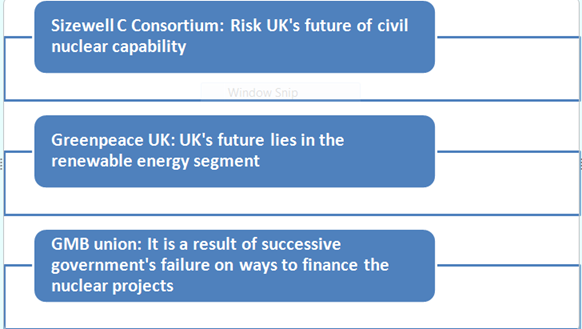
The Sizewell C Consortium commented that the latest developments in the Wylfa nuclear project would lead to severe implications for companies in Wales and across Britain. The consortium highlighted that the project would have served as a next milestone in Britain’s nuclear supply chain, besides creating thousands of jobs. It added that until Sizewell C, which is considered as a replica of the under-construction Hinkley Point C, is provided the nod, there would be substantial risk to the future of Britain’s civil nuclear construction capability in addition to the loss of thousands of jobs.
The latest announcement by Hitachi is likely to bring worries on the involvement of China in Britain’s nuclear power sector. The China General Nuclear Power Group, a company from China that manages and operates nuclear power stations, owns a 33 per cent interest in the Hinkley Point in Somerset, UK’s other major new nuclear power plant under construction. It is to be recalled that around a couple of years ago, Toshiba, another Japanese multinational company from Tokyo, Japan, abandoned plans to build a new nuclear power station at Moorside in Cumbria. The UK has been putting efforts to attract foreign investors to invest in massive upfront costs and risks of building new reactors.
Some key comments
Views from Greenpeace
Commenting on the matter, Greenpeace UK stated that the increasing cost of nuclear power has surpassed the reducing costs of renewable energy years ago. At present, new reactor supplies electricity at more than twice the price of a new offshore wind farms, stressed the environmental organisation. Greenpeace observed that supporting the industry was tough and expensive for the governments that hoped for a nuclear renaissance. Greenpeace is an international environmental organisation with more than 50 offices across the world.
Stressing on the fact that Britain’s future was in the renewable energy segment, Greenpeace hoped that the British government would consider Hitachi‘s decision to scrap the Wylfa project as an affirmation of what the energy market was trying to convey for long. Greenpeace is an independent organisation funded by ordinary people and works on the issues related to destruction of natural world.
Views of the GMB union
Portraying the disintegration of the Wylfa nuclear power station in Anglesey as quite predictable the GMB Union said on 15 September 2020 that reports from the Asian country, Japan, meant that Hitachi, who was financing the build have pulled out of the project. GMB is a trade union in the UK with close to 0.6 million members from almost all the sectors of the national economy.
GMB mentioned that Britain needs at least six new nuclear power stations to suffice the country’s energy demands of future as well as achieve the goals of green energy. The GMB union has more than 620,000 members who work in various types of jobs across public and private companies.
Justin Bowden, national secretary of GMB union, commented that the predictable announcement from Hitachi is a result of failure from successive governments to take strong decisions on setting up new nuclear power plants, and specific ways to finance them. Bowden stressed that new nuclear energy is crucial to attain decarbonisation, especially when combined with hydrogen. It is not by accident and without exception that across the world such projects are generally financed by the governments as they are the lenders in a last option.
Conclusion
The latest decision by Hitachi to end its operations in the UK to build £16 billion nuclear project in Wales has come a major blow to the prospects of creations of thousands of jobs as well the UK’s goals of becoming a net-zero carbon emission country by 2020. The economic impact of the coronavirus pandemic triggered the Japanese multinational entity to end its operations at Wylfa project that was suspended at the start of 2019. Hitachi could not secure UK government funding to resume work. With earlier instances of abandonment of similar arrangements on nuclear energy projects, it remains to be seen how the existing projects would come up in coming times, especially in light of the coronavirus-led crisis. Many industry insiders viewed nuclear power stations as crucial projects for the economic growth of the region where they are based, besides securing power supplies and achieving the target of net zero climate damaging emissions by 2050. Experts also believed that going forward renewable energy sources would play a key role in securing the required energy in the UK.
