
 AUS
AUS
 NZ
NZ
 UK
UK
 CA
CA
 USA
USA
 IND
IND






Summary
- ACCC has alleged that Facebook's free VPN app misled Australians by using their data for commercial purposes.
- The app had claimed to keep the data protected.
- Though Facebook discontinued the app back in 2019, ACCC has sought a penalty for misusing consumers’ data.
The Australian Competition and Consumer Commission (ACCC) has sued Facebook for collecting user data without their permission and knowledge.
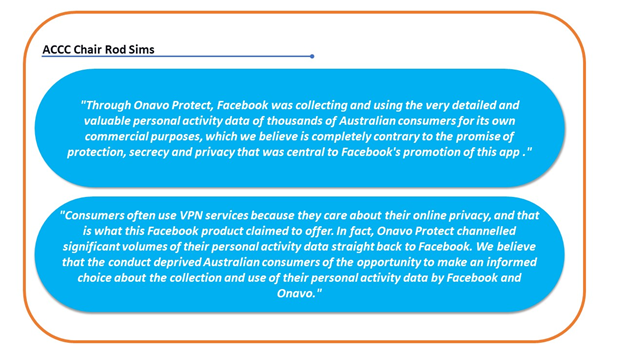
The competition regulator found a mismatch between how Facebook promoted its Onavo Protect app and how it was secretly using user data for commercial purposes, despite claiming to protect the same.
As per the Australian watchdog, the data was not protected with the free app that provided a virtual private network (VPN) service to consumers.
Data Source: ACCC Release, 16 December 2020
The world’s biggest social media network Facebook bought this app in 2013 at a price of AUD 158.7 million. On 6 May 2019, the company discontinued the Onavo Protect app.
Also read: In a first, Australia to make Facebook, Google pay for news content
ACCC Seeks Penalty
The allegations are serious as data privacy is a massive issue during the digital era, and all governments want to regulate how social media networks are using the data to prevent any misuse.
The ACCC is seeking an unspecified fine from the social media giant for promoting this app as a means for people to preserve their data; however, the app collected, aggregated, and used the data. As per the allegations, Aussies were being tracked through data of the apps they accessed. The time spent on each of the apps was also being recorded.
The Australian government body has claimed that during February 2016 to October 2017, the social media giant and two of its subsidiaries Onavo, Inc. and Facebook Israel Ltd, had declared that the app was protected.
On the app's website, it claimed to "save, measure and protect" the users' data. In Facebook advertisements, it was written, "Keep it secret. Keep it safe… Onavo Protect, from Facebook". However, it is alleged that the company was misleading the Australian consumers with these false claims.
