
 AUS
AUS
 NZ
NZ
 UK
UK
 CA
CA
 USA
USA
 IND
IND






Summary
- Air Canada, the country’s largest airline, has been navigating challenges of unseen proportions as the COVID-19 virus spread worldwide.
- The airline reduced its workforce by over 50 percent, permanently retired 79 aircrafts, indefinitely suspended certain routes and is operating with 92 per cent reduced seat capacity.
- Air Canada stock price lost 64 per cent of its value this year.
- In the second quarter results, the carrier lost 89 per cent of its revenue and posted an operating loss of C$ 1.555 billion.
- The devasting second fiscal quarter numbers have given rise to bankruptcy fears.
Air Canada’s shares have been decimated in the pandemic, the stock prices doffing 64 per cent of its value this year and trading at just a little over C$ 16. Canada’s flag carrier and largest airline has been navigating challenges of unseen proportions as the COVID-19 virus spread worldwide without any regard for borders or human lives.
The airline does not expect its revenues and capacity to reach pre-pandemic levels for at least three years. Under the stark realities of diminished demands and strict federal restrictions for aviation industry due to the virus, the carrier has resorted to a series to harsh measures to optimize performance and financial statements.
The airline trimmed its workforce, letting go of approximately 20,000 employees or over 50 percent of staff in the second fiscal quarter of 2020. Most of the reductions were achieved through early retirements, special leaves and layoffs.
Air Canada also permanently retired 79 aircrafts accounting for 30 percent of Air Canada Rouge and its mainline fleet. It also indefinitely suspended certain routes and reduced seating capacity by 92 per cent.
The moves were aimed at cutting spending and preserving liquidity.
Air Canada’s Pandemic Financials
Here’s a quick snapshot of Air Canada’s financials in the second fiscal quarter of 2020:
- The Canadian carrier lost 89 per cent of its revenue, falling from C$ 4.738 billion in the second quarter of 2019 to C$ 527 million in Q2/FY20.
- Air Canada’s operating loss stood at C$ 1.555 billion in Q2 FY20 as opposed to an operating income of C$ 422 million in Q2 2019.
- Negative EBITDA of C$ 832 million in Q2/FY20 as opposed to EBITDA of C$ 916 million last year same quarter.
- Unrestricted liquidity up to C$ 9.120 billion in Q2/FY20, compared to C$ 7.380 billion in Q4/F19
- “Unencumbered asset pool” stood at approximately C$ 2.5 billion in the end of second quarter. This excludes Aeroplan and Air Canada Vacations value.
- Air Canada reported 96 per cent decline in total passengers carried in Q2/FY20 as compared to the second quarter of 2019.
- Suspending service indefinitely on 30 domestic regional routes
- The carrier closed eight stations at regional Canadian airports.
Air Canada’s Stock Performance
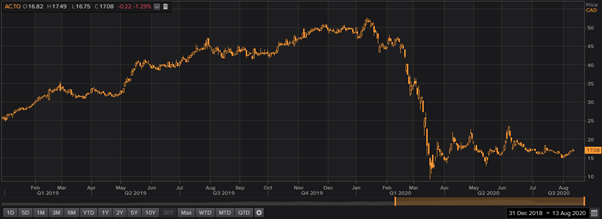
During the COVID stock market crash, Air Canada shares lost nearly 75 per cent by March 20. Since then, the stocks have recovered by 40 per cent, but still trading 64 per cent lower year-to-date. In last one month, the share has lost 4.4 per cent and is currently trading at C$ 16.
Air Canada Stock Price Graph (2019 - 2020)
(Source: Refinitive, Thompson Reuters)
The scrips touched a 52-week high of C$ 52.71 on 14 January and 52-week low of C$ 9.27 on March 18. Its current market cap is C$ 4.9 billion and has a negative earnings-per-share of (EPS) C$ 7.48.
To give a boost to sales and the stocks value, Air Canada relaunched its Aeroplan program this week, allowing members to book seats on any company flight using loyalty points. The revamped plan has several features including no carrier surcharge, sharing loyalty points with friends and family members, etc.
Future of Air Canada
Air Canada had filed for bankruptcy in 2003 during the SARS epidemic and posted net loss of C$ 1.9 billion. After massive restructuring, the air company stock went on to be one of the best performers on the Toronto Stock Exchange in 2019. The share price rose 50 times between 2012 to 2019.
The devasting second fiscal quarter results in 2020 have once again given rise to bankruptcy fears.
As the carrier continues to deal with low air traffic amid strict travel restrictions worldwide and the threat of resurgence in COVID 19 cases, the stock performance is likely to continue to be unpredictable.
The airline has added its voice to numerous other business requesting the federal government to ease blanket travel restrictions and loosen quarantine measures, so that the aviation industry can restart.
While some analysts are wary, others are expecting the stock to return to its former glory after COVID conditions stabilize.
It all boils down to when will the pandemic conditions stabilize.
But for now, the current downturn is likely to last at least this year.
