
 AUS
AUS
 NZ
NZ
 UK
UK
 CA
CA
 USA
USA
 IND
IND







Highlights
- Sona Nanotech has reported preclinical study results evaluating Targeted Hyperthermia™ in combination with immunotherapy.
- Combined therapy resulted in 38% of animals remaining disease-free at the 45-day study endpoint.
- The company has completed a first-in-human study targeting metastatic melanoma patients.
- Eight out of ten patients demonstrated a clinical response in the early feasibility study.
- The company’s CTAB-free gold nanorod technology is designed to address toxicity concerns.
Sona Nanotech Inc. (CSE:SONA, OTCQB:SNANF), a nanotechnology life sciences company, is advancing a photothermal treatment approach that uses heat to target solid tumours, positioning its platform within the evolving landscape of cancer therapies. The company’s work centres on Targeted Hyperthermia™, a therapy that converts light into heat within tumours, with recent study outcomes providing further insight into its potential interactionwith existing immunotherapies.
A Heat-Based Therapy Approach
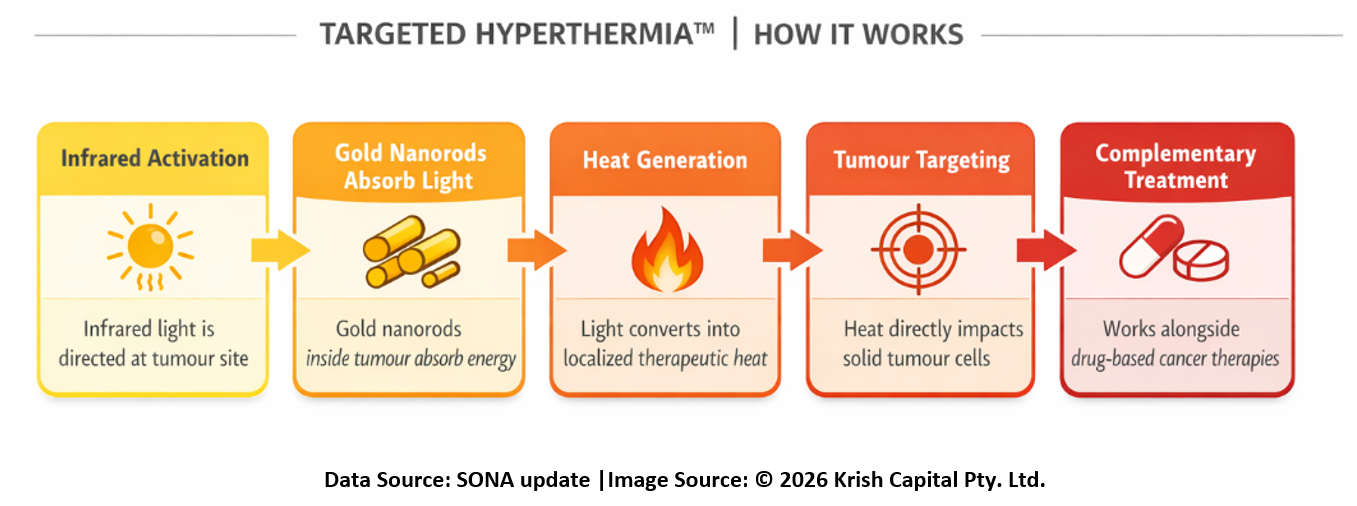
Sona Nanotech’s core technology, Targeted Hyperthermia™, uses infrared light absorbed by gold nanorods to generate heat within tumours. This heat is intended to treat solid cancer tumours while remaining minimally invasive. Unlike conventional drug-based therapies, the approach relies on physical mechanism, positioning it as a potential complement to existing treatment modalities.
Study Explores Combination Strategy
Building on this foundation, the company reported findings from a preclinical study published in the Journal of Nanobiotechnology. The study examined Targeted Hyperthermia Therapy (THT) in combination with PD-1 inhibitor immunotherapy in a colorectal cancer (CT26) tumour model.
In the study, animals received two THT treatments alongside immunotherapy, followed by additional PD-1 treatments, and were monitored over a 45-day period.
At the conclusion of the study, 38% of treated animals were reported to be alive and disease-free. The model used in the study represents an immunologically ‘cold’ tumour type, providing insight into how the therapy may function in settings where immune response is typically limited.
Clinical Study Provides Early Human Data
Extending from preclinical work, Sona Nanotech had earlier completed a first-in-human clinical study focused on patients with immunotherapy-resistant metastatic melanoma. The study involved ten advanced-stage patients who had not responded to standard treatments. Participants received up to four THT treatments across two sessions.
By day 15, eight out of ten patients showed a clinical response, with six of those patients demonstrating no detectable residual melanoma in sampled tumours. Two patients showed no response under the study conditions.
Nanoparticle Platform and Development Path
Supporting these studies is Sona’s proprietary gold nanoparticle platform, which produces CTAB-free gold nanorods. This design removes toxicity risks associated with conventional nanorod technologies, making them more suitable for medical applications.
The company notes that its technology may extend beyond cancer therapy into diagnostic and broader treatment delivery systems, subject to regulatory approvals from agencies such as Health Canada and the US FDA.
Next Steps in Development
The company notes that safety data from its human study, combined with durability results from preclinical studies, will inform the next stage of clinical evaluation. Future trials are expected to explore the combination of Targeted Hyperthermia Therapy with immunotherapy, as the program advances from early feasibility toward broader clinical validation.
Shares of SONA last traded at CAD 0.31 on April 09, 2026.
