
 AUS
AUS
 NZ
NZ
 UK
UK
 CA
CA
 USA
USA
 IND
IND

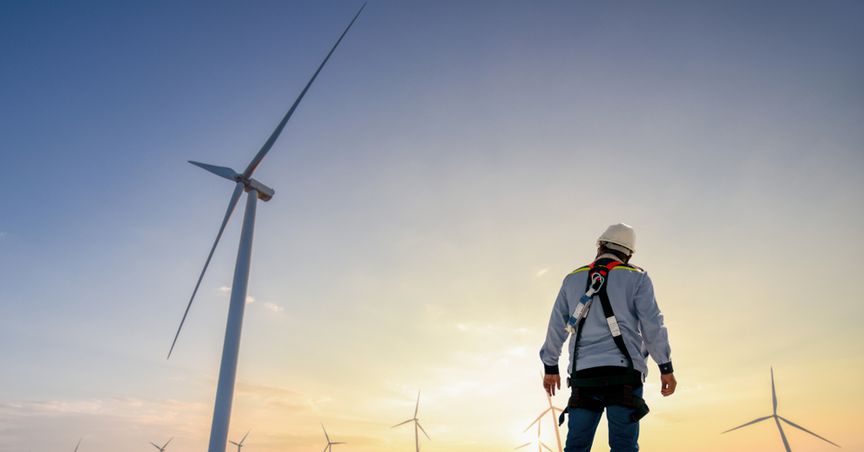





Renewable energy enthusiasts have a reason to cheer. The US administration green lit a large-scale offshore wind project in Massachusetts off Martha’s Vineyard on May 11. The project will have over 60 turbines generating enough electricity to power nearly 4,00,000 homes in the US.
This is a first-of-its kind project on such a large scale. The administration is hopeful of approving more such projects that could see over 3000 turbines being installed in the Atlantic Ocean. It comes on the back of Biden’s goal to achieve 30,000 megawatts of electricity generation in the US from offshore wind projects by 2030. The government is also likely to approve 13 more such projects by 2025 to power millions of homes through offshore wind resources.
We know a lot about offshore wind projects coming up in near future. But what does the ‘offshore’?
Offshore wind projects install turbines in water bodies. While land-based onshore wind farms are quite popular and are increasingly becoming a common sight, offshore wind projects also bring with them huge potential. According to the National Renewable Energy Laboratory, the US has over 2000 gigawatts offshore wind capacity potential, which can lead to generation of over 7000 terawatt-hours every year.
Offshore wind turbines can have blades the size of a football field, which can facilitate optimal use of abundant wind resources available in water bodies.
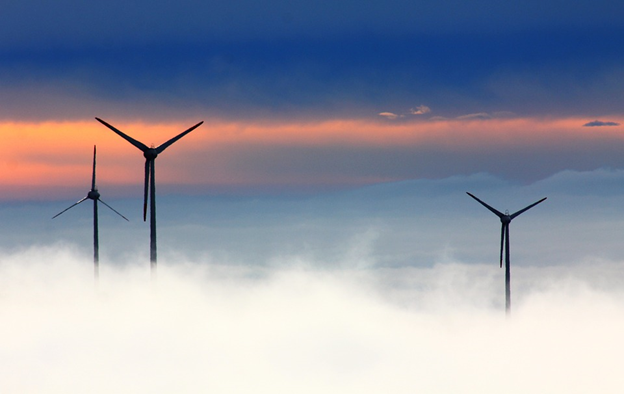
Image: Pixabay
Another major advantage is that while onshore wind projects face logistical bottlenecks in transporting big and heavy turbine components through narrow roads, transportation in offshore projects can be done using ships and barges.
And lastly, offshore winds are stronger during daytime, ensuring stable electricity generation during peak demand hours. In contrast, onshore winds are stronger during the night.
The renewable energy or electricity generated by these offshore wind turbines is transmitted to the grid via cables buried under the sea floor, and subsequently to homes and offices. The Office of Energy Efficiency & Renewable Energy– a US government agency – claims that some companies are working on innovative floating offshore wind platforms that can be installed in deep waters.
The Block Island Wind Farm, located in southeast of Block Island, is the country’s first commercial offshore wind project. This 30-megawatt, five-turbine demonstration project was commissioned in the year 2016.
The latest Martha’s Vineyard offshore wind project in Massachusetts will have the capacity to generate 800 megawatts of electricity. The turbines to be installed as part of this project will be supplied by General Electric, a New York Stock Exchange-listed American conglomerate. The developers are reportedly paying close to US$38 million to compensate commercial fishermen in Massachusetts and Rhode Island, who are set to be adversely impacted by the project.
If all goes well and as planned, the Martha Vineyard offshore wind project will begin producing electricity by 2023. And we are a step closer to achieving our net-zero carbon emission pledge.
