
 AUS
AUS
 NZ
NZ
 UK
UK
 CA
CA
 USA
USA
 IND
IND





_11_13_2025_18_02_02_174695.jpg)

Summary
- Most Canadian banks have been impacted by the pandemic crisis and reported drops in quarterly profits YoY
- The S&P/TSX Banks Index, which nosedived in March, is slowing recovering, signalling renewed investor interest
- Canada’s banking sector is dominated by big six lenders, whose stocks are rebounding after the March lows triggered by the pandemic
- Canada’s largest lenders are in a good position to manage this new normal but revival path cannot yet be predicted as the country braces for a second wave of the coronavirus cases.
Banking shares in Canada appear to be on a slow recovery path, despite most of the big lenders reporting massive drops in quarterly profits due to bad loans, economic slowdown and falling oil prices triggered by the COVID-19 pandemic.
One strong indicator of the recovery is the slow rebound in the S&P/TSX Banks Index. The index, which fell from the average of 3,400 points in mid-February to around 2,200 points in March – the lowest in six years – quickly carved a V-shaped recovery to over 2,900 points in June, signalling renewed investor interest in buying up bank stocks. Individual bank stock prices are rising again, after a massive fall in February and March.
S&P/TSX Banks Index in 2020
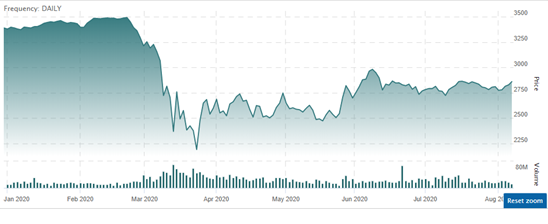
(Source: TMX)
The slow rise in the index comes on the back of how things are going to shape up in the coming months and not what may be happening now – as the economy recovers from the hit and the banks take the load of the recovery.
The country’s central bank – Bank of Canada – left its benchmark interest rate unchanged at 0.25 percent and has been actively buying up Government of Canada bonds to cushion the economic slump.
In a statement before the House of Commons of Canada, the central bank governor Tiff Macklem expressed hope of resumption of economic growth in the third fiscal quarter.
However, ringing the alarm bells, Canada’s federal deficit hit C$343 billion. The economy could also contract by 7.8 percent in 2020, says the central bank. Economic growth will slowly rebound by 5.1 percent in 2021 and 3.7 percent in 2022, it added.
The Big Six
Canada’s banking sector is dominated by big six lenders:
- The Royal Bank of Canada
- Bank of Montreal
- National Bank of Canada
- Toronto Dominion Bank
- Canadian Imperial Bank of Commerce
- Bank of Nova Scotia (Scotiabank)
All of them are expected to stay resilient and flexible despite their increasing bad loans, indebtedness among households and businesses, volatile oil prices, and exposure to the receding domestic real estate market.
The main reasons for this resilience are low net debt, central bank’s liquidity facility to better manage risks and continue providing customers credit, and government guaranteed mortgage insurance.
Canadian banks also increased their loan loss provisions to brace against the economic fallout of the pandemic. The big six banks set aside a record C$ 10.9 billion for bad loans in the second quarter in the face of unprecedented shutdown. The move, in turn, impacted their earnings for the three-month period ending April 30, 2020. Toronto-Dominion set aside C$ 3.22 billion while CIBC earmarked C$ 1.41 billion. The Royal Bank of Canada, Bank of Montreal, and Scotiabank earmarked C$ 2.83 billion, C$ 1.12 billion and C$ 1.85 billion, respectively. Disclosures also show that cumulative energy loans jumped by 23 percent to C$71.6 billion in Q2 as compared to previous fiscal period.
To support self-employed, small and medium-sized businesses, over 669,000 Canada Emergency Business Account (CEBA) loans representing nearly C$ 26 billion have been approved by financial institutions till June 15, according to the Canadian Bankers Association (CBA). Of these, the country’s top banks facilitated C$ 15 billion loans. Thirteen CBA member banks have also deferred mortgage payment for over 736,000 customers as of June 17, representing about 15 percent of the number of mortgages in bank portfolios.
The expected credit losses (ECL) for Canadian banks in Q2 2020 increased on an average by four times compared to Q2 2019, says KPMG. While the loss allowance ratio increased from 0.58 percent to 0.78 percent between 31 October 2019 and 30 April 2020.
Banking Stocks
Stocks of the top Canadian banks have recovered after falling to new lows following a pickup in economic activities.
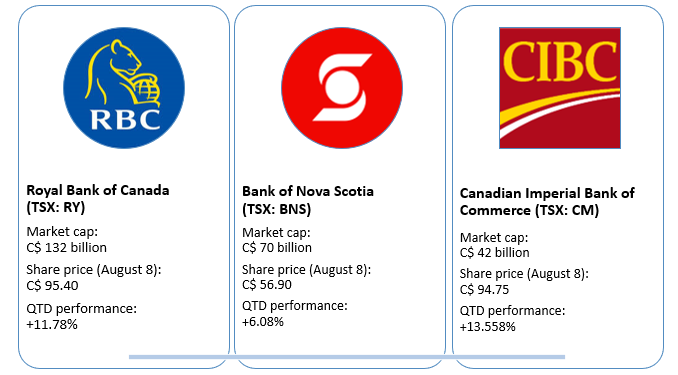
For example, Bank of Nova Scotia (TSX:BNS), the counter’s third-largest bank with current market capitalization of nearly C$ 69 billion, was trading above C$74 in February 2020 before the pandemic hit. The scrip fell to a five-year low of around C$46 in mid-March. The bank share made has made a decent recovery since, gaining over 6 per cent in last three months. Th scrips are currently trading at C$ 56.90.
The Royal Bank of Canada (TSX:RY), counted among the most profitable banks in the world, has a market capitalization of $135 billion. The scrip fell to a three-year low of around C$ 72 in March but bounced back to C$ 96.82 on June 6.
Here’s a look at the top six banks and their share’s performance in the last three months:
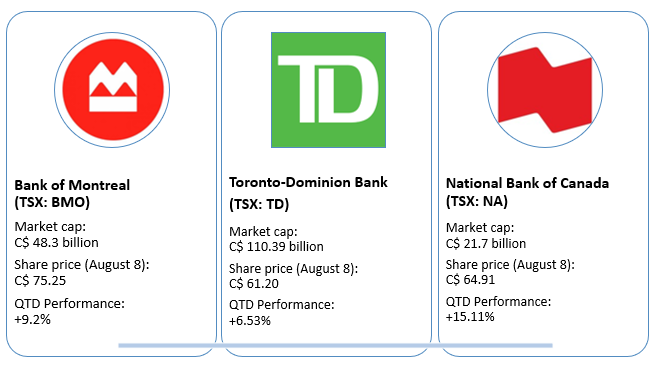
With the exception of the Bank of Nova Scotia (BNS) and National Bank of Canada (NBC), all other top banks have reported lower YoY earnings in the first quarter. However, credit ratings agency Fitch says revenues and earnings of the banks are expected to recover after the equity market stabilizes.
Overall, the Canadian economy and its largest lenders are in a good position to manage this new normal, thanks to low net debt, shock absorption capability, conservative risk management practice and aggressive economic policies.
But the revival path cannot yet be predicted as the country braces for a second wave of the coronavirus cases.
