
 AUS
AUS
 NZ
NZ
 UK
UK
 CA
CA
 USA
USA
 IND
IND








Summary
- The decision to publicly list a company is crucial as it calls for several requirements, structural changes, regulations and, not the least of all, significant costs.
- While the benefits of going public may seem appealing, it comes with a substantial cost.
- About 50 per cent of Canadians invest in purchasing shares of public companies.
It is considered a big milestone for a company to go public, which is basically the process where a privately-owned enterprise transitions into a public one. The traditional way to go about it is by launching an initial public offering (IPO) and listing its securities on the stock market.
This is where the question comes in as to how to go about an IPO. In this article, we will discuss in detail the procedure of launching an IPO in Canada.
Experts believe that the decision to make a private company public is crucial as it calls for several requirements, structural changes, regulations and, not the least of all, significant costs. There are, however, some benefits to it as well.
Benefits Of Going Public
- For starters, public listing can give a company a chance to establish a value for its securities.
- It can amplify a company’s access to opportunities of raising capital.
- It can help expand the company’s investor base.
- It can increase the company’s liquidity for investors as its securities are traded via a public market.
- It can enhance the company’s credibility and visibility before the public, etc.
What Does It Cost To Publicly List A Company?
While the benefits of going public may seem appealing, it comes with a substantial cost. It is difficult to gauge exactly how much the process could cost, but there are a few general expenses.
- Underwriters, which are essentially investment banks, charge a significant commission for their services. Some studies claim that this charge can range anywhere between four to seven per cent of the proceeds of the IPO, while others say it could be roughly five to six per cent of the total issue price.
- Lawyers, accountants and other experts involved in the IPO process charge a fee.
- There are expenses like filing and regulatory fees, a listing fees to pay the stock exchange, a fee that that transfer agent charges, etc.
- Then, there is a cost of marketing, which includes roadshows by the underwriters.
- In Canada, there is also reportedly an added cost of translating prospectus to French if the IPO is being done in Quebec.
How Do You Launch An IPO In Canada?
About 50 per cent of Canadians invest in purchasing shares of public companies, which is one of the many reasons that compel private businesses to go public.
In Canada, a company would have to complete an application for listing and file a prospectus with the Canadian securities regulatory in order launch an IPO. Once the IPO process is initiated, it usually takes at least 12 weeks to wrap up. But the length of the time required can vary from one company to another.
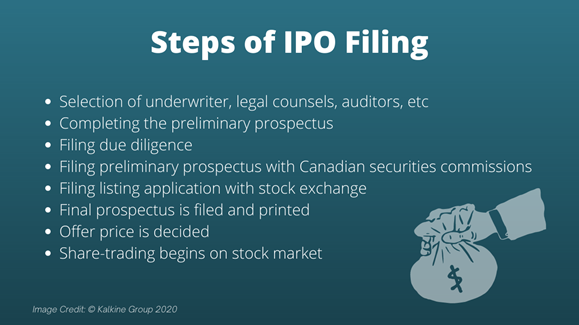
Here are steps of launching an IPO in Canada:
- First and foremost, a company is expected to determine if its plans to go public aligns with its long-term business goals.
- It should also ideally review its financials and see if it needs external financing.
- The company in question selects an investment bank for advice and underwriting services, along with legal counsels, auditors, etc.
- Then comes the crucial part of properly completing the preliminary prospectus. A prospectus is basically a full and detailed disclosure of the issuing company’s business, financials and the securities it is offering.
- Meanwhile, the underwriters will fill a ‘due diligence’ on the company. A due diligence is filed to make sure that the prospectus does consist of any misrepresentations.
- A board meeting is then called to go over the preliminary prospectus.
- Once approved by its board of directors, the company files the preliminary prospectus with Canadian securities commissions and puts out a news release about it.
- While preliminary prospectus is being scrutinized by the securities commission, the company and the undertakers solicit potential investors with presentations, etc. This step is also known as the ‘roadshow’.
- An application is filed with whichever stock exchange the company is listing its issues on.
- The preliminary prospectus is updated with any changes asked by the securities commissions.
- The final prospectus is then filed and printed. The underwriting agreement is also completed.
- The company and the underwriter decide on exactly how many shares would be sold and at what price, a.k.a., the offer price.
- The formalities of signing closing documents, exchanging the securities and proceeds from the issue are completed.
- Finally, the company’s shares start trading on the stock market.
Is Going Public Worth It?
It is a very subjective scenario that varies from one company to another. Getting your company publicly listed, which can be done in ways other than an IPO, comes with its own list of both pros and cons. Ultimately, it is up to the company to weigh in on it and decide based on its needs.
