
 AUS
AUS
 NZ
NZ
 UK
UK
 CA
CA
 USA
USA
 IND
IND






Highlights
- Glenstar Minerals is progressing exploration across Nevada projects targeting high-demand polymetallic systems.
- Wildhorse trenching returned 6 g/t gold and copper mineralisation, supporting ongoing drill momentum.
- Green Monster drilling highlighted geological complexity and shifted focus toward geophysical targeting.
- Nevada hosts some of the world’s most productive gold belts, including Carlin and Cortez.
Across Nevada’s vast mineral belts, decades of mining history intersect with ongoing exploration, shaping a landscape where geological continuity meets modern demand. Known for its established infrastructure and consistent production trends, the region continues to draw attention for its mineral potential. At the same time, critical metals remain central to global industries, supporting clean technologies, energy storage, renewable power systems, electronics, infrastructure, aerospace, defence, and advanced manufacturing. Within this broader context, Glenstar Minerals Inc. (CSE:GSTR), a Vancouver-based mineral exploration company, is progressing exploration across its Wildhorse and Green Monster projects, targeting polymetallic systems linked to these evolving industrial needs.
Nevada: A Strategic Mining Hub
Nevada is recognised for combining mineral-rich geology with a stable regulatory environment. The presence of established gold trends such as Carlin and Cortez reflects the region’s consistent production history. The availability of infrastructure, skilled workforce, and defined permitting processes contributes to continued exploration activity. These factors position Nevada as a location where both historical data and modern exploration methods can be applied to identify mineral potential.
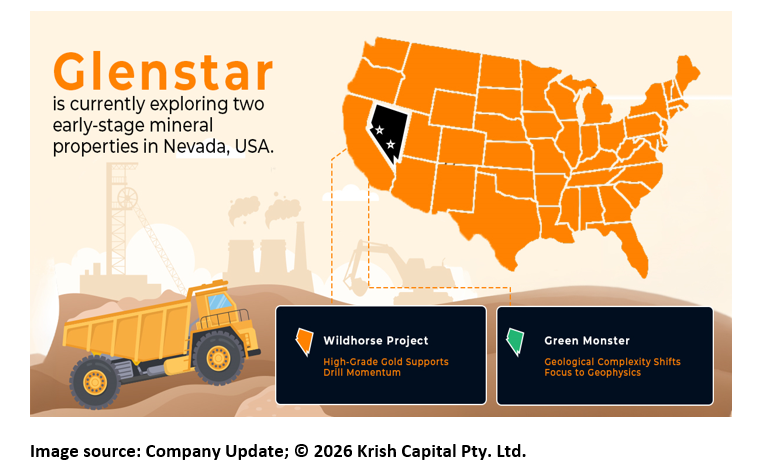
Wildhorse Project: High-Grade Gold Supports Drill Momentum
At the Wildhorse Project, Glenstar is beginning to unlock promising value. Recent trenching assays from the Coca-Cola Zone returned standout results, including a high-grade gold sample of 23.6 g/t, alongside approximately 1% copper, reinforcing the polymetallic potential of the target area.
The results helped shape the company’s Phase 1 reverse circulation drilling campaign, now underway at the project. The Phase 1 program includes six permitted drill sites at the Coca Cola Zone and seven drill sites at the Rattlesnake zone.
What makes this particularly compelling is the emerging multi-system potential:
- Coca-Cola Zone: gold-copper mineralisation
- Rattlesnake Zone: silver, tungsten, antimony, and copper targets.
This diversification not only broadens the exploration potential but also aligns the project with both precious and critical metals demand.. To know more, read here.
Green Monster Project: Geological Complexity Shifts Focus to Geophysics
At the Green Monster Project, Phase 2 drilling encountered multiple polymetallic zones and confirmed mineralisation along trends identified in earlier drilling, although grades were below expectations. Rather than narrowing the opportunity, the results highlighted a structurally complex system requiring further definition.
Glenstar is now advancing a Terean geophysical survey to map faults, alteration zones and structural controls that could influence future drill targeting.
Historical data already indicates the presence of copper, nickel, cobalt and zinc mineralisation, reinforcing the project’s relevance to critical minerals supply chains. The latest work is expected to help refine the geological model ahead of the next exploration phase. More details here.
Glenstar Minerals is advancing exploration across two Nevada projects as it targets polymetallic systems linked to rising critical minerals demand. While Wildhorse has delivered encouraging high-grade gold and copper results, Green Monster is refining structural targets through geophysics, underscoring a dual-track exploration strategy across established mining terrain.
Shares of GSTR last traded at CAD 0.29 on April 23, 2026.
