
 AUS
AUS
 NZ
NZ
 UK
UK
 CA
CA
 USA
USA
 IND
IND



.jpg)



Summary
- Canadian REITs are yet to recover from the setback triggered by the March market crash.
- Some REITs, such as Melcor Real Estate Investment Trust Units (TSX: MR.UN) and H&R Real Estate Investment Trust (TSX: HR.UN), have been drawing attention among investors.
- Both these companies currently pay dividends and are rebounding from their March lows.
Canada’s housing market has picked up pace after its setback amid the COVID-19 pandemic. Real estate stocks, on the other hand, haven’t been doing quite that well. Handful REITs such as Melcor Real Estate Investment Trust Units (TSX: MR.UN) and H&R Real Estate Investment Trust (TSX: HR.UN) are on a rebound, having recovered some of the lost ground.
The S&P/TSX Composite Index, despite its recovery since the coronavirus-triggered market crash, continues to suffer and the laggardly real estate sector has been a contributor to this. The setback in this sector has been majorly caused by the lockdowns triggered by the pandemic. The subsequent social distancing measures, forcing people to stay indoors and shutdown of office spaces further pushed the sector in to an abyss.
The S&P/TSX Capped Real Estate Index, with 27 constituents, is currently down 22.06 per cent year-to-date and in mostly trading flat quarter-to-date.
As the Canadian government slowly eases the lockdown restrictions and people return to their daily routines, it could have a likely impact on the performance of REITs. However, these factors are subject to micro- and macroeconomic conditions.
Real estate companies such as Melcor and H&R are large-cap and dividend-paying stocks. Here is a closer look at these two real estate stocks and why they continue to be in demand among investors:
Melcor Real Estate Investment Trust (TSX: MR.UN)
Current Stock Price: C$ 3.90
Melcor Real Estate Investment Trust Units (REIT) saw its stock price nosedive as low as C$ 2.78 amid the market crash in March. It suffered a nearly 52 per cent year-to-date decline. However, in the last six months, Melcor scrips have slowly recovered, up by about 40 per cent in value.
Based in Alberta, Melcor REIT is into asset management and real estate investment. In the wake of the coronavirus outbreak, Melcor cut its dividend in March. In August, it once again started monthly dividend payout of C$ 0.03. The current dividend yield is 9.23 per cent.
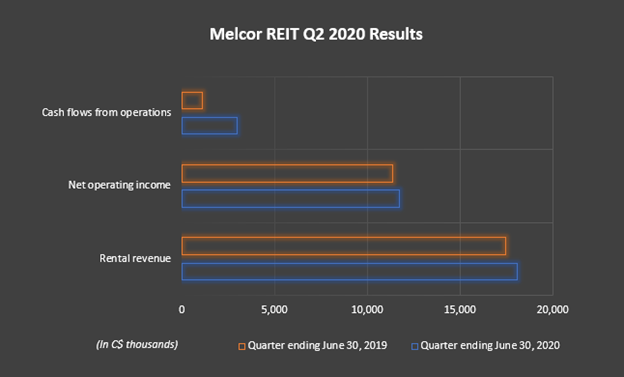
(Data Source: Melcor REIT / Image Credit: Kalkine Group)
Melcor REIT recorded a rental revenue of C$ 18 million in its second quarter ending 30 June 2020, up 4 per cent year-over-year (YoY). Its net operating income amounted to C$ 11.7 million, a three per cent year-over-year increase. Its adjusted cash flow from operations was stood at C$ 4.7 million.
Melcor REIT underwent an external valuation in the second quarter, which identified fair value losses of C$ 57.3 million. Cash flows from operations saw a substantial 165 per cent YoY decline. The company had C$ 3.7 million in cash and C$ 8 million in additional capacity under revolving credit facility as of June 2020.
Melcor REIT currently has a market cap of C$ 50 million. Its price-to-book (P/B) ratio is 0.24, price-to-cash flow (P/CF) ratio is 7.1 and debt-to-equity (D/E) ratio is 2.15, as per TSX data. The company also has a return on equity of 10 per cent.
H&R Real Estate Investment Trust (TSX: HR.UN)
Current Stock Price: C$ 9.97
H&R Real Estate Investment Trust, also known as H&R REIT, also took a massive hit during the coronavirus pandemic-triggered market crash in March. From C$ 21.68 in February, its stock price tumbled to the lows of C$ 7.56 in a month’s time, a substantial 65 per cent decline. It also registered a nearly 53 per cent YTD decline. Since hitting its March lows, H&R REIT’s share value has slightly recovered, but is nowhere close to its pre-pandemic levels. In the last six months, H&R REIT value has climbed by about 10 per cent. Currently, it has a 10-day average trading volume of 1.3 million.
One of the major real estate investment trusts in Canada, H&R REIT is primarily involved in properties across Canada and the US. It has total assets of around C$ 13.3 billion, as of June this year. In the second quarter ending 30 June 2020, H&R REIT’s revenue from investment properties dropped by C$ 9.8 million YoY. The company said that this loss was principally due to lower operating recoveries, which, in turn, was caused by properties being temporarily or permanently shut down due to the COVID-19 outbreak. H&R REIT also incurred a C$ 713 million quarter-over-quarter (QoQ) increase in its total comprehensive loss in Q2 2020. Its cash flows from operations fell by C$ 1.4 million YoY, primarily a result of the provision for bad debts and costs amid the pandemic. By the end of Q2 2020, H&R over C$ 131 million cash in hand.
Despite the pandemic-led crisis, H&R REIT continues to pay a monthly dividend of C$ 0.06. The dividend yield currently stands at 6.92 per cent, as per the TSX data. The C$ 2.8 billion-market cap company has a price-to-book (P/B) ratio of 0.47 and a price-to-cash flow (P/CF) ratio of 7.4.
