
 AUS
AUS
 NZ
NZ
 UK
UK
 CA
CA
 USA
USA
 IND
IND




_06_16_2026_01_38_04_856127.jpg)


Summary
- Zoom fatigue refers to the exhaustive feeling of tiredness after prolonged video conferences.
- A new study from Stanford University found women are 13.8 percent more Zoom fatigue than men.
- Zoom overtook Google and Microsoft video apps during pandemic.
All of a sudden, Zoom Video Communications, Inc. (Nasdaq: ZM) started gathering a lot of attention since the outbreak of COVID-19 last year and became every household name. Everyone in the family, starting from grandparents to children, are aware of this term now. The video conferencing app that got listed last year was initially used for business communications. It has now become a hot new way for people to stay connected while maintaining pandemic restrictions of social distancing.
While Zoom has been capable of overruling Google Hangouts or Microsoft Skype in such a short span of time, its fatigue refers to the exhaustive feeling of tiredness after prolonged video conferences.
Please read: How will Zoom maintain it’s earnings with keen competition on it’s heels?
As per the Stanford Study on Zoom Fatigue
A recent study by Stanford University revealed that women report greater Zoom fatigue than men. An online survey of over 10,000 people reported that 13.8 percent of women experience more Zoom fatigue than men.
The research found that both men and women have the same number of daily meetings. However, the women have longer meetings and shorter breaks in between the meetings.
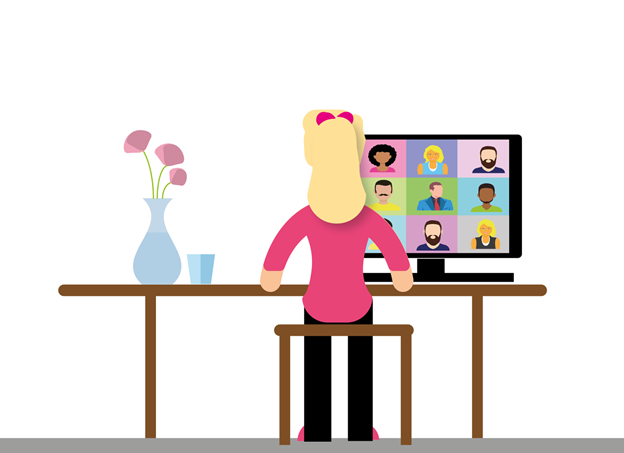
Source: Pixabay
The four main reasons that lead to Zoom Fatigue:
- Mirror anxiety: Self-view in video calls can lead to mirror anxiety. Exposure to mirrors can increase self-focused attention among people. It can lead to negative effects, such as anxiety and depression. The study noted that women could be more prone to mirror anxiety than men as women are more likely to have greater self-focused attention during real-time self-view than men.
- Physical trap: Individuals stay in the field of view of the camera during a video conference. This reduces people’s mobility, which can undermine cognitive performance.
- Hyper gaze: The study notes that being stared at while speaking in a video conference can cause physiological arousal. During video calls, all participants get the direct eye-gaze of one another even if they are not speaking.
- Cognitive load: In video calls, the person has to put more effort to interpret nonverbal cues or gestures, unlike the face-to-face interaction. An attempt to exhibit nonverbal behavior such as head nodding or exaggerating gestures on the screen can raise the cognitive load.
Seeing the current scenario of continuation of work from home and widespread of the second wave of COVID-19, Zoom will not lose its shine. More and more first-time users are downloading Zoom as it's easy and free. Data privacy challenges while using Zoom, which was raised earlier this year and is being worked on. However, in this time of immense growth, people have realised that a free app may come up with a high cost of personal data loss.
