
 AUS
AUS
 NZ
NZ
 UK
UK
 CA
CA
 USA
USA
 IND
IND







Highlights:
- Definition and Importance:
The operating rate measures the percentage of total production capacity currently being utilized by a company, industry, or economy. It is a key indicator of operational efficiency and economic health.- Business and Economic Impact:
A high operating rate signifies strong demand and efficient resource utilization, whereas a low operating rate may indicate underutilization, economic slowdown, or inefficiencies in production.- Strategic Considerations:
Companies and policymakers monitor operating rates to optimize production strategies, manage costs, and forecast economic trends to ensure sustainable growth and competitiveness.
The operating rate is a crucial metric used by businesses and economies to measure the extent to which their production capacity is being utilized. It reflects the efficiency and effectiveness of resource allocation, providing insights into economic activity, industry performance, and business sustainability. An optimal operating rate ensures that resources such as labor, machinery, and raw materials are being used efficiently without overburdening the system.
In this article, we will explore the concept of operating rate, its significance, how it is calculated, factors that influence it, and strategies to optimize it for better business and economic outcomes.
What is the Operating Rate?
The operating rate, often expressed as a percentage, represents the proportion of total available production capacity that is actively being used at a given time. It is commonly applied to businesses, manufacturing industries, and entire economies to assess how efficiently production facilities are operating relative to their full potential.
A company or economy operating at 100% capacity is utilizing all available resources, whereas a lower percentage indicates that there is unused capacity, which may suggest reduced demand, inefficiencies, or operational challenges.
Formula for Calculating Operating Rate:
Operating Rate=(Actual OutputMaximum Potential Output)×100\text{Operating Rate} = \left( \frac{\text{Actual Output}}{\text{Maximum Potential Output}} \right) \times 100Operating Rate=(Maximum Potential OutputActual Output)×100
For example, if a manufacturing plant has the potential to produce 10,000 units per month but is currently producing 8,000 units, its operating rate would be:
(8,00010,000)×100=80%\left( \frac{8,000}{10,000} \right) \times 100 = 80\%(10,0008,000)×100=80%
Significance of Operating Rate
Understanding and tracking the operating rate is vital for businesses and economies for several reasons:
- Measuring Efficiency
The operating rate helps assess whether a company or industry is efficiently utilizing its available resources. A high rate suggests effective use of assets, while a low rate may highlight inefficiencies that need to be addressed.
- Economic Indicator
On a macroeconomic level, the operating rate serves as a reliable indicator of economic health. A high national operating rate suggests robust economic activity, while a declining rate may indicate a slowdown or recession.
- Cost Management
Businesses can use the operating rate to optimize production processes, minimize wastage, and control costs. Operating too far below capacity can result in high fixed costs per unit produced, reducing profitability.
- Capacity Planning
Monitoring the operating rate allows companies to plan for future expansion or contraction. If the operating rate is consistently high, it may indicate the need for investment in additional capacity. Conversely, a low rate may prompt cost-cutting measures.
Factors Affecting Operating Rate
Several factors can influence the operating rate of a business or industry, including:
Market Demand:
- Fluctuations in customer demand directly impact production levels. Increased demand typically leads to higher operating rates, while a decline results in lower utilization.
- Supply Chain Efficiency:
- A well-functioning supply chain ensures the timely delivery of raw materials and components, supporting smooth operations and higher capacity utilization.
- Labor Availability:
- A skilled and adequate workforce is essential for maintaining a high operating rate. Labor shortages or strikes can hinder production capacity.
- Technological Advancements:
- Automation and technology upgrades can improve efficiency, allowing businesses to operate closer to full capacity without increasing costs significantly.
- Economic Conditions:
- Broader economic factors such as inflation, interest rates, and global trade policies can affect production levels and overall capacity utilization.
- Operational Bottlenecks:
- Equipment failures, inefficient processes, and logistical challenges can create bottlenecks that prevent businesses from achieving their full operating potential.
Interpreting Different Operating Rate Levels
Understanding whether an operating rate is too high or too low requires context within an industry or business sector.
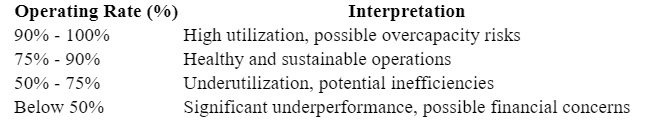
High Operating Rate:
A very high operating rate may indicate strong demand, but it could also suggest potential overcapacity issues that might lead to equipment wear, workforce fatigue, and inefficiencies in the long run.
Low Operating Rate:
A low operating rate often signals excess capacity and underperformance, which may lead to financial strain due to higher per-unit costs and reduced profitability.
Strategies to Optimize Operating Rate
To achieve an optimal operating rate, businesses can adopt several strategies, including:
Demand Forecasting:
- Implementing accurate demand forecasting techniques to align production with market needs and avoid underutilization or overcapacity.
- Process Improvement:
- Streamlining production processes through lean manufacturing techniques and automation to enhance efficiency and capacity utilization.
- Flexible Production Systems:
- Investing in adaptable systems that allow for quick adjustments in production levels based on market fluctuations.
- Cost Reduction Measures:
- Reducing operational costs through better inventory management, energy efficiency, and resource optimization.
- Diversification:
- Expanding into new markets or product lines to increase demand and utilize available production capacity more effectively.
Operating Rate vs. Other Performance Metrics
To gain a comprehensive view of performance, the operating rate is often compared with other financial and operational metrics such as:

Conclusion
The operating rate is a vital performance metric that helps businesses and economies gauge how efficiently they are utilizing their production capabilities. A well-balanced operating rate ensures that resources are being used effectively without unnecessary strain or underutilization.
For businesses, maintaining an optimal operating rate can lead to improved profitability, better cost management, and long-term sustainability. Policymakers and economists also monitor operating rates to understand market conditions and guide economic policies.
By leveraging data-driven insights and strategic planning, businesses can optimize their operating rates and achieve greater efficiency in today's dynamic economic environment.
