
 AUS
AUS
 NZ
NZ
 UK
UK
 CA
CA
 USA
USA
 IND
IND







Highlights
- Definition of Open Depending on the Floor: This term is used in the context of listed equity securities and refers to a scenario where a customer buy or sell order is contingent on the outcome of trades executed on the exchange floor. The order's execution depends on satisfying the specialist's book and the orders already opened.
- Role in Market Execution: Open depending on the floor is crucial for ensuring efficient price discovery and order fulfillment by allowing traders to gauge market conditions before executing large trades.
- Impact on Traders and Investors: This approach helps traders optimize their order execution by leveraging real-time market conditions on the trading floor, ensuring better alignment with supply and demand.
In financial markets, particularly within stock exchanges that facilitate listed equity securities, various trading mechanisms and order types are used to ensure efficient execution. One such mechanism is known as "Open Depending on the Floor." This term refers to an order type where a buy or sell order is placed but remains contingent on the outcome of trades occurring on the exchange floor. The order will only be executed if the specialist book and existing open orders are satisfied.
This trading strategy allows investors and traders to take advantage of market dynamics while ensuring that their orders align with prevailing market conditions. Understanding how "Open Depending on the Floor" works is essential for investors who seek to optimize their trading performance in a highly competitive environment.
How Open Depending on the Floor Works
The concept of "Open Depending on the Floor" primarily applies to specialist-driven trading systems, where human traders on the exchange floor play a crucial role in matching buy and sell orders. When a trader places an order with this condition, it means the execution of the order is subject to the completion of trades already being processed by the floor specialist.
For example, if an investor wishes to buy a certain stock at the market opening, their order may be marked as "open depending on the floor." The execution will occur only if:
The specialist book (list of limit orders) is cleared at the specified price or better.
Existing orders in the market are satisfied, ensuring there are no conflicting orders that could affect price stability.
This method helps prevent price manipulation and ensures fair execution based on market supply and demand.
Key Components of Open Depending on the Floor
Several factors contribute to how this order type functions within the stock market:
- Specialist Book Management
The floor specialist is responsible for maintaining an orderly market and ensuring that pending orders are fulfilled before allowing new orders to impact the stock price. An order marked as open depending on the floor will be executed only after the specialist book's existing orders are settled.
- Price Discovery Mechanism
Orders contingent on floor trades contribute to the price discovery process. If significant demand or supply exists, prices may adjust before the order is executed, helping to align it with market realities.
- Market Contingencies
This order type considers various contingencies, such as high market volatility, price fluctuations, and trading halts, ensuring orders are executed under optimal conditions.
Advantages of Using Open Depending on the Floor Orders
Traders and investors can benefit from using this order type in several ways, especially when dealing with large trades or uncertain market conditions.
- Improved Order Execution
By allowing market conditions to dictate the timing of the trade, traders can achieve better execution prices and avoid unfavorable market conditions.
- Reduced Market Impact
Large trades can significantly affect stock prices if executed abruptly. Open depending on the floor helps minimize the market impact by waiting for favorable conditions.
- Strategic Flexibility
This order type provides traders with strategic flexibility by enabling them to observe floor activity and adjust their approach accordingly.
- Alignment with Institutional Strategies
Institutional investors, who often deal with large orders, prefer this method as it helps them avoid slippage and ensures better market integration.
Challenges and Risks Associated with Open Depending on the Floor
While this order type offers several advantages, it also presents certain challenges and risks that traders must consider.
- Delayed Execution
Since the order is contingent on floor trades, it may not be executed immediately, leading to missed opportunities in fast-moving markets.
- Dependence on Market Liquidity
The success of such orders depends on the availability of counterparties. In illiquid markets, execution might take longer than expected.
- Potential for Partial Fills
If the specialist cannot fulfill the entire order due to market conditions, traders might receive only a partial fill, affecting their trading strategy.
- Reliance on Floor Specialists
As electronic trading systems become more prevalent, reliance on floor specialists for order execution might lead to inefficiencies in rapidly changing markets.
Comparison with Other Order Types
It is important to distinguish open depending on the floor orders from other commonly used order types in stock trading.
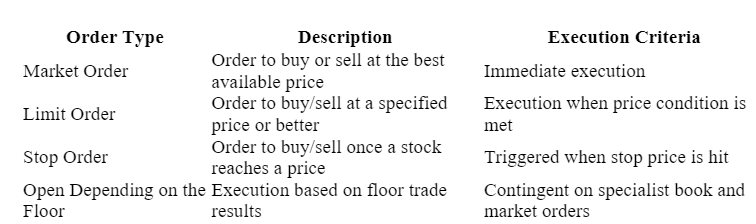
Understanding the differences can help traders choose the right order type based on their goals and market conditions.
When to Use Open Depending on the Floor Orders
This order type is particularly useful in specific market scenarios where:
Pre-market and Opening Sessions: Traders looking to capitalize on opening price volatility may benefit from waiting for floor activity to settle.
High Volatility Periods: In times of uncertainty, waiting for floor confirmation helps in making informed trade decisions.
Large Order Execution: Institutions placing large orders can avoid disrupting the market by utilizing this strategy.
Best Practices for Using Open Depending on the Floor Orders
To maximize the benefits of this order type, traders should consider the following best practices:
- Monitor Market Conditions: Keeping track of market trends, volume, and volatility helps in optimizing order placement.
- Use in Combination with Other Strategies: Pairing this order type with limit orders or stop orders can help manage risk and achieve better execution.
- Work with Experienced Brokers: Brokers with deep market knowledge can provide insights on when and how to use open depending on the floor orders effectively.
Conclusion
The Open Depending on the Floor order type plays a crucial role in equity markets, providing traders with a strategic advantage by allowing their trades to align with market conditions on the exchange floor. It offers benefits such as improved execution prices and reduced market impact while requiring careful consideration of potential delays and liquidity challenges.
By understanding how this order type works and implementing best practices, traders and investors can enhance their trading strategies and achieve better outcomes in dynamic market environments.
