
 AUS
AUS
 NZ
NZ
 UK
UK
 CA
CA
 USA
USA
 IND
IND







Highlihgts:
- Definition of Nasdaq Small-Capitalization Companies – Nasdaq small-cap companies are a group of approximately 2,000 publicly traded firms with relatively low market capitalization, listed separately on the Nasdaq exchange. They must meet specific requirements, including having at least two market makers facilitating trade.
- Characteristics and Importance – These companies typically have market capitalizations ranging from $300 million to $2 billion, representing emerging businesses with high growth potential. They provide investors with opportunities to invest in smaller, innovative firms that may eventually scale into mid- or large-cap entities.
- Risks and Investment Strategies – Small-cap stocks can be volatile and high-risk, but they also offer significant upside potential. Investors often analyze factors like revenue growth, industry trends, and financial stability to identify promising small-cap companies.
Introduction
The Nasdaq Stock Market is home to companies of all sizes, from industry giants like Apple, Microsoft, and Amazon to smaller, fast-growing firms in various industries. Among them, Nasdaq small-capitalization companies (commonly known as Nasdaq Small-Cap stocks) form a unique category, consisting of approximately 2,000 companies with relatively low market capitalization.
These small-cap companies play a critical role in the financial ecosystem, serving as a stepping stone for startups and emerging businesses looking to expand. For investors, Nasdaq small-cap stocks offer a mix of high risk and high reward, making them an attractive yet challenging segment of the stock market.
What Are Nasdaq Small-Capitalization Companies?
Nasdaq small-cap companies are publicly traded firms with market capitalizations ranging from approximately $300 million to $2 billion. These companies are listed separately on Nasdaq and must meet certain listing requirements, including:
- Having at least two market makers to ensure liquidity and smooth trading.
- Meeting minimum financial standards, such as revenue and net income thresholds.
- Maintaining compliance with Nasdaq’s corporate governance rules.
While they may not yet have the financial strength of mid-cap or large-cap companies, many Nasdaq small-cap firms represent innovative startups in technology, healthcare, biotech, and consumer sectors, with strong potential for future growth.
Key Characteristics of Nasdaq Small-Cap Stocks
- Lower Market Capitalization
- Unlike large-cap stocks such as Google (Alphabet) or Tesla, small-cap firms have relatively modest valuations, often between $300 million and $2 billion.
- These companies are in the early growth stages, seeking expansion and profitability.
- Higher Growth Potential
- Many small-cap companies are disruptive startups or niche players in emerging industries.
- Investors are attracted to them due to their ability to outpace larger competitors in growth rates.
- Increased Volatility
- Small-cap stocks tend to experience larger price fluctuations due to lower trading volumes and market sensitivity.
- While they can generate high returns, they also come with higher investment risks.
- Liquidity and Market Makers
- Nasdaq requires each small-cap stock to have at least two market makers, ensuring adequate liquidity.
- Market makers help facilitate buying and selling, reducing price manipulation risks.
- Greater Investment Risk
- Small-cap companies may lack financial stability, making them more vulnerable to economic downturns.
- Investors must conduct thorough research before investing in Nasdaq small-cap stocks.
Why Nasdaq Small-Cap Stocks Matter
Nasdaq small-cap stocks provide significant benefits to both companies and investors:
- A Platform for Emerging Companies
- The Nasdaq small-cap segment allows startups and growing firms to raise capital by going public.
- Many companies start as small-caps before scaling into mid-cap or large-cap businesses.
- Opportunities for High Returns
- Small-cap stocks have historically outperformed large-cap stocks over long-term periods due to their faster revenue and earnings growth.
- Investors who identify early-stage companies with strong fundamentals can achieve substantial gains.
- Innovation and Industry Disruption
- Many small-cap companies are involved in cutting-edge industries, such as artificial intelligence, clean energy, and biotechnology.
- Investing in small-cap stocks allows exposure to next-generation market leaders.
Investment Strategies for Nasdaq Small-Cap Companies
Investing in small-cap stocks requires careful analysis and risk management. Here are some effective strategies:
- Fundamental Analysis
- Evaluate revenue growth, profitability trends, and market positioning.
- Analyze earnings reports, balance sheets, and management efficiency.
- Diversification
- Instead of investing in just one small-cap stock, consider a diversified portfolio to reduce risk.
- Small-cap exchange-traded funds (ETFs) provide diversified exposure to this segment.
- Sector Analysis
- Focus on high-growth industries such as technology, healthcare, and renewable energy.
- Identify companies with disruptive business models and strong competitive advantages.
- Risk Management
- Small-cap stocks can be volatile, so using stop-loss orders helps minimize losses.
- Consider a long-term investment approach to withstand market fluctuations.
- Liquidity Considerations
- Stocks with higher trading volume and more market makers tend to be more stable and easier to buy/sell.
- Avoid highly illiquid small-cap stocks, as they may have extreme price swings.
Challenges and Risks of Investing in Small-Cap Stocks
Despite their growth potential, small-cap stocks come with significant risks:
- Market Volatility
- Small-cap stocks can experience sharp price swings due to limited liquidity and investor speculation.
- Financial Stability Concerns
- Many small-cap firms are unprofitable or in early development stages, making them vulnerable to market downturns.
- Competitive Pressures
- Smaller companies often struggle against larger competitors with more resources.
- Economic Sensitivity
- During economic recessions, small-cap stocks often decline more than large-cap stocks due to weaker financial reserves.
Comparison: Nasdaq Small-Cap vs. Large-Cap Stocks
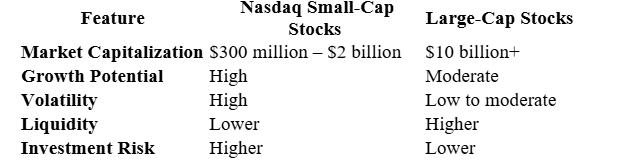
Conclusion
Nasdaq small-capitalization companies represent a dynamic segment of the stock market, offering investors opportunities to invest in early-stage, high-growth businesses. While they come with higher volatility and risk, they also have the potential to deliver substantial returns over time.
Investors interested in small-cap stocks should focus on fundamental analysis, sector trends, and diversification strategies to maximize gains while managing risks. As the market continues to evolve, Nasdaq small-cap stocks will remain a key area for investors looking to capitalize on the next wave of innovative and disruptive companies.
