
 AUS
AUS
 NZ
NZ
 UK
UK
 CA
CA
 USA
USA
 IND
IND







Highlights:
- Definition of NASD Form FR-1 – NASD Form FR-1 is a regulatory document required by the National Association of Securities Dealers (NASD) to ensure that foreign dealers participating in a new securities distribution adhere to U.S. market rules and conduct a bona fide public offering.
- Purpose and Importance – The form helps maintain transparency, fairness, and compliance in securities markets by ensuring that foreign firms engage in legitimate trading practices without market manipulation or unfair advantages.
- Regulatory Impact and Compliance – Foreign dealers must submit Form FR-1 to demonstrate adherence to U.S. securities laws, ensuring investor protection and market integrity while avoiding penalties or regulatory action.
Introduction
The NASD Form FR-1 plays a vital role in regulating the participation of foreign dealers in the U.S. securities market. Required by the National Association of Securities Dealers (NASD)—now part of the Financial Industry Regulatory Authority (FINRA)—this form ensures that firms engaging in the distribution of new securities conduct a bona fide public offering and comply with U.S. financial regulations.
In global finance, where cross-border transactions are common, regulatory measures like Form FR-1 help protect investors, prevent market manipulation, and promote fair trading. This article explores the purpose, requirements, and significance of NASD Form FR-1 in foreign securities offerings.
What Is NASD Form FR-1?
NASD Form FR-1 is a compliance document that foreign securities dealers must submit when participating in the distribution of new securities in the U.S. market. This form ensures that these firms:
- Follow U.S. securities laws and NASD/FINRA regulations.
- Engage in legitimate and fair public offerings.
- Do not manipulate prices or engage in unethical trading practices.
Foreign dealers looking to distribute securities in the United States must complete Form FR-1 to confirm their adherence to market regulations.
The Role of NASD in Securities Regulation
The National Association of Securities Dealers (NASD) was a self-regulatory organization (SRO) responsible for overseeing the securities industry. In 2007, NASD merged with the New York Stock Exchange (NYSE) Regulation to form FINRA, which now oversees securities firms and enforces compliance.
The primary goal of NASD/FINRA is to maintain market integrity by:
- Regulating broker-dealers and securities professionals.
- Preventing fraudulent activities in securities trading.
- Ensuring transparency in new securities offerings.
Form FR-1 was introduced as part of NASD’s regulatory framework to ensure that foreign dealers entering the U.S. market comply with these principles.
Purpose of NASD Form FR-1
Foreign dealers engaging in U.S. securities offerings must complete NASD Form FR-1 to:
Ensure a Bona Fide Public Offering
- A bona fide public offering means that securities are offered fairly and transparently to the public, preventing exclusive sales to select investors or price manipulation.
- Prevent Market Manipulation
- The form ensures that foreign firms do not engage in activities such as price-fixing, insider trading, or deceptive sales tactics.
- Demonstrate Regulatory Compliance
- Filing Form FR-1 proves adherence to U.S. securities laws, ensuring that foreign dealers operate within legal boundaries.
- Protect Investors
- By enforcing compliance, the NASD (now FINRA) safeguards retail and institutional investors from unethical trading practices.
Requirements for Filing NASD Form FR-1
Foreign dealers submitting NASD Form FR-1 must meet specific regulatory requirements, including:
- Disclosure of Firm Information
- The firm must provide details about its business operations, ownership structure, and regulatory status in its home country.
- Certification of Public Offering Compliance
- The dealer must confirm that the securities offering follows U.S. laws and is available to the general public without restrictions.
- Agreement to U.S. Market Rules
- The firm must acknowledge that it will comply with all NASD/FINRA rules while distributing securities in the U.S. market.
- Submission of Financial Records
- Foreign dealers may be required to provide financial disclosures, ensuring that they have the financial stability to operate in U.S. markets.
Failure to submit accurate and complete Form FR-1 can result in regulatory penalties, fines, or denial of market access.
Impact of NASD Form FR-1 on Foreign Dealers
For foreign firms looking to expand their presence in the U.S. securities market, NASD Form FR-1 presents both challenges and opportunities:
- Increased Market Access
- Successfully filing Form FR-1 allows foreign firms to legally participate in U.S. securities offerings, expanding their business opportunities.
- Regulatory Scrutiny
- Foreign dealers must maintain strict compliance with U.S. laws, requiring thorough documentation and adherence to financial regulations.
- Enhanced Market Reputation
- Firms that comply with NASD/FINRA rules gain a positive reputation, making them more attractive to investors and business partners.
- Risk of Non-Compliance
- Failure to meet regulatory standards can result in fines, legal action, or bans from participating in U.S. markets.
Comparison: NASD Form FR-1 vs. Other Regulatory Filings
Foreign dealers engaging in securities trading in the U.S. may also encounter other compliance forms, such as:
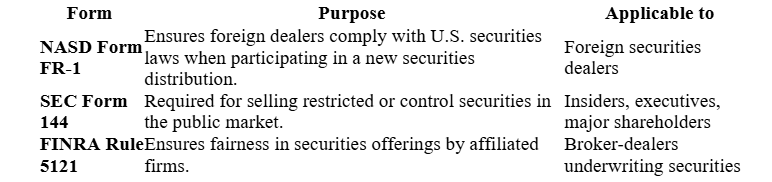
NASD Form FR-1 is specific to foreign dealers, ensuring their compliance in U.S. securities distribution.
Conclusion
NASD Form FR-1 is an essential regulatory document for foreign dealers looking to participate in the U.S. securities market. By ensuring compliance with NASD/FINRA regulations, the form plays a critical role in protecting investors, preventing market manipulation, and promoting fair public offerings.
For foreign firms, completing Form FR-1 ensures legal access to the U.S. financial market, but also requires adherence to strict regulatory standards. As the global securities market continues to evolve, compliance with U.S. laws remains a key factor in maintaining transparency, integrity, and investor confidence in cross-border financial transactions.
