
 AUS
AUS
 NZ
NZ
 UK
UK
 CA
CA
 USA
USA
 IND
IND







Highlights:
- Definition and Importance: Hard dollars refer to actual cash payments made by clients to brokerage firms for services such as research, trade execution, and advisory, distinguishing them from soft dollars, which involve indirect compensation.
- Transparency and Compliance: Hard dollar payments promote transparency and regulatory compliance, as they ensure that services are paid for directly rather than through commission-based arrangements, reducing potential conflicts of interest.
- Impact on Investors and Brokerage Firms: While hard dollar payments enhance cost clarity and accountability, they can also increase upfront costs for investors, making them more selective about the research and services they purchase.
Introduction to Hard Dollars
In financial markets, brokerage firms provide various services to their clients, including trade execution, research reports, market analysis, and investment advisory. These services can be paid for through either hard dollars or soft dollars.
Hard dollars refer to actual, direct cash payments made by investors or institutions for the services they receive from brokerage firms. This payment structure contrasts with soft dollars, where clients compensate brokers indirectly through commissions on trades rather than separate payments.
Hard dollar arrangements ensure clear, upfront pricing, making them a preferred option for firms and investors who prioritize transparency and cost control.
Hard Dollars vs. Soft Dollars: Key Differences
Understanding the distinction between hard dollars and soft dollars is essential in evaluating the financial relationship between investors and brokers.
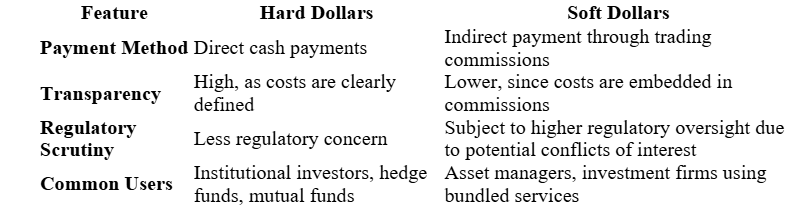
While soft dollar arrangements allow investors to receive brokerage services without upfront costs, they can create conflicts of interest, as brokers may be incentivized to increase trading volume to maximize their commission earnings.
Benefits of Hard Dollar Payments
Choosing a hard dollar payment structure offers several advantages:
- Greater Transparency and Accountability
Since hard dollars involve direct payments, investors know exactly what they are paying for, ensuring transparency in financial transactions.
- Better Cost Management
Hard dollar arrangements allow firms to budget more effectively, as service costs are separate from trading expenses.
- Reduced Conflict of Interest
Unlike soft dollars, which can encourage excessive trading to generate commissions, hard dollars ensure that brokerage services are paid for based on value rather than trading volume.
Challenges of Using Hard Dollars
Despite its benefits, hard dollar payments present certain challenges:
- Higher Upfront Costs
Since services must be paid for separately, investors may face higher direct costs compared to soft dollar arrangements, where costs are distributed over multiple trades.
- Limited Access to Premium Research
Some investors may struggle to afford top-tier research and analytics, which are often bundled into soft dollar agreements.
- Competitive Disadvantages
Firms that rely exclusively on hard dollar payments may find it harder to compete with those that offer bundled services through soft dollars, particularly in research-heavy investment strategies.
Regulatory Perspective on Hard and Soft Dollars
Regulators worldwide have placed greater scrutiny on soft dollar practices due to potential conflicts of interest. In the United States, the Securities and Exchange Commission (SEC) mandates that soft dollar arrangements must comply with Section 28(e) of the Securities Exchange Act, ensuring that commission payments are used for legitimate research and execution services.
In contrast, hard dollar payments are less likely to attract regulatory concerns, as they involve clear, documented transactions without indirect compensation structures.
When Should Investors Use Hard Dollars?
While soft dollars provide flexibility, investors may prefer hard dollar arrangements in the following situations:
- When transparency is a priority – Institutional investors who require a clear breakdown of expenses.
- For regulatory compliance – Firms that need to meet strict financial disclosure requirements.
- To ensure research independence – Investors who want unbiased, high-quality research without trading volume influencing service costs.
Conclusion
Hard dollar payments provide a clear and transparent method for investors to pay for brokerage services, ensuring that costs are fully accounted for and not embedded within trading commissions. While they may involve higher upfront costs, they also reduce conflicts of interest and enhance financial accountability. As regulatory oversight increases, the preference for hard dollar transactions is expected to grow, reinforcing their role in maintaining ethical and efficient financial markets.
