
 AUS
AUS
 NZ
NZ
 UK
UK
 CA
CA
 USA
USA
 IND
IND







Highlights:
- Definition and Importance: Hard capital rationing refers to a strict financial constraint where a company has a fixed capital budget that cannot be exceeded under any circumstances, often imposed by external factors such as lenders or market conditions.
- Causes and Implementation: Companies may face hard capital rationing due to limited external funding, credit restrictions, or financial distress, requiring them to prioritize investment projects based on profitability and strategic value.
- Implications and Challenges: While it enforces financial discipline and risk management, hard capital rationing can also limit growth opportunities and hinder innovation if not managed effectively.
Introduction to Hard Capital Rationing
In corporate finance, businesses must allocate resources efficiently to ensure sustainability and growth. One key concept that affects financial decision-making is hard capital rationing, a strict budgetary constraint that limits a company’s ability to invest beyond a predetermined capital budget. Unlike flexible financial planning, where additional funds can be secured if necessary, hard capital rationing imposes a fixed spending cap that cannot be exceeded under any circumstances.
This financial restriction is often imposed by external lenders, investors, or economic conditions that prevent a company from accessing additional funds. Businesses facing hard capital rationing must carefully prioritize investment opportunities to ensure optimal use of available resources.
Causes of Hard Capital Rationing
Several factors can lead a company to operate under hard capital rationing. These include:
Limited Access to External Financing – Companies that struggle to raise funds through debt, equity, or other financial instruments may have to operate within a strict budget.
Lender or Investor Restrictions – Banks and financial institutions may impose borrowing limits due to concerns over a company’s creditworthiness or market conditions.
Economic Downturns – A recession or financial crisis can restrict capital markets, making it difficult for companies to secure additional funding.
Internal Risk Management Policies – Some companies deliberately enforce hard capital rationing as part of their financial strategy to minimize debt and ensure sustainable growth.
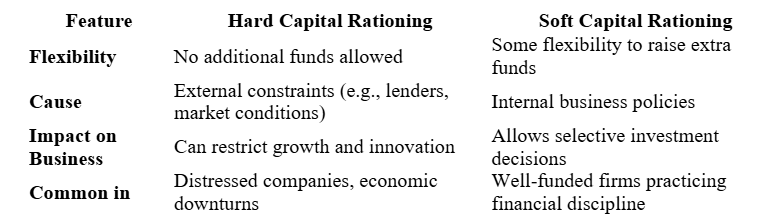
Hard Capital Rationing vs. Soft Capital Rationing
It is important to distinguish between hard and soft capital rationing:
Implications of Hard Capital Rationing
Operating under hard capital rationing presents both benefits and challenges for businesses.
- Financial Discipline and Efficiency
A strict capital budget forces companies to:
- Prioritize high-return projects.
- Eliminate unnecessary expenditures.
- Improve operational efficiency.
- Limited Growth Opportunities
Since firms cannot secure additional funds, they may have to delay or abandon profitable projects, limiting their expansion potential.
- Increased Competition for Capital
Departments within the company must compete for funding, leading to rigorous internal evaluation of projects.
- Innovation and Risk Management
While capital constraints promote financial caution, they can also restrict investment in research and development (R&D), potentially hindering long-term innovation.
Strategies for Managing Hard Capital Rationing
To mitigate the challenges of hard capital rationing, businesses can adopt the following strategies:
- Capital Budgeting Techniques: Using methods like Net Present Value (NPV), Internal Rate of Return (IRR), and Payback Period to rank and select the most profitable projects.
- Cost Reduction Measures: Implementing lean operations and efficiency improvements to maximize available capital.
- Exploring Alternative Funding Sources: Seeking strategic partnerships, venture capital, or government grants to fund crucial projects.
- Long-Term Planning: Aligning capital expenditures with long-term financial goals to avoid liquidity crises.
Conclusion
Hard capital rationing is a strict financial constraint that requires businesses to carefully manage their investment decisions within a fixed budget. While it enforces financial discipline and risk control, it can also limit business expansion and innovation if not handled strategically. Companies facing hard capital rationing must adopt effective capital allocation methods to ensure that available resources are utilized for the highest-value projects, balancing financial stability with long-term growth potential.
