
 AUS
AUS
 NZ
NZ
 UK
UK
 CA
CA
 USA
USA
 IND
IND







Highlights:
- Definition and Characteristics: A hands-on investor is someone who holds a significant stake in a company and actively participates in its management, decision-making, and strategic direction, unlike a passive or hands-off investor.
- Roles and Responsibilities: Hands-on investors often engage in governance, operational decisions, financial planning, and business expansion, directly influencing the company's growth and performance.
- Impact on Business and Market: Their involvement can drive efficiency, innovation, and strategic development, but it can also lead to conflicts with existing management and other stakeholders if interests do not align.
Introduction to Hands-On Investing
Investing in a company can take different forms, ranging from passive stock ownership to direct involvement in management. A hands-on investor is someone who not only holds a significant financial stake in a company but also actively participates in its decision-making and operations. This approach contrasts with that of a hands-off investor, who simply provides capital without taking an active role in the company’s direction.
Hands-on investors often include venture capitalists, private equity investors, large institutional shareholders, and influential individual investors who want to ensure that their investment yields maximum returns by steering the company toward strategic growth.
Who is a Hands-On Investor?
A hands-on investor is typically involved in:
- Corporate Governance: Participating in board meetings and influencing major business decisions.
- Operational Strategy: Helping shape the company’s business model, marketing, and product development.
- Financial Planning: Providing guidance on capital allocation, fundraising, and financial structuring.
- Business Expansion: Supporting mergers, acquisitions, and entry into new markets.
For example, activist investors—such as hedge fund managers who acquire large stakes in underperforming companies—often push for changes in leadership, cost-cutting measures, or restructuring to enhance profitability.
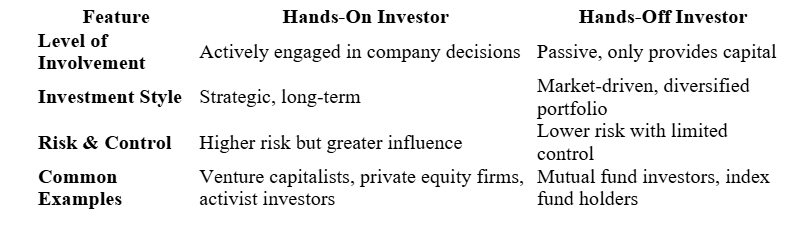
Hands-On vs. Hands-Off Investing
Understanding the difference between hands-on and hands-off investing can help investors determine their preferred approach.
Why Do Investors Take a Hands-On Approach?
There are several reasons why investors choose to take an active role in a company’s management:
Maximizing Returns – Direct involvement allows investors to shape strategies that can increase profitability and shareholder value.
Protecting Their Investment – Investors with a large stake may intervene to prevent mismanagement or financial losses.
Rescuing Struggling Companies – Some hands-on investors specialize in turning around underperforming businesses through restructuring.
Aligning Business with Their Vision – Entrepreneurs and venture capitalists often take an active role in companies they fund to ensure they align with their strategic vision.
Challenges Faced by Hands-On Investors
While hands-on investing provides control and influence, it also comes with challenges:
- Conflict with Existing Management: Investors pushing for changes may face resistance from company executives.
- Time and Resource Intensive: Active involvement requires continuous attention, unlike passive investments.
- Market Uncertainty: Despite strategic efforts, external factors such as economic downturns can impact the business.
Notable Examples of Hands-On Investors
Some well-known hands-on investors have left a significant impact on businesses and industries:
- Elon Musk (Tesla, Twitter/X, SpaceX) – Musk takes an active role in managing and directing the companies he invests in, influencing their technological advancements and corporate strategies.
- Carl Icahn (Activist Investor) – Known for acquiring stakes in companies and advocating for management changes to unlock shareholder value.
- Warren Buffett (Berkshire Hathaway) – While often seen as a value investor, Buffett also takes active roles in companies he acquires, ensuring long-term profitability.
Conclusion
A hands-on investor plays a crucial role in shaping a company’s future by actively engaging in decision-making and management. While this approach comes with significant responsibility and risk, it can lead to increased efficiency, innovation, and financial growth. For investors who seek not only financial returns but also strategic influence, hands-on investing remains a powerful approach in the corporate world.
