
 AUS
AUS
 NZ
NZ
 UK
UK
 CA
CA
 USA
USA
 IND
IND




_07_03_2026_03_50_21_133108.jpg)

Highlights:
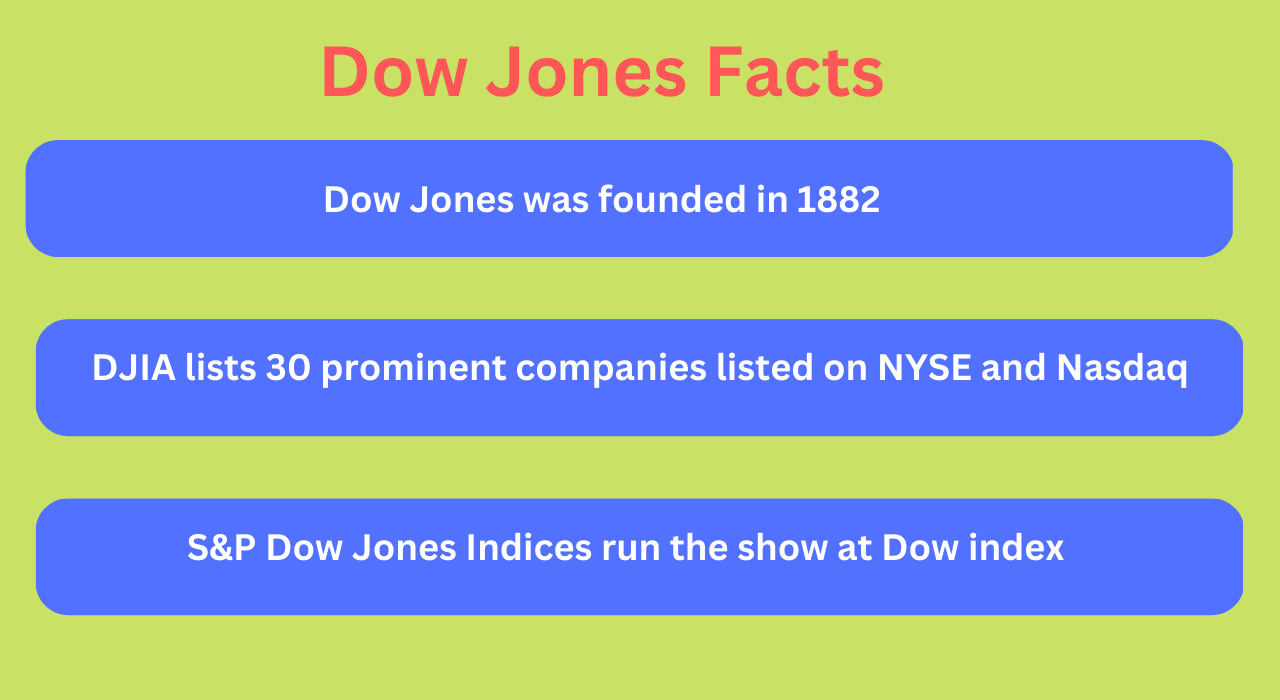
- Dow Jones was founded in 1882.
- Dow Jones and DJIA should not be confused.
- DJIA lists 30 prominent companies listed on NYSE and Nasdaq.
The Dow Jones Industrial Average (DJIA) is an equity market index. It lists the top 30 companies listed on NYSE & Nasdaq. It is among the oldest equity exchanges.
Many investors feel that it is not comparable to S&P 500 as it considers only 30 large-cap companies.
Many people may confuse Dow Jones as one individual. However, Dow Jones was founded by Charles Dow, Charles Bergstresser, and Edward Jones in 1882.
They also later created the Dow Jones Industrial Average (DJIA). People often mix up the DJIA with the Dow Jones company.
Let us look at some of the most important aspects of Dow Jones and the Dow Jones Industrial Average.
The Dow Jones is still a formidable financial news source since its inception. It has some key financial publications, considered bona fide sources for stock information and financial news.
Its key publications include MarketWatch, The Wall Street Journal, and Barron’s. These publications are believed to carry authentic and precise financial news and data.
On the other hand, Dow Jones Industrial Average is the stock index that lists some of the most prominent companies in the world. It lists companies like Coca-Cola, Apple, Boeing, Microsoft, etc.
Initially, DJIA only listed industrial sector companies, initially starting with 12. It later grew to 30, its limit. So, it was regarded as a true measure of the overall economy. The DJIA is still a vital parameter of the US economy.
“How did the market perform today?”, this market lingo often refers to what the DJIA has to say/predict or depict. It is more sought-after than the S&P 500. The S&P 500 lists 500 companies, while the Nasdaq lists more than 2,500 companies. Yet, investors look for data from the DJIA.
What DJIA actually does?
Market participants take a cue from the DJIA about the direction of the stock prices in the US. When the Dow has an upward trajectory, then the market is regarded as bullish. And when the Dow is on a downward spiral, the market is considered bearish. Hence, one can say that the DJIA is a vital indicator for the US equity market.
Source: ©Kalkine Media®; © Canva via Canva.com
Stocks with higher share prices gain precedence on Dow Jones. Hence, a higher percentage change in a higher-priced component will impact the final calculated value more.
Who has the reins of DJIA?
S&P Dow Jones Indices run the show at Dow index. S&P Global majorly owns this entity. A committee is designated to pick its components. Higher dividend yields of the ten components are the differentiator, and these ten are commonly touted as the Dogs of the Dow.
Bottom line:
Investing has become challenging when the market is so volatile in these trying times. Always do thorough market research before taking any decision.
