
 AUS
AUS
 NZ
NZ
 UK
UK
 CA
CA
 USA
USA
 IND
IND






Summary
- Sainsbury’s reported a loss of £179 million on account of the coronavirus pandemic while announcing its half-yearly report
- Despite the loss, the company has decided to pay an interim dividend and a special dividend for the first half
- The largest grocery retailers of the UK will be closing down 420 Argos stores which would also include 3,500 job redundancies
One of the largest grocery retailers of UK, J Sainsbury’s Plc has decided to initiate a major restructuring process amidst the onset of lockdown 2 in the country.
The company, which has reported a loss of £179 million for the first half of 2020, has seen major growth in its online business segments whereas its physical stores continue to feel the stress of the pandemic.
The restructuring process, which will see the company closing down 420 of its Argos stores and laying off 3,500 of the company’s staff, is in line with similar restructuring processes being undertaken by other retailers in the country.
The company though is confident of pulling off a good show in the coming future despite a loss in the first half of 2020, underpinning the efficiencies it will garner from the restructuring process. It has decided to pay an interim dividend and a special dividend for the first half despite its losses in place. The final dividend of last year it had delayed earlier this year.
Restructuring and the Argos store closing
The company’s objective to go ahead with the restructuring despite the country being in the middle of the pandemic is to boost its profitability. The restructuring though, will see 3,500 roles being extinguished but will also see 6,000 new roles being created in the company, with various other divisions.
However, by shutting down its standalone stores, the company would be adding counters or collection points at every Sainsbury location to integrate its homeware and electrical chain it had acquired in 2016. On the matter of a large number of job redundancies, the company would be looking at redeployment of most of these staff in new positions as it had done during its first tranche of Argos store closures.
The majority of the new roles will be in the company’s fast-expanding online retail decision which requires large numbers of van and truck drivers and “Store pickers” to deliver goods at the customer front doors. The cost of the closure of the Argos stores and other related strategic and market charges are expected to be around £438 million but will provide an immediate benefit of 5 per cent to the bottom line of the company for the rest of this year, with more in the forecast for future periods.
Company’s results
The company came out with its H1 2020 results on 5 November 2020
The total group sales (exc. VAT, inc. Fuel) for the period stood at £14.934 billion whereas, for the previous year in the same period, the company’s total group sales (exc. VAT, inc. Fuel) were £15.097 billion.
The loss before tax for the period stood at £137 million whereas, for the previous year in the same period, it had reported a profit before tax of £9 million. The loss for the period stood at £179 million whereas, for the previous year in period, the company had reported a loss of £38 million.
The basic loss per share for the period stood at 8.3 pence whereas, for the same period in the last year, it had reported a loss per share of 2.2 pence.
The digital sales of the company for the period were up by 117 per cent to stand at £5.8 billion, which accounted for nearly 40 per cent of the company’s total sales. Grocery sales of the company, on the other hand, grew by as much as 102 per cent over the same period last year.
The free cash flow generated by the company for the period stood at £943 million. (All figures are on a statutory reporting basis)
The stock price performance of J Sainsbury Plc
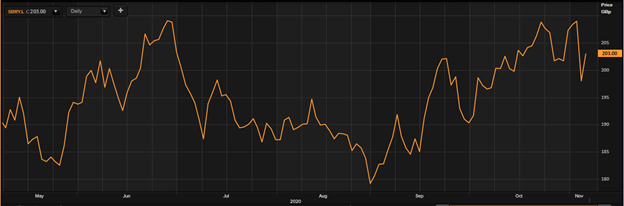
six- months performance (Source- Thomson Reuters)
As on 06 November 2020, the share of J Sainsbury Plc has been trading at GBX 202.80 (9.41 AM GMT+1), gaining 2.42 per cent over the previous day’s close. On 5 November 2020 after the release of the results, the stock price of the company had seen a drop of 4.4 per cent.
Impact of the second lockdown on UK’s retail sector
The second lockdown that came into effect on 5 November 2020 is likely to adversely affect the retail industry, especially the physical retail stores that have just started to see an increase in the number of visitors. Online retailing, however, would continue to expand till at least the winter lasts and the pandemic infection rate is not brought under control.
Other than the second lockdown, the British retail industry is currently plagued by several other problems. The industry has seen several of its prominent companies shutting their shop during the first lockdown because of low customer turnout, which is highly likely to continue this time as well.
Online retailing, on the other hand, has been eating into the market of traditional retailing very rapidly. During the lockdown, online retailing has recorded a fantastic growth in the United Kingdom and is projected to perform better over traditional retailing in times to come.
However, despite this transition taking place in the retail industry the sources of merchandise have not changed. Be it online retailing or traditional shop floor retailing, both are dependent on supplies from the EU. The most likely scenario of the failure of the Brexit deal talks is a major challenge the industry has to tackle. It will be interesting, thus, to see how this industry copes with this problem in the mid to long-term timeframe.
