
 AUS
AUS
 NZ
NZ
 UK
UK
 CA
CA
 USA
USA
 IND
IND






Summary
- Grocery sales in the UK have registered a growth of 7.2 per cent in the last week of October 2020 and 6.2 per cent for the whole month on a year-on-year basis
- This sharp increase in grocery sale is attributed to the panic buying by many customers ahead of the second lockdown which started on 5 November 2020
- In the month of March when the first lockdown was imposed massive panic buying was witnessed in the United Kingdom
Grocery sales in the UK saw a peak in the last week of October 2020, growing by 7.2 per cent year- on- year. This was the result of the panic buying that was initiated by the announcement of the second phase of the nationwide lockdown starting from the 5th of November 2020.
The country after witnessing a relapse in the pandemic infection rates went for the second lockdown till the first week of December after which a review will be done to see if an extension will be required. Many people who are worried that this second lockdown will extend or are worried that there will be a shortage of foodstuff have bought groceries more than their requirements and stocked up for the period.
Most large and small supermarket grocers have witnessed an increased in their sales during the last week of October, as eateries and pubs are required to remain closed except for delivery businesses. As expected, physical store visits witnessed a fall of 12 per cent in the month of October in the run-up to the lockdown while online grocery sales have witnessed a growth of 87 per cent.
The phenomenon of Panic buying and the winter months
In the month of March, when the first lockdown was imposed massive panic buying was witnessed in the United Kingdom. Many supermarkets had witnessed a run on their shelves with people buying their daily needs in bulk, despite the government assurances that there was no shortage of provisions in the country.
In the subsequent months also the demand for grocery products did not go down, and online sales of food and beverages saw record-breaking growth during the lockdown. A similar phenomenon is being witnessed at the start of this second lockdown, but this time it is not as acute as it was in the month of March. Secondly, this time the lockdown is comparatively relaxed with supermarkets being allowed to remain open with strict observance of safety protocols. However, despite the fact, there is a sharp spike in the sale of food and beverages during the lockdown period.
Favourable for supermarkets
This second lockdown has, however, created circumstances that favour the supermarkets. Unlike the first lockdown, when all establishments were asked to close, this time, restaurants, pubs and smaller food and beverage serving establishments have been given some relaxations. This essentially means that people would have to cook food at home more often than they did before, which will translate into more grocery demand.
In the outset, this period is going to bring about a considerable rise in their revenue levels. Below are four top grocery supermarkets of UK, and how have their stocks been reacting to the second lockdown.
What the top four grocers in the UK have been experiencing over the past one month
- Ocado Group plc (LON:OCDO) – The company came out with a trading update on 2 November 2020, where it informed that it had been witnessed strong demand for its products till the third quarter of the year. Given the continuing momentum of its sales the company, it has now upgraded its full-year EBITDA guidance from earlier stated £40 million to £60 million.
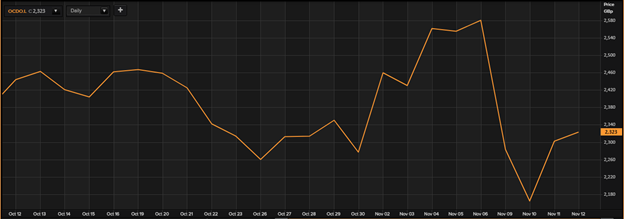
One- month performance (Source- Thomson Reuters)
As on 12 November 2020, the shares of Ocado Group plc have been trading at GBX 2,312.00 per share (8.24 AM GMT+1) gaining 0.45 per cent over the previous day’s close.
- Tesco plc (LON:TSCO) – Tesco has put restrictions on several of its grocery items due to huge demand and fear of panic buying situation it had witnessed in March. Additionally, it has barricaded sections inside its supermarket stores which sell non-essential items like clothes, electronics and furnishing items after the imposition of the second lockdown.
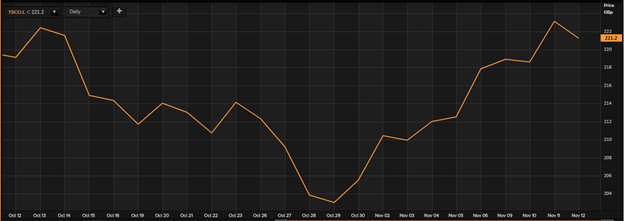
One- month performance (Source- Thomson Reuters)
As on 12 November 2020, the shares of Tesco Plc have been trading at GBX 220.80 per share (8.26 AM GMT+1) losing 1.03 per cent over previous day’s close.
- J Sainsbury Plc (LON:SBRY) – The company came out with its Half yearly report on 5 November 2020 the day the second lockdown was imposed in the country. In the report the company has stated that it expects its before tax profits of this year to be at least 5 per cent higher than last year, which is an indication that the company is expecting to perform well through the second lockdown as well.
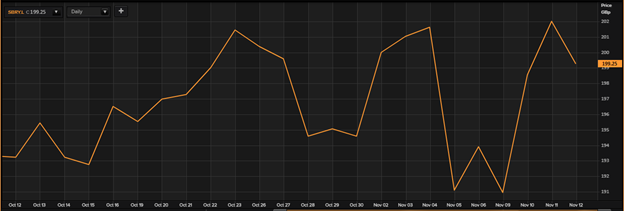
One- month performance (Source- Thomson Reuters)
As on 12 November 2020, the shares of J Sainsbury plc have been trading at GBX 199.12 per share (8.28 AM GMT+1) gaining 0.16 per cent over previous day’s close.
- WM Morrison Supermarkets plc (LON:MRW) – The company is the best performing grocery retailer in the country over the past five months, currently witnessing a sales growth rate of 11.4 per cent.
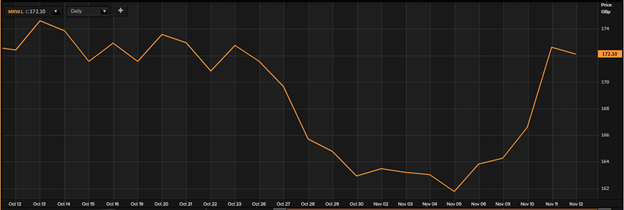
One- month performance (Source- Thomson Reuters)
As on 12 November 2020, the shares of WM Morrison Supermarkets plc have been trading at GBX 172.45 per share (8.30 AM GMT+1) losing 0.087 per cent over previous day’s close.
