
 AUS
AUS
 NZ
NZ
 UK
UK
 CA
CA
 USA
USA
 IND
IND







Summary
- The TDR Capital-backed EG Group has emerged as Walmart’s preferred bidder in the race to buy Asda with a £6.5-billion deal.
- The billionaire owners of the EG Group, the Issa brothers, surpassed a rival bid from Apollo Global.
- Walmart, the department store chain from the US, bought Asda in 1999 and is the parent company.
- In 2019, the competition watchdog in Britain blocked a deal between Asda and leading supermarket chain Sainsbury’s.
- Walmart might keep a minority stake in Asda and plan to float it on the stock market in the future.
The TDR Capital-backed EG Group has emerged as Walmart’s preferred bidder in the race to buy Asda Stores Limited with a £6.5-billion deal. Walmart Inc., the department store chain from the US is the parent company of Asda. While TDR Capital is a well-known British private equity company with head office at London, the EG Group Limited, based in Blackburn, owns and operates gas stations. The billionaire owners of the EG Group, the Issa brothers surpassed a rival bid from Apollo Global Management Inc., an alternative investment management company based in the US.
Issa brothers along with TDR were able to bid for the deal to acquire a majority stake in Asda due to their capabilities of expanding the supermarket into petrol forecourts. In September 2020, there were high speculations after the British supermarket chain revealed its plans to test three convenience stores with the EG Group. Asda, which is based at Leeds, operates more than 600 stores across Britain. Though the deal is yet to be formalised, reports suggest that the final deal could cost Asda more than £6.5 billion.
Walmart’s plans for Asda
In 2019, the competition watchdog in Britain had blocked a £7-billion merger of Asda with Sainsbury’s, the UK’s leading supermarket chain. Since then, Walmart had been trying to strike another deal. In case the Issa brothers and TDR Capital successfully strike the deal, Asda would have British owners for the first time since 1999.
More than a year after the failed merger, Walmart restarted talks to sell its stake in Asda in July 2020. The final deal could be announced soon. However, beating the details could delay as bidders seemed to be fighting over possible liabilities, comprising Asda’s pension scheme and dispute over equal payment, which is being considered by the Supreme Court of the UK. These could incur a huge sum of money in back pay.
Walmart, which purchased Asda in 1999 for $8.4 billion, might keep a minority stake in the British supermarket giant. Walmart might look at floating Asda on the stock market but given the volatility of markets due to the pandemic this could happen later. During preparations for any initial public offering (IPO), Walmart considers a PE deal as a way to bring new investments in Asda.
Also read: Second Covid-19 wave likely to close 12 million m2 of retail space
Also read: Retailers adopt 5-pronged strategy to fight Covid-19 crisis: focus on TSCO, SBRY, and MRW
Also read: Tesco’s Experiment with Drone Can Be A Game Changer for Supermarkets
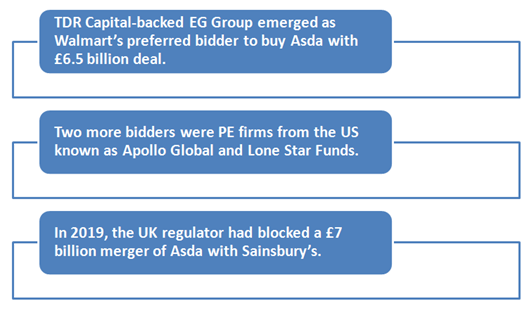
The three bidders
The EG Group and TDR have together formed a new entity to bid for Asda’s takeover. Several experts believed that the bidding entity’s structure would not be sufficient to rule out a competition investigation. It needs to be understood that besides examining the bidder for mergers and acquisitions, the regulators also consider what else is being controlled by the bidder.
The EG Group, which is worth £10 billion, has made several acquisitions, including forecourt groups in the US, Little Chef roadside cafes, and a Kentucky Fried Chicken franchise in the UK. While the Issa brothers own a quarter each of the EG Group, rest is owned by the TDR Capital.
Apollo Global, which is associated with Rob Templeman, who formerly headed Debenhams, presented a more straightforward deal that was based on expanding Asda’s online presence. As per reports, Apollo still doesn’t know officially that it has not secured the preferred bidder status. Industry sources said that Apollo might enter the race again with a new offer. Sources have also added that the deal could have attracted criticism over its dependence on raising debt.
It is to be noted here that Asda had a third bidder - US-based PE company Lone Star Funds, backed by Paul Mason, who was the former Asda and Somerfield executive. Mason’s bid offer was rejected as it could not match the price provided by the rival bidders.
Online shopping plans from Asda
The coronavirus pandemic has significantly accelerated the shift towards online shopping. In order to meet the consumer’s changing demands, Asda has also revamped its online division with better service to meet the growing demand. In mid-August 2020, Asda said that in order to meet the online rush, it has planned to increase its weekly delivery capacity to almost one million slots in 2021 and sustain the changing demand from the customers.
As per the reports, in the second quarter (Q2) between January and June 2020, Asda’s online grocery sales doubled. Besides, their click-and-collect sales at the supermarket chain have grown almost four times. Asda increased its online capacity by almost 65 per cent to reach at 700,000 weekly slots, since March 2020. By the end of 2020, the retailer plans to increase the weekly slots to 740,000. Asda has also announced to expand its delivery partnership trial with Uber Eats to include more stores.
Considering that the online grocery shopping trend is here to stay in the future, Asda has accelerated its plans for expanding online capacity. The online segment growth and rise in demand for grocery items led to a 3.8 per cent rise in like-for-like sales during Q2. The supermarket giant’s operating income in Q2 decreased because of the rise in pandemic-related costs. Despite recording a substantial growth in sales, Asda lagged behind its competitors, like Tesco, Sainsbury’s, and Morrisons. Industry sources said the food and grocery market in the UK can grow by 14.6 per cent in the next five years. The forthcoming Asda deal will be crucial in that direction as the sector growth will be based on rapid expansion and upgrades of existing stores.
