
 AUS
AUS
 NZ
NZ
 UK
UK
 CA
CA
 USA
USA
 IND
IND






With over a million active coronavirus cases, the British government had to enforce another lockdown to curb the spread of the deadly virus. Similar situation was observed in March during the first lockdown when most of the economic activities came to a screeching halt. However, some businesses such as Tesco Plc (LON: TSCO) outperformed during the unprecedented crisis. The food and drug retailers have been operational throughout the unprecedented crisis. These retailers primarily deal in essentials such as groceries, consumer staples and stuff that is needed for daily household use. In the current scenario of Lockdown 2.0 has been in force and markets getting impacted due to it, investors should look for businesses, which are resilient in nature.
The largest supermarket chain and one of the biggest food retailers of UK, Tesco is an FTSE 100 listed company which also deals in financial services apart from groceries and consumer staples. The UK’s leading supermarket chain operates in a very competitive space and has a market capitalisation of nearly £22 billion. Tesco’s nature of business has not been affected by the coronavirus pandemic. Instead, it has flourished more during the unprecedented crisis.
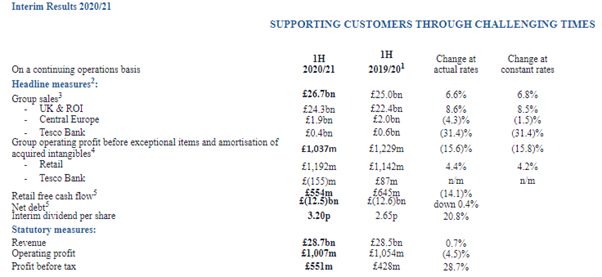
The company has shown decent financial performance during the first half of the financial year 2021. Both the revenue and profit for the period improved, with increased capacity of online business. The Group’s overall sales were up by 6.6 per cent (at actual rates) during the first half of 2021. The company recorded a growth rate of 8.6 per cent in its turnover in the Republic of Ireland (ROI) and UK region. The retailer’s statutory revenue was marginally up by 0.7 per cent year-on-year to £28.7 billion.
(Source: Company’s filings, LSE)
The panic-stricken consumers resorted to stockpiling and bulk orders on key items ahead of COVID-19 lockdown restrictions and consumed more meals at home; the company recorded strong growth in essential categories such as grocery and household during the first quarter of 2021.
The company continued to witness heightened demand across the food items, particularly in the meat, fish, and poultry category and in beers, wines, and spirits while like-for-like sales growth eased slightly from the first to the second quarter of 2021. UK’s leading supermarket chain quickly adapted to shift in buying behaviour as it witnessed an increase of 9.2 per cent in food sales. The company time and again has improved its online capacity to cater to the surge in demand.
Under the Tesco banking business, balance sheet and capital ratios remained strong, while it expects to report operating loss of £175-£200 million in 2021.
The company expects operating profit from the retail business for 2021 to be like the previous year. Tesco had sold its Polish business to Salling Group A/S for net cash of £165 million; the completion of the sale is expected to occur in Spring 2021. The company expects the capital expenditure to be in the range of £0.9-£1.2 billion for 2021. Notably, due to an increase in the provision for potential bad debts along with reduced income, Tesco Bank incurred an operating loss before exceptional items of £155 million during the first half of 2021.
The company also deals in fuel. The fuel sales of the company declined by 42 per cent year-on-year to £2.1 billion as customers travelled significantly less due to coronavirus lockdown restrictions.
Throughout the years, company has managed a solid bottom-line. the company’s Net profit surged to £973 million in 2020 from £129 million in 2016; at a CAGR (Compounded annual growth rate) of 65.72 per cent. The company managed to reduce its debt marginally by 0.4 per cent to £12.5 billion as on 29 August 2020.
An interim dividend of 3.20 pence was announced during the first half of 2021, representing 35 per cent of last year's full-year dividend.
(Source: EODHD/Others, Thomson Reuters)
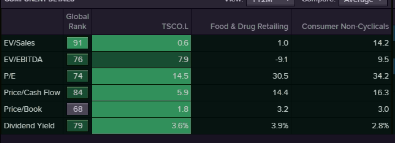
When analysed on the basis of some common valuation ratios, Tesco performed well compared to the industry or its peers. EV/EBITDA, Price/Earnings and Price/Book Value multiples of Tesco Plc are currently lower versus the corresponding multiples of the Food & Drug Retailing industry. This implies that the current value of Tesco shares is far less than their intrinsic value.
TSCO-YTD chart
(Source: EODHD/Others, Thomson Reuters)
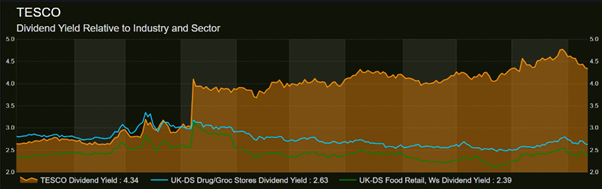
Tesco’s annual dividend yield stood at 4.34 per cent, far better in comparison to the overall sector’s performance. This is another point which attracts most of the investors as higher dividend yields indicate that the stock is attractively priced.
TSCO Price Chart 5 Years
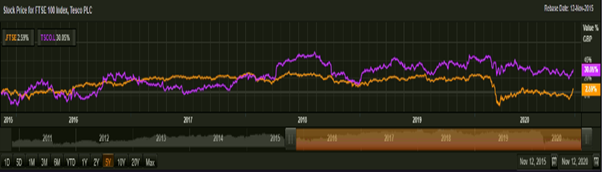
(Source: EODHD/Others, Thomson Reuters)
Price comparison states that Tesco shares have clearly outperformed the benchmark index in the last five years. Tesco shares have delivered a price return of more than 30 per cent in the last five years.
What makes Tesco different from its league?
Tesco continuously invests in technological advancement to stay ahead of its competition. UK’s leading supermarket chain prudently doubled-up its online capacity during the unprecedented surge in online orders. The company had partnered with Manna, a drone delivery company to test home deliveries of essentials through the drone. Drone deliveries could be a potential gamechanger in the retail industry. Tesco also operates in diverse businesses lines such as financial services and fuel retailing. Tesco recently took on Amazon by introducing free home delivery for cardholders. In the wake of a second lockdown, Tesco is likely to witness a windfall of orders as people will look for stockpiling.
