
 AUS
AUS
 NZ
NZ
 UK
UK
 CA
CA
 USA
USA
 IND
IND







Summary
- The second lockdown has not affected the momentum of the housing market as prospective buyers are busy purchasing properties before the expiry of the stamp duty holiday period next year.
- The pandemic this year has been a massive demand for houses as people are keen to shift from the metropolitan areas to the suburbs.
- Focus on Grainger, Savills, Fletcher King, and Hunters Property stocks.
The second lockdown has not dampened the spirits of the buyers keen on purchasing properties in the UK. In fact, experts are predicting that the market can expand further in the next few months before the stamp duty expires next year. While the pandemic has seen a massive spike in the sector due increasing demand and government stimulus measures.
The stamp duty holiday announced earlier this year, which is set to continue till the end of March 2021, has been a major force in driving people to book their houses.
Several industry observers believe that the second lockdown may actually accelerate housing activity as companies would tend to expand their work from home facilities, prompting employees to hasten their new housing purchasing decisions.
Importance of stamp duty changes
The stamp duty holiday measure announced by Chancellor Rishi Sunak could be one of the major drivers of demand and price rise in the UK property market in the coming months.
It has been witnesses that the volume of transactions in the property markets show a sharp increase whenever a change in stamp duty regimen in initiated in the UK.
In 2016 when stamp duty rates were changed for secondhand properties, transaction volumes suddenly jumped from 110,000 to 175,000 levels.
Similarly, transaction surges were witnessed in 2012 and 2010 when stamp duty was altered in the country.
In the past three years the average transaction volume has remained at nearly 100,000 and during this time no major changes were made to the stamp duty.
Thus, the government’s move to spur demand in the market is backed by strong empirical evidence.
Let us take a look at the share price performance of four housing companies in the nation.
Grainger plc (LON:GRI)
The company had recently come out with an update stating that it had been observing a strong sales performance during H1 of the year despite the pandemic crisis. The company expects its sales for the year to be in line with sales of 2019.
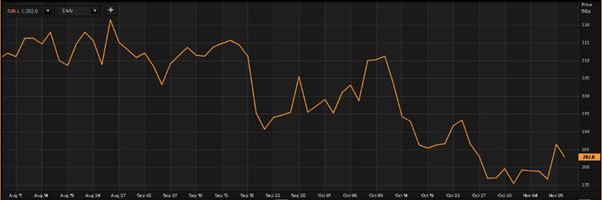
Source- Thomson Reuters (Three months)
As on 10 November, the shares of Grainger plc have been trading at GBX 282.80 per share (12.39 PM GMT+1) losing 1.47 per cent over the previous day’s close.
Savills plc (LON:SVS)
Savills has experienced a doubling of the number of registrations in its country offices outside of London in July 2020 compared to July 2019. The company is confronted with a shortage of houses to meet the growing demand right now. The company is expected to do well for the rest of the year as well.
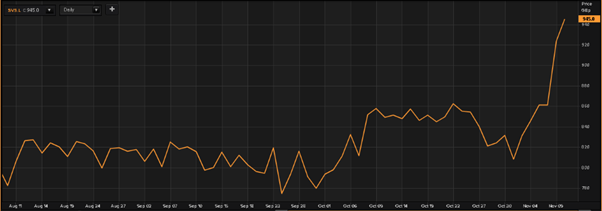
Source- Thomson Reuters (Three months)
As on 10 November 2020, the shares of Savills plc have been trading at GBX 945.00 per share (12.41 PM GMT+1) gaining 2.38 per cent over the previous day’s close.
Fletcher King plc (LON:FLK)
The company has come out with an update that in the H1 ending period 31 October it has made a trading loss of approximately £450,000. The company shall come out with its interim results before 31 January 2021. The company’s results revenues for the period have been lower because of the lower transaction fee earnings for the period.
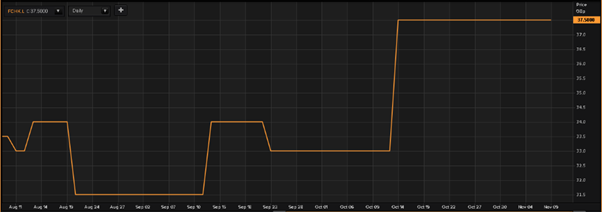
Source- Thomson Reuters (Three months)
As on 9 November 2020, the shares of Fletcher King plc were trading at GBX 37.50 per share at the close of the day’s trade losing 3.0 per cent over the previous day’s close.
Hunters Property plc (LON:HUNT)
In its H1 report published on 29 September, the company has reported an 18 per cent jump in its revenues for H1 2020 compared to H1 2019, while its profit before tax for the period was higher by 163 per cent for in H1 2020 compared to H1 2019.
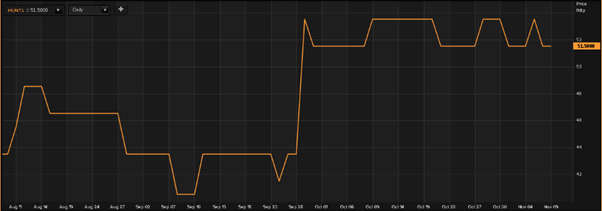
Source- Thomson Reuters (Three months)
As on 9 November, the shares of Hunters Property plc had traded at GBX 51.50 per share at the close of trade losing 1.4 per cent over the previous day’s close.
