
 AUS
AUS
 NZ
NZ
 UK
UK
 CA
CA
 USA
USA
 IND
IND







Summary
- Persimmon Plc announced a dividend of 40 pence per share after witnessing a boom in sales
- During the first half of the financial year 2020, total revenue of the company increased to £1,190 million
- As per Halifax the average UK house price rose by 3.8 per cent to a record £241,000 in July
The London’s broader equity benchmark index, FTSE 100 or Footsie on Friday (21 August 2020) closed at 6,001.89, marginally down by 0.19 per cent. Footsie plummeted by nearly 30 per cent during the peak of the coronavirus pandemic (March). Since then, FTSE 100 has recovered by nearly 22 per cent. The index has been consistently trying to maintain a level of more than 6,000.
FTSE 100 listed, Persimmon Plc (LON:PSN), a leading British housebuilder, witnessed a boom in sales last month, which seem to be triggered by recently announced stamp duty holiday by the Chancellor of the Exchequer, Rishi Sunak, and therefore the company has restored its shareholder pay-out. The British government is making all effort to boost consumer sentiment in terms of people buying, selling, or renovating their houses. Therefore, on the first £500,000 of all property sales in England and Northern Ireland, the Chancellor had announced a temporary holiday on stamp duty with immediate effect until 31 March 2021. This implied that buying a property of £500,000 or more could translate into a lot of savings, that one would have otherwise paid in the form of taxes. This move was announced in the summer statement and was aimed at supporting jobs and stimulate growth across the property and the housebuilding sectors.
Do read: Bonanza for the Hospitality & Housebuilding Sector in Chancellor’s Summer Statement
Amid the recent boom in housing prices, Persimmon Plc announced a dividend of 40 pence per share in its half year results for the six months ended 30 June 2020. While most of the A-listers are slashing dividends to ensure liquidity in the current economic crisis, leading UK housebuilder resumed dividend pay-out.
The Group delivered a robust first half performance with 4,900 new home completions and improved upon its customer care services through its preparedness, agility, and strength despite the significant challenges along with the disruption caused by the coronavirus pandemic.
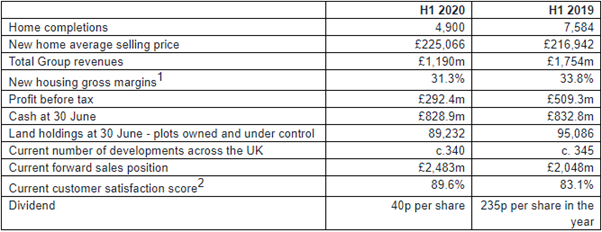
(Source: Company’s filings, London Stock Exchange)
The company’s revenue increased, while the bottom-line performance declined. During the first half of the financial year 2020, total revenue of the company increased to £1,190 million (H1 2019: £1,754 million) due to higher home average selling price realised. The gross margins for new housing stood at 31.3 per cent for the period, which was consistent in comparison to last year’s performance. The Profit before taxation (PBT) of the company was down substantially, 43 per cent to £292.4 million in the first half of 2020 due to lesser home completions (H1 2019: £509.3 million) as the operations came to a screeching halt with the onslaught of the novel coronavirus.
As per the management, the rise in average selling prices along with strong forward sales, could boost the financial performance of the company and make it easy for it to sail through the unprecedented crisis. Persimmon maintains a strong foothold in the market and has the DNA to deliver growth in the coming years. The company can leverage upon its High-quality land holdings to increase its operational capacity as the housing sector is likely to witness stable demand.
Moreover, Persimmon had a dream start to the second half of 2020. Since July, the housebuilder witnessed a 49 per cent increase year on year in average weekly private sales rates per site. In addition, the company’s forward order book increased by 21 per cent on last year to £2.5 billion. The company maintains strong liquidity and has a current cash position of more than £820 million. Notably, unlike other businesses, Persimmon did not take advantage of the furlough scheme launched by the British government for any of its employees.
|
Marker Capitalisation (£ million) |
8,582.73 |
|
52 weeks High (GBX) |
3298.00 |
|
52 weeks Low (GBX) |
1534.50 |
|
1-yr Return |
40.89% |
As on 21 August 2020 at market close (Source: London Stock Exchange)
UK’s economy does not seem to be in pink of the health as GDP shrank by 20.4 per cent during April to June 2020, and by 2.2 per cent during January to March 2020, according to data from Office of National Statistics (ONS). Despite the poor state of the economy, there is a surge in demand for real estate. Sellers are having an upper hand as the supply of property remains low in the market. Real estate agents have estimated that the number of home buyer applications with them for a property value between £500,000-£750,000 has risen by nearly 90 percent in comparison to 2019.
Also read: UK is Undergoing Economic Recession
According to a study conducted by the UK’s leading property website, Rightmove, instead of a normal slow down during the summer season, there is a significant acceleration in the house sales after the government allowed the property market to start functioning in mid-May 2020 by lifting the coronavirus-induced lockdown. Rightmove described July 2020 as its busiest month in the housing market that it has witnessed in more than a decade. Similarly, as per Halifax data, the average UK house price rose by 3.8 per cent to a record £241,000 in July.
In July 2020, Rightmove recorded its highest monthly sales in UK since it started keeping records. Sales agreed in July 2020 with a total worth of around £37 billion increased by 38 per cent as compared to the same period in 2019 which reported the total sales at £25 billion. While the number of sales agreed for large homes ascended by 59 per cent on an annual basis, it climbed 29 per cent for first-time properties. The sales numbers were up by £12 billion in July 2020 as compared to July 2019 despite the economic impact of the novel coronavirus.
Also read: Housing market boom continues with £37 billion summer sales
The overall health of the economy has a strong influence on the housing prices which directly impacts the sector. The political & economic uncertainties prevalent due to Brexit and novel coronavirus respectively, have resulted in the occupational and cashflow uncertainty in the future. Persimmon’s seems to be confident of stability of its future earnings and cash flows, therefore, it decided to reinstate the dividend, even in these pressing times and other housebuilders may follow the line. Although, housing prices have exhibited resilience so far, the current outlook for the economy seems to be murky. The government support schemes are likely to be called off in October 2020. The real impact in the real estate market would become more apparent in the upcoming months. To exacerbate further, weakened labour market could drive the housing prices southwards in the near term.
