
 AUS
AUS
 NZ
NZ
 UK
UK
 CA
CA
 USA
USA
 IND
IND





Summary
- Rolls-Royce is reportedly looking to improve its liquidity position by tapping investors for £2.5 billion
- Group’s revenue was severely impacted by Covid-19 and declined by 24 per cent in H1 2020
- Company is carrying out major restructuring of its Civil Aerospace business and is talking rapid actions to bolster liquidity
UK based engineering company, Rolls-Royce Holdings Plc (LON: RR.) is reportedly looking to improve its liquidity position by tapping investors for £2.5 billion at a steep discount to the current share price. Aircraft manufacturers, engine makers to airline operators, all have been impacted due to the travel curbs induced by the coronavirus.
As per the reports, Rolls-Royce is expected to price the equity shares at a discount to the current market price. The shares available at a discount may be a put off for some investors; however, at the same time, some new might consider this opportunity to create a position in the FTSE 100 listed company. The company is planning to raise £2.5 billion through a combination of financial instruments such as rights issue other than equity issuance. The company can also look to issue debt, if necessary. The company continues to review funding options available to boost the resilience of the balance sheet. Rolls Royce is currently assessing the different advantages of raising equity of around £2.5 billion. However, no decision has been taken yet and all funding options are still being evaluated by the company.
Pandemic impact and company’s plan to tackle the situation
The engine maker does not expect demand for its engines to return to pre-pandemic levels in short to medium term. Moreover, the company has announced nearly 3 thousand job redundancies due to major restructuring decisions undertaken by the management.
Travel & Leisure has been one of the worst impacted sectors globally as it came to a screeching halt with the onslaught of the novel coronavirus. Putting further pressure, there is addition of countries to the quarantine list that necessitate travellers to Britain to self-isolate and has dashed the hopes of a pick-up in the sector.
The engine maker makes money every time an engine is placed on a plane, and it generates billions through this model. Rolls Royce expects the flying hours to halve for this financial year due to a substantial decrease in the number of travellers and declining revenue per seat. The Company has recently announced the closure of factories in Nottinghamshire and Lancashire and has decided to reduce the number of its sites to almost half across the world.
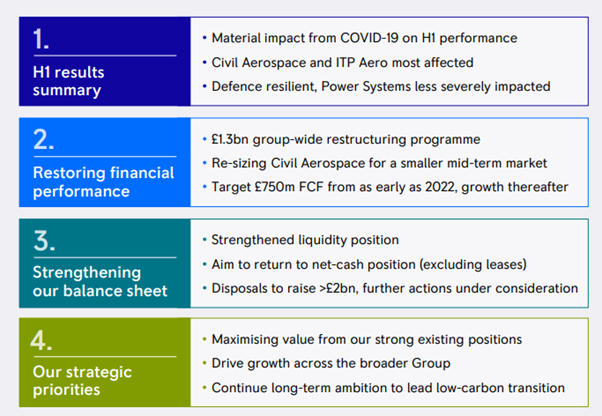
The company hopes to save over £1.3 billion by the end of 2022 by restructuring its civil aerospace division. Rolls-Royce is also aiming to sell off its Spain based ITP Aero turbine-making business and raise a further £2 billion. The gradual easing of lockdown along with gradual recovery in civil aviation could help Rolls Royce with the recovery by the end of the second half of 2020.
In addition, the policy inconsistency of the British government with respect to the quarantine regime has dented the prospects of the aviation sector. These kinds of regimes will deter the confidence of travellers, and they would refrain themselves from travelling.
Suppliers of the aviation industry, such as the jet makers, are indirectly impacted by the travel bans induced by the coronavirus pandemic. The UK is anticipating a second wave of the coronavirus, which could be another blow for the already battered sector. The world is desperately awaiting a coronavirus vaccine to get out of this difficult situation.
(Source: Company’s presentation)
Business Highlights H1 2020
(Source: Company’s presentation)
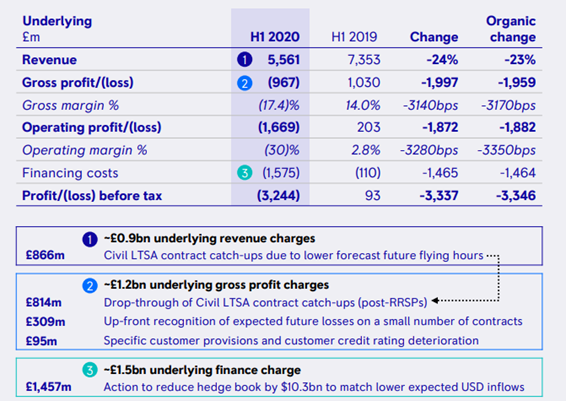
During the first half of the financial year 2020, the Company’s financial performance worsened significantly. Despite the gradual reopening of economy and easing of travel restrictions, the company still expects the market to remain uncertain.
Rolls-Royce believes business recovery to commence by the end of the second half of 2020, based on a gradual recovery in civil aviation. The Company expects a recovery by the end of 2021 in the majority of Power Systems end markets. The Defence division witnessed resilient performance as revenue was up by 2 per cent during the period; the Company expects its overall revenue to reach the pre-pandemic levels by 2022. As per the expectations of the Company, large engine deliveries are expected to occur after 2022.
For the fiscal year 2020, the Company’s underlying revenue is expected to be 25-30 per cent less than the fiscal year 2019. The Company anticipates liquidity of £6 billion, free cash outflow of around £4 billion along with a rise of £3.5 billion in net debt. The Company’s free cash generation is expected to turn green by the second half of 2021.
Due to lesser contribution from Civil Aerospace, Power Systems, and ITP Aero businesses, the Company’s reported revenue declined by 26 per cent, and underlying revenue declined by 24 per cent during the first half of the financial year 2020. The Company’s reported operating loss stood at £1.8 billion; the underlying operating loss stood at £1.7 billion due to the impact of Covid-19, which resulted in one-off charges in Civil Aerospace of £1.2 billion.
The company is considering bolstering its liquidity as it has mustered an RCF (revolving credit facility) of £1.9 billion along with cash balances of £4.2 billion as on 30 June 2020. The Company also took a term loan of £2 billion backed by UKEF (UK Export Finance) in August.
Rolls-Royce: Stock Performance
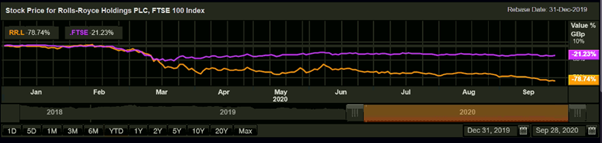
On 28 September 2020 at GMT 1:33 PM+1, Rolls Royce shares were trading at GBX 144.95, down by 6.33 per cent from previous day price close. The shares have lost value of over 75 per cent on-year to date scale.
(Source: EODHD/Others, Thomson Reuters)
The shares of the engine maker have performed poorly in comparison to the benchmark index on a YTD scale.
Covid-19 pandemic has caused a lot of economic disruption, travel restrictions due to lockdown and supply chain disruption. The sky remained closed for the aviation industry for a considerable period of time. The demand for new aircraft and engines has declined substantially. In addition, Rolls-Royce operates in a very challenging macro-economic environment and is exposed to foreign currency fluctuations, oil prices, and interest rates, which has led it to look for improving its liquidity position by tapping investors.
