
 AUS
AUS
 NZ
NZ
 UK
UK
 CA
CA
 USA
USA
 IND
IND







Summary
- Royal Mail has hinted on asking the Ofcom to end its services of delivering letters on Saturdays.
- The company believed that the coronavirus pandemic has speeded up the long-term reduction in volume of letters, besides surge in online shopping has increased the need for delivering parcels.
- In the five months to August 2020, Royal Mail delivered around 1.1 billion lesser letters on a year-on-year (YOY) basis.
- In the five months to 30 August 2020, the company delivered extra 177 million parcels, up 34 per cent YOY. This led to a 33 per cent rise in the company’s revenues.
- Delivery of 1.1 billion lesser letters in the same period strained the revenues. The income from delivering letters reduced 21.5 per cent.
Royal Mail plc (LON:RMG) has indicated that it could ask the UK Office of Communications (Ofcom) to end its services of delivering letters on Saturdays. The company is into delivery of letters, parcels, and other products. It stressed that the coronavirus pandemic has speeded up the long-term reduction in volume of letters. At the same time, the surge in online shopping has increased the need for delivering parcels.
Findings of the survey conducted by Royal Mail
Royal Mail asserted that changing customer behavior in recent times compelled to think if deliveries of letters on Saturdays needed of continue. The company showed some findings regarding delivery on letters in recent months. These insights are an indication of the changing needs of the customers.
The findings would also be useful for the review being conducted by Ofcom. It is to be informed that Ofcom at present has undertaken a user need review of Royal MailI. The regulator is likely to publish its report in the autumn. In addition, Ofcom has plans to come out with another review on the financial sustainability aspects that guide the postal market by 2022. The Ofcom has been approved by the government as regulatory and competition authority for the broadcasting, telecommunications, and postal industries of the UK.
In the five months to August 2020, Royal Mail is reported to have delivered around 1.1 billion lesser letters on a year-on-year (YOY) basis. Royal Mail’s survey included thousands of customers and hundreds of sessions with the staff. The findings from these activities demonstrated clearly on where the company needs to focus. However, there is a strong resistance from the unions over Royal Mail’s five-year plan to focus on parcels business. It is to be recalled that in 2019, Royal Mail had charted a five-year turnaround plan worth £1.8 billion to strengthen Royal Mail as a global parcel-focused business. However, there were strikes at the company that held the plans.
Royal Mail emphasised that there exists a demand for a service that involved a cost effective means to deliver letters the next day. This service is crucial for businesses during the weekdays in a week. And, it was clearly indicated that the company’s Saturday letter delivery service was not considered a central offering from the company. In order to meet the changing customer needs, Royal Mail is deliberating on offering a seven-day service for delivery of parcels.
Key aspects of the letter to the staff at Royal Mail
Keith Williams, interim executive chairman at the Royal Mail told the company’s staff that findings of the study suggested necessary ways to carry on its universal service and meet the customer’s needs. Williams communicated with the staff through a recent letter.
It is required to incline the company’s service model towards the surging parcels market, with focus on urgent parcels and letters. It is pertinent to note that Royal Mail held its annual general meeting on 8 September 2020.
The letter to the employees clarified that this change in focus does not suggest mirroring other countries like New Zealand or Italy that have restricted delivery of letters to three days a week in some locations. The company informed that it would meet additional customers and other stakeholders to further understand these issues.
The letter reiterated that Royal Mail would prefer to deliver the products that customers want more often and not less. Royal Mail would continue delivering letters to each and every part of Britain at the same cost. Under its universal service, Royal Mail needs to deliver to every address in Britain for six days a week at a standard cost.
Also read: A Communications Company Poised for A Giant Leap on The Back of Strong Demand
Impact of the coronavirus pandemic on Royal Mail’s business
During the coronavirus pandemic, Royal Mail has reported a significant rise in the requests for delivery of parcels. The company informed that it incurred additional costs of approximately £160 million during the coronavirus pandemic period till end of August 2020, cautioning that it might lead to a substantial loss in the current financial year FY 21 if strategy changes are not undertaken now. Royal Mail emphasised that in order to generate profits, the company needs to change its archaic working systems and practices.
Royal Mail highlighted that at present majority of the parcels are sorted by hand and the company is not able to adapt its business to fundamentally lower letter volumes and systems that do not meet the changing needs of the customers. Royal Mail has significant plans that comprise of creating new parcel hubs and daily delivery mechanism for parcels, automated clock-in and clock-out systems, and removal of outdated machines for sorting the letters.
During the coronavirus pandemic, the Communication Workers Union said that that many of the company’s sorting offices were not providing the staff with necessary masks, gloves, and sanitisers to help protect against Covid-19 infections.
Also read: What Next For The Ailing UK Economy?
Recent financial updates from Royal Mail
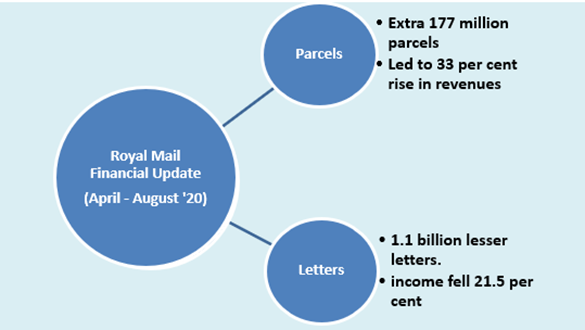
In the five months to 30 August 2020, the company delivered additional 177 million parcels, up 34 per cent YOY. This led to a 33 per cent rise in the company’s revenues. On the other hand, delivering 1.1 billion lesser letters in the same period strained the revenues generated from the service. The income from delivering letters was reported to have reduced by 21.5 per cent. Royal Mail’s total revenue increased by £139 million.
Royal Mail informed that the recent shift from letters to parcels increased the costs by £85 million. The company incurred additional costs of £75 million due to the pandemic-led necessities, including increased staff absences, social distancing norms, and providing protective equipment to the staff. The ongoing fight against the pandemic and need to maintain these requirements is expected to cost additional £65 million in coming seven months.
In June 2020, Royal Mail announced cost cutting measures that might cut 2000 jobs at management levels (IT, finance, marketing, and sales) by March 2021.
The company indicated that its workforce of around 90,000 postal workers would not be affected by the job cuts.
Stock performance of Royal Mail
Royal Mail operates as a global business. The company has developed a modern, optimised, and efficient network for delivery of letters, parcels, and other products.
On 10 September 2020, at 8.09 PM, the company’s stock (LON:RMG) was trading at £221.10 up 0.68 per cent from its previous day’s close of £219.60. The 52 week low high range was recorded as 124.30 and 250.50. With a market capitalisation (Mcap) of £2,196.00 million, the stock provided a negative return on price, which was minus 5.30 per cent on a year to date (YTD) basis. The total volume of shares traded at the time of reporting was recorded at 180,008.
Conclusion
The coronavirus pandemic has brought significant shift in customer behavior, bringing noteworthy changes in the letter and parcel delivery businesses. The lower numbers of letters being delivered during the pandemic and a surge in online deliveries has been the reasons behind Royal Mail seeking to end the delivery of letters on Saturdays. The finding of the survey by Royal Mail that showed letter delivery business is no more a core company offering, further strengthens the need to meaningfully deliberate on ending the letter deliveries on Saturdays.
