
 AUS
AUS
 NZ
NZ
 UK
UK
 CA
CA
 USA
USA
 IND
IND

.jpg)
_07_03_2026_03_50_21_133108.jpg)



Summary
- Sanofi-GSK entered a deal with the European Union for supplying as many as 300 million doses of their Coronavirus vaccine
- The vaccine candidate being perused by Sanofi and GSK is getting increased attention by governments worldwide because of its superior working mechanism than others.
- The vaccine is based on a combination of Sanofi’s recombinant protein-based technology and GSK’s established adjuvant technology, which combinedly propagate a stronger and long-lasting immune response against the virus.
- The company had previously signed a similar deal with the UK for the supply of 60 million doses of its vaccine, which could cost the British exchequer about £500 million.
The popularity of Sanofi-GSK coronavirus candidate has strengthened further as the two companies announced last week that they had entered a deal with European Union for supplying as many as 300 million doses to the bloc. This deal which is the largest so far that the company has entered in the past few months, speaks volumes on how its technology is being received by the scientific fraternity worldwide. Though its candidate is well behind the Oxford University-AstraZeneca candidate in terms of its progress made in its clinical trials and the attention that it has gained so far is certain to give it substantial sales traction over its competitors. The vaccine candidate, which is an adjuvanted vaccine, has a built-in booster which compared to other vaccines propagates a stronger and long-lasting immune response in the recipient, providing him with a higher level of protection.
The new EU vaccine deal
This deal entered into by Sanofi-GSK with EU is the third major deal they have been able to get in recently. The deal signed on 18 September 2020, is an advanced purchase agreement where both the companies will supply vaccines to EU member countries when the approval process gets completed. The deal provides for the EU providing advanced funding for both companies to scale up their production facilities. This vaccine which is most likely to be manufactured in GSK and Sanofi’s facilities in France, Belgium, Germany, and Italy will keep the production within European territory, and any excess left from a country may be used to donate to some other middle-income country. The vaccine candidate has entered into 1/2 stage of its clinical trials on 3 September 2020, and the companies are planning to start its phase three trial by the end of this year. The regulatory approvals are expected to come by the mid of 2021 after which large scale production and distribution of the vaccine will start. The mass inoculation phase could take another few month, with most of the EU population receiving coverage, not before the end of next year.
Incidentally, Sanofi has another vaccine candidate in its folds which it is developing in association with American biotech company Translate Bio. This mRNA technology-based candidate is expected to enter its 1/2 clinical trial in the month of November this year with its final approvals also expected to be received by the mid of 2021.
Other deals entered by the company
Prior to this deal both these companies had entered into a deal with the United States, the candidate of the company was selected by the US government as a promising vaccine candidate under its operation warp speed programme, and it had agreed to provide funding up to $2.1 to both the companies for development, manufacturing, scaleup and delivery.
In the United Kingdom also, both the companies were able to secure a similar deal to supply up to 60 million doses at a price which would cost the British government up to £500 million.
Thanks to the above three deals GSK Sanofi have now enough order book to scale up the production of this vaccine to 1 billion doses per year. It may so happen that this vaccine candidate is able to get more such deals from other countries as well, but the logistical dynamics of being able to make reach out to people in all nook and corner of the world would be the greatest challenge it would need to overcome.
The Share price performance of GlaxoSmithKline Plc after the news broke on the EU deal.
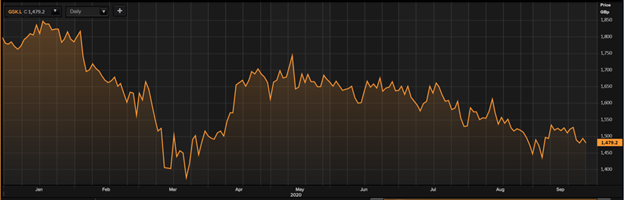
(Source – Thomson Reuters)
The shares of GlaxoSmithKline Plc have not been performing well on the London Stock Exchange since the beginning of the year. The shares of the company started the year at GBX 1,777.20 per share on 2 January 2020 after which it fell to reach a low of GBX 1,374.60 per share on 23 March 2020 the same day the UK entered into a lockdown. Thereafter, there was some recovery, but the shares have once again started showing a downward trend, and as on 24 September 2020 (12.24 PM GMT+1) the shares of the company were trading at GBX 1,479.200 per share down by 0.94 per cent over previous day close.
Conclusion
Presently an effective vaccine against the coronavirus is what desired by everyone. The world economy has been battered by the pandemic for over seven months now. Though most countries have been slowly opening up, business activity recovery levels have been relatively slow owing to the continuing fear of catching the infection. Moreover, there is now a renewed threat from the pandemic, as the winter months are upon us, and several countries in Europe have already started seeing a spike in the number of infections.
The vaccine thus is not only going to serve to protect most of the world population from the pandemic but will also help to protect economies, jobs, and livelihood of millions of people. The vaccine candidate of Sanofi-GSK may be more advanced amongst most of its contemporaries but may lose out to the ones who arrive at the marketplace early. Many of the renowned experts on medicines and epidemic have stated that even a vaccine which is 50 per cent effective will go a long way in restoring normalcy in the world.
